


 Cart
Cart
 sales@molnova.com



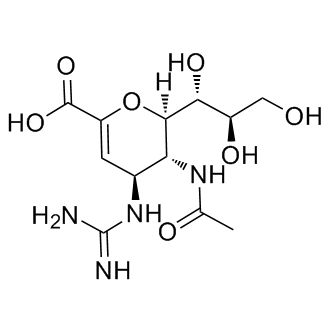
Zanamivir
CAS No. 139110-80-8
Zanamivir( GG 167 | GR 121167X | Relenza )
Catalog No. M11621 CAS No. 139110-80-8
Zanamivir is a hihly potent, broad-spetrum influenza viral neuraminidase (NA) inhibitor with IC50 of 0.95 nM and 2.7 nM for influenza A and B, respectively.
Purity : >98% (HPLC)
 COA
Datasheet
HNMR
HPLC
MSDS
Handing Instructions
COA
Datasheet
HNMR
HPLC
MSDS
Handing Instructions
| Size | Price / USD | Stock | Quantity |
| 2MG | 29 | In Stock |


|
| 5MG | 43 | In Stock |
|
| 10MG | 68 | In Stock |
|
| 25MG | 106 | In Stock |
|
| 50MG | 146 | In Stock |
|
| 100MG | 220 | In Stock |
|
| 200MG | 327 | In Stock |
|
| 500MG | Get Quote | In Stock |
|
| 1G | Get Quote | In Stock |
|
Biological Information
-
Product NameZanamivir
-
NoteResearch use only, not for human use.
-
Brief DescriptionZanamivir is a hihly potent, broad-spetrum influenza viral neuraminidase (NA) inhibitor with IC50 of 0.95 nM and 2.7 nM for influenza A and B, respectively.
-
DescriptionZanamivir is a hihly potent, broad-spetrum influenza viral neuraminidase (NA) inhibitor with IC50 of 0.95 nM and 2.7 nM for influenza A and B, respectively; inhibits plaque formation by laboratory-passaged strains of influenza A and B viruses,IC50 ranging from 0.005 to 0.014 uM; interacts with a group of amino acids in the active site of neuraminidase, which are conserved in all influenza A and B strains. Zanamivir blocks the action of neuraminidase, which prevents the cleavage of sialic acid on the cell receptors, thus preventing release and spread of the newly formed virions.Influenza Approved(In Vitro):Zanamivir interacts with a group of amino acids in the active site of neuraminidase, which are conserved in all influenza A and B strains. Zanamivir blocks the action of neuraminidase, which prevents the cleavage of sialic acid on the cell receptors, thus preventing release and spread of the newly formed virions.(In Vivo):Zanamivir has a poor bioavailability in oral administration, with only 4–17% of the agent. Oral delivery of zanamivir has been a problem due to its strong hydrophilic nature that limits its transport across the intestinal epithelium. Permeation enhancers such as sodium cholate, hydroxypropyl β-cyclodextrin could be used with zanamivir to enhance the intestinal permeability.
-
In VitroZanamivir interacts with a group of amino acids in the active site of neuraminidase, which are conserved in all influenza A and B strains. Zanamivir blocks the action of neuraminidase, which prevents the cleavage of sialic acid on the cell receptors, thus preventing release and spread of the newly formed virions.
-
In VivoZanamivir has a poor bioavailability in oral administration, with only 4–17% of the agent. Oral delivery of zanamivir has been a problem due to its strong hydrophilic nature that limits its transport across the intestinal epithelium. Permeation enhancers such as sodium cholate, hydroxypropyl β-cyclodextrin could be used with zanamivir to enhance the intestinal permeability.
-
SynonymsGG 167 | GR 121167X | Relenza
-
PathwayMicrobiology/Virology
-
TargetInfluenza Virus
-
RecptorInfluenzaA|InfluenzaB
-
Research AreaInfection
-
IndicationInfluenza
Chemical Information
-
CAS Number139110-80-8
-
Formula Weight332.3098
-
Molecular FormulaC12H20N4O7
-
Purity>98% (HPLC)
-
SolubilityH2O: ≥ 33.33 mg/mL
-
SMILESCC(=O)N[C@@H]1[C@H](C=C(O[C@H]1[C@@H]([C@@H](CO)O)O)C(=O)O)N=C(N)N
-
Chemical NameD-glycero-D-galacto-Non-2-enonic acid, 5-(acetylamino)-4-[(aminoiminomethyl)amino]-2,6-anhydro-3,4,5-trideoxy-
Shipping & Storage Information
-
Storage(-20℃)
-
ShippingWith Ice Pack
-
Stability≥ 2 years
Reference
1. Woods JM, et al. Antimicrob Agents Chemother. 1993 Jul;37(7):1473-9.
2. Gubareva LV, et al. Antimicrob Agents Chemother. 2001 Dec;45(12):3403-8.
3. McKimm-Breschkin JL, et al. Treat Respir Med. 2005;4(2):107-16.
4. Ryan DM, et al. Antimicrob Agents Chemother. 1994 Oct;38(10):2270-5.
molnova catalog



related products
-
D715-2441
D715-2441 (D 715-2441) is a novel antiviral compound that interferes with the conserved cap-binding domain of the PB2 protein.
-
SP187
SP187 (MON-DNJ) is a host-targeted iminosugar. It has anti-filovirus infection activity.SP187 is used for therapeutic use against influenza and dengue viruses.
-
Salcomine
Salcomine shows anti-influenza virus activity.
