


 Cart
Cart
 sales@molnova.com



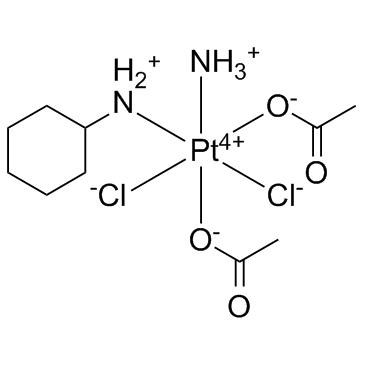
Satraplatin
CAS No. 129580-63-8
Satraplatin( BMS-182751 | BMY-45594 | JM-216 )
Catalog No. M11196 CAS No. 129580-63-8
Satraplatin (BMS-182751, BMY-45594, JM-216) is a platinum-based antineoplastic agent that binds to guanine residues in DNA, inhibits DNA replication and transcription, leads to subsequent apoptosis.
Purity : >98% (HPLC)
 COA
Datasheet
HNMR
HPLC
MSDS
Handing Instructions
COA
Datasheet
HNMR
HPLC
MSDS
Handing Instructions
| Size | Price / USD | Stock | Quantity |
| 5MG | 293 | In Stock |


|
| 10MG | 426 | In Stock |
|
| 25MG | 699 | In Stock |
|
| 50MG | 981 | In Stock |
|
| 100MG | 1314 | In Stock |
|
| 200MG | Get Quote | In Stock |
|
| 500MG | Get Quote | In Stock |
|
| 1G | Get Quote | In Stock |
|
Biological Information
-
Product NameSatraplatin
-
NoteResearch use only, not for human use.
-
Brief DescriptionSatraplatin (BMS-182751, BMY-45594, JM-216) is a platinum-based antineoplastic agent that binds to guanine residues in DNA, inhibits DNA replication and transcription, leads to subsequent apoptosis.
-
DescriptionSatraplatin (BMS-182751, BMY-45594, JM-216) is a platinum-based antineoplastic agent that binds to guanine residues in DNA, inhibits DNA replication and transcription, leads to subsequent apoptosis; shows similar cytotoxicity and pattern of cytotoxicity to cisplatin against human ovarian carcinoma cell lines (IC50=1.7 uM); shows antitumor selectivity far superior to cisplatin, carboplatin, or tetraplatin in vivo; orally active.Chemotherapeutic Agents, Phase 2 Clinical(In Vitro):Satraplatin needs to avoid light in the solution, and it is unstable in the alkaline state but stable in the acidic state.Satraplatin has potent antitumor activity. Satraplatin combined with dichloroacetate (DCA) inhibits UMC-11 cells with an IC50 of 1.36 ± 0.11 μM. Satraplatin also suppresses CDDP-resistant (KB-R) cells (IC50, 7.04 μM), and causes G2/M arrest in KB-R cells.
-
In VitroSatraplatin needs to avoid light in the solution, and it is unstable in the alkaline state but stable in the acidic state.Satraplatin has potent antitumor activity. Satraplatin combined with dichloroacetate (DCA) inhibits UMC-11 cells with an IC50 of 1.36 ± 0.11 μM. Satraplatin also suppresses CDDP-resistant (KB-R) cells (IC50, 7.04 μM), and causes G2/M arrest in KB-R cells.
-
In Vivo——
-
SynonymsBMS-182751 | BMY-45594 | JM-216
-
PathwayCell Cycle/DNA Damage
-
TargetDNA Alkylator
-
RecptorDNA Alkylator
-
Research AreaCancer
-
IndicationChemotherapeutic
Chemical Information
-
CAS Number129580-63-8
-
Formula Weight500.2816
-
Molecular FormulaC10H22Cl2N2O4Pt+2
-
Purity>98% (HPLC)
-
SolubilityDMSO: ≥ 33 mg/mL
-
SMILESCC(O[Pt]([NH2]C1CCCCC1)(Cl)(Cl)([NH3])OC(C)=O)=O
-
Chemical NamePlatinum, bis(acetato-κO)amminedichloro(cyclohexanamine)-, (OC-6-43)- (9CI)
Shipping & Storage Information
-
Storage(-20℃)
-
ShippingWith Ice Pack
-
Stability≥ 2 years
Reference
1. Kelland LR, et al. Cancer Res. 1993 Jun 1;53(11):2581-6.
2. Mellish KJ, et al. Br J Cancer. 1993 Aug;68(2):240-50.
3. Ricart AD, et al. Clin Cancer Res. 2009 Jun 1;15(11):3866-71.
molnova catalog



related products
-
KCC-07
KCC-07 is a selective, potent and brain-penetrant inhibitor of methyl-CpG-binding domain protein 2(MBD2) with anticancer activity.
-
Glufosfamide
A conjugate of glucose and active alkylating moiety of ifosfamide with potentially enhanced selectivity for tumors that overexpress transmembrane glucose transporters.
-
Trabectedin
Trabectedin (Ecteinascidin-743, ET-743, Ecteinascidin)?is a marine alkaloid isolated from the Caribbean tunicate Ecteinascidia turbinata that shows remarkably anticancer activity in a variety of in vitro and in vivo systems.
