


 Cart
Cart
 sales@molnova.com



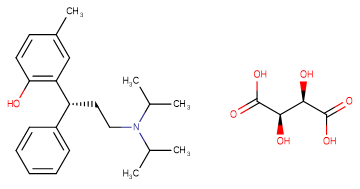
Tolterodine tartrate
CAS No. 124937-52-6
Tolterodine tartrate( PNU-200583E | Kabi-2234 )
Catalog No. M11006 CAS No. 124937-52-6
Tolterodine Tartrate(PNU-200583E; Kabi-2234) is a potent muscarinic receptor antagonists that show selectivity for the urinary bladder over salivary glands in vivo.
Purity : >98% (HPLC)
 COA
Datasheet
HNMR
HPLC
MSDS
Handing Instructions
COA
Datasheet
HNMR
HPLC
MSDS
Handing Instructions
| Size | Price / USD | Stock | Quantity |
| 1 mL x 10 mM in DMSO | 28 | In Stock |


|
| 25MG | 32 | In Stock |
|
| 50MG | 49 | In Stock |
|
| 100MG | 63 | In Stock |
|
| 200MG | Get Quote | In Stock |
|
| 500MG | 138 | In Stock |
|
| 1G | Get Quote | In Stock |
|
Biological Information
-
Product NameTolterodine tartrate
-
NoteResearch use only, not for human use.
-
Brief DescriptionTolterodine Tartrate(PNU-200583E; Kabi-2234) is a potent muscarinic receptor antagonists that show selectivity for the urinary bladder over salivary glands in vivo.
-
DescriptionTolterodine Tartrate(PNU-200583E; Kabi-2234) is a potent muscarinic receptor antagonists that show selectivity for the urinary bladder over salivary glands in vivo.(In Vitro):Carbachol-induced contractions of isolated guinea pig bladder were effectively inhibited by tolterodine (IC50 14 nM) and 5-HM (IC50 5.7 nM). The IC50 values were in the microM range and the antimuscarinic potency of tolterodine was 27, 200 and 370-485 times higher, respectively, than its potency in blocking histamine receptors, alpha-adrenoceptors and calcium channels. The active metabolite, 5-HM, was >900 times less potent at these sites than at bladder muscarinic receptors.(In Vivo):Tolterodine was extensively metabolized in vivo. In the passive-avoidance test, tolterodine at 1 or 3 mg/kg had no effect on memory; the latency to cross and percentage of animals crossing were comparable to controls. In contrast, scopolamine induced a memory deficit; the latency to cross was decreased, and the number of animals crossing was increased.
-
In VitroCarbachol-induced contractions of isolated guinea pig bladder were effectively inhibited by tolterodine (IC50 14 nM) and 5-HM (IC50 5.7 nM).The IC50 values were in the microM range and the antimuscarinic potency of tolterodine was 27, 200 and 370-485 times higher, respectively, than its potency in blocking histamine receptors, alpha-adrenoceptors and calcium channels. The active metabolite, 5-HM, was >900 times less potent at these sites than at bladder muscarinic receptors.
-
In VivoTolterodine was extensively metabolized in vivo.In the passive-avoidance test, tolterodine at 1 or 3 mg/kg had no effect on memory; the latency to cross and percentage of animals crossing were comparable to controls. In contrast, scopolamine induced a memory deficit; the latency to cross was decreased, and the number of animals crossing was increased.
-
SynonymsPNU-200583E | Kabi-2234
-
PathwayEndocrinology/Hormones
-
TargetAChR
-
RecptormAChR
-
Research AreaNeurological Disease
-
Indication——
Chemical Information
-
CAS Number124937-52-6
-
Formula Weight475.58
-
Molecular FormulaC22H31NO·C4H6O6
-
Purity>98% (HPLC)
-
SolubilityEthanol: 6 mg/mL (12.61 mM); Water: 17 mg/mL (35.74 mM); DMSO: 95 mg/mL (199.76 mM)
-
SMILESCC1=CC(=C(C=C1)O)[C@H](CCN(C(C)C)C(C)C)C2=CC=CC=C2.[C@@H]([C@H](C(=O)O)O)(C(=O)O)O
-
Chemical Name——
Shipping & Storage Information
-
Storage(-20℃)
-
ShippingWith Ice Pack
-
Stability≥ 2 years
Reference
1.Nilvebrant L, et al. Life Sci, 1997, 60(13-14), 1129-1136.
molnova catalog



related products
-
Hosenkoside A
Hosenkoside A has antimicrobial effect.
-
Scopolamine HBr trih...
An alkaloid from SOLANACEAE, especially DATURA and SCOPOLIA.
-
Scopolamine butylbro...
Scopolamine butylbromide is a competitive antagonist of muscarinic acetylcholine receptor (mAChR) with an IC50 of 55.3 ± 4.3 nM.
