


 Cart
Cart
 sales@molnova.com



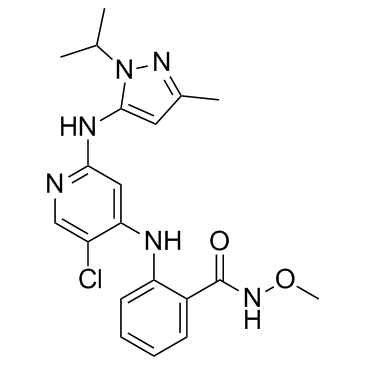
GSK-2256098
CAS No. 1224887-10-8
GSK-2256098( GTPL-7939 | GSK2256098 | GTPL7939 )
Catalog No. M10861 CAS No. 1224887-10-8
GSK-2256098 (GTPL-7939) is a potent, selective, reversible and ATP-competitive inhibitor of FAK kinase with Ki of 0.4 nM.
Purity : >98% (HPLC)
 COA
Datasheet
HNMR
HPLC
MSDS
Handing Instructions
COA
Datasheet
HNMR
HPLC
MSDS
Handing Instructions
| Size | Price / USD | Stock | Quantity |
| 1 mL x 10 mM in DMSO | 77 | In Stock |


|
| 2MG | 52 | In Stock |
|
| 5MG | 77 | In Stock |
|
| 10MG | 132 | In Stock |
|
| 25MG | 262 | In Stock |
|
| 50MG | 439 | In Stock |
|
| 100MG | 646 | In Stock |
|
| 200MG | Get Quote | In Stock |
|
| 500MG | 1358 | In Stock |
|
| 1G | Get Quote | In Stock |
|
Biological Information
-
Product NameGSK-2256098
-
NoteResearch use only, not for human use.
-
Brief DescriptionGSK-2256098 (GTPL-7939) is a potent, selective, reversible and ATP-competitive inhibitor of FAK kinase with Ki of 0.4 nM.
-
DescriptionGSK-2256098 (GTPL-7939) is a potent, selective, reversible and ATP-competitive inhibitor of FAK kinase with Ki of 0.4 nM; dispalys high selectivity over a panel of 261 kinases, including the nearest FAK family member, Pyk2 (>1,000-fold); inhibits FAK activity through targeting the phosphorylation site of FAK Y397; decreases levels of phosphorylated Akt and ERK, cell viability, anchorage-independent growth, and motility in L3.6P1 cells; causes lower microvessel density, less cellular proliferation, and higher apoptosis rates in the Ishikawa model.Pancreatic Cancer Phase 2 Clinical(In Vitro):GSK2256098 is a thousand fold more selective for FAK compared to the nearest FAK family member, Pyk2. GSK2256098 inhibits FAK activity through targeting the phosphorylation site of FAK, tyrosine (Y) 397. GSK2256098 inhibits FAK activity or Y397 phosphorylation in cancer cell lines, OVCAR8 (ovary), U87MG (brain), and A549 (lung), at IC50s of 15, 8.5 and 12 nM, respectively. The responses of 6 PDAC cell lines in regards to FAK Y397 phosphorylation or activity to GSK2256098 treatments (0.1–10 μM) ranged from low (less than 20% inhibition) to high (more than 90% inhibition). The least and most sensitive cell lines (PANC-1 and L3.6P1) are selected for further analysis. GSK2256098 inhibition of FAK Y397 phosphorylation correlated with decreased levels of phosphorylated Akt and ERK in L3.6P1 cells. GSK2256098 decreases cell viability, anchorage-independent growth, and motility in a dose dependent manner. (In Vivo):FAK is well-known to play an important role in angiogenesis, proliferation, and apoptosis, so the tumor samples harvested from the therapy experiments are examined. Evaluating CD31, significantly lower microvessel densities in tumors from mice treated with GSK2256098 and Paclitaxel is observed than in tumors from mice in the vehicle control group (P<0.05). This is consistent across both models, but Ishikawa tumors had the lowest microvessel density. All tumor models in mice treated with GSK2256098 exhibit less proliferation via Ki67 than control. Ishikawa tumors have the lowest Ki67 expression in response to therapy. Ishikawa tumors have higher apoptotic indices than Hec1A tumors after treatment with GSK2256098. Significant rates of apoptosis are seen in all models that had been treated with combination GSK2256098 and Paclitaxel.
-
In VitroGSK2256098 is a thousand fold more selective for FAK compared to the nearest FAK family member, Pyk2. GSK2256098 inhibits FAK activity through targeting the phosphorylation site of FAK, tyrosine (Y) 397. GSK2256098 inhibits FAK activity or Y397 phosphorylation in cancer cell lines, OVCAR8 (ovary), U87MG (brain), and A549 (lung), at IC50s of 15, 8.5 and 12 nM, respectively. The responses of 6 PDAC cell lines in regards to FAK Y397 phosphorylation or activity to GSK2256098 treatments (0.1–10 μM) ranged from low (less than 20% inhibition) to high (more than 90% inhibition). The least and most sensitive cell lines (PANC-1 and L3.6P1) are selected for further analysis. GSK2256098 inhibition of FAK Y397 phosphorylation correlated with decreased levels of phosphorylated Akt and ERK in L3.6P1 cells. GSK2256098 decreases cell viability, anchorage-independent growth, and motility in a dose dependent manner.
-
In VivoFAK is well-known to play an important role in angiogenesis, proliferation, and apoptosis, so the tumor samples harvested from the therapy experiments are examined. Evaluating CD31, significantly lower microvessel densities in tumors from mice treated with GSK2256098 and Paclitaxel is observed than in tumors from mice in the vehicle control group (P<0.05). This is consistent across both models, but Ishikawa tumors had the lowest microvessel density. All tumor models in mice treated with GSK2256098 exhibit less proliferation via Ki67 than control. Ishikawa tumors have the lowest Ki67 expression in response to therapy. Ishikawa tumors have higher apoptotic indices than Hec1A tumors after treatment with GSK2256098. Significant rates of apoptosis are seen in all models that had been treated with combination GSK2256098 and Paclitaxel.
-
SynonymsGTPL-7939 | GSK2256098 | GTPL7939
-
PathwayAngiogenesis
-
TargetFAK
-
RecptorFAK
-
Research AreaCancer
-
IndicationPancreatic Cancer
Chemical Information
-
CAS Number1224887-10-8
-
Formula Weight414.8886
-
Molecular FormulaC20H23ClN6O2
-
Purity>98% (HPLC)
-
SolubilityDMSO: ≥ 30 mg/mL
-
SMILESCC1=NN(C(=C1)NC2=NC=C(C(=C2)NC3=CC=CC=C3C(=O)NOC)Cl)C(C)C
-
Chemical NameBenzamide, 2-[[5-chloro-2-[[3-methyl-1-(1-methylethyl)-1H-pyrazol-5-yl]amino]-4-pyridinyl]amino]-N-methoxy-
Shipping & Storage Information
-
Storage(-20℃)
-
ShippingWith Ice Pack
-
Stability≥ 2 years
Reference
1. Zhang J, et al. Cell Cycle. 2014;13(19):3143-9.
2. Soria JC, et al. Ann Oncol. 2016 Dec;27(12):2268-2274.
3. Thanapprapasr D, et al. Mol Cancer Ther. 2015 Jun;14(6):1466-1475.
molnova catalog



related products
-
AMP-945
AMP-945 is a proprietary focal adhesion kinase (FAK) inhibitor.
-
ALK inhibitor 1
ALK inhibitor 1 is a selective ALK kinase inhibitor.
-
FAK-IN-10
FAK-IN-10 is an inhibitor of FAK (IC50: 76.3 μM) and demonstrates antitumor activity in MCF-7 and A431 cell lines with IC50 values of 4.23 μM and 0.78 μM, respectively.
