


 Cart
Cart
 sales@molnova.com



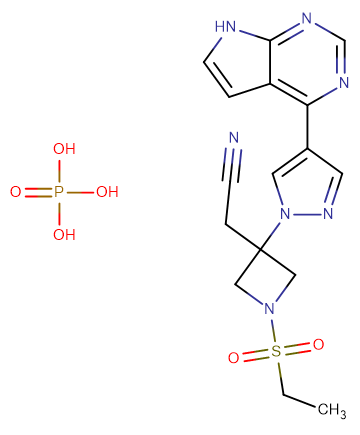
Baricitinib?(Phosphate)
CAS No. 1187595-84-1
Baricitinib?(Phosphate)( —— )
Catalog No. M10643 CAS No. 1187595-84-1
Baricitinib phosphate(INCB 028050; LY 3009104) is a selective JAK1 and JAK2 inhibitor with IC50 of 5.9 nM and 5.7 nM.
Purity : >98% (HPLC)
 COA
Datasheet
HNMR
HPLC
MSDS
Handing Instructions
COA
Datasheet
HNMR
HPLC
MSDS
Handing Instructions
| Size | Price / USD | Stock | Quantity |
| 1 mL x 10 mM in DMSO | 39 | In Stock |


|
| 5MG | 34 | In Stock |
|
| 10MG | 48 | In Stock |
|
| 25MG | 67 | In Stock |
|
| 50MG | 83 | In Stock |
|
| 100MG | 105 | In Stock |
|
| 200MG | 156 | In Stock |
|
| 500MG | 269 | In Stock |
|
| 1G | Get Quote | In Stock |
|
Biological Information
-
Product NameBaricitinib?(Phosphate)
-
NoteResearch use only, not for human use.
-
Brief DescriptionBaricitinib phosphate(INCB 028050; LY 3009104) is a selective JAK1 and JAK2 inhibitor with IC50 of 5.9 nM and 5.7 nM.
-
DescriptionBaricitinib phosphate(INCB 028050; LY 3009104) is a selective JAK1 and JAK2 inhibitor with IC50 of 5.9 nM and 5.7 nM, ~70 and ~10-fold selective versus JAK3 and Tyk2, no inhibition to c-Met and Chk2.(In Vitro):In cell-based assays, Baricitinib phosphate (INCB028050 phosphate) proves to be a potent inhibitor of JAK signaling and function. In PBMCs, Baricitinib inhibits IL-6-stimulated phosphorylation of the canonical substrate STAT3 (pSTAT3) and subsequent production of the chemokine MCP-1 with IC50 values of 44 nM and 40 nM, respectively. In isolated naive T-cells, INCB028050 also inhibits pSTAT3 stimulated by IL-23 (IC50=20 nM). Importantly, this inhibition prevented the production of two pathogenic cytokines (IL-17 and IL-22) produced by Th17 cells-a subtype of helper T cells with demonstrable inflammatory and pathogenic properties-with an IC50 value of 50 nM. In stark contrast, the structurally similar but ineffective JAK1/2 inhibitors INCB027753 and INCB029843 has no significant effect in any of these assays systems when tested at concentrations up to 10 μM. (In Vivo):Baricitinib phosphate (INCB028050 phosphate) treatment, compares with vehicle, inhibits the increase in hind paw volumes during the 2 wk of treatment by 50% at a dose of 1 mg/kg and >95% at doses of 3 or 10 mg/kg. Because baseline paw volume measurements are taken on treatment day 0-in animals with significant signs of disease-it is possible to have >100% inhibition in animals showing marked improvement in swelling. Baricitinib (0.7 mg/day) treated mice exhibits substantially reduced inflammation as assessed by H&E staining, reduced CD8 infiltration, and reduced MHC class I and class II expression when compared with vehicle-control treated mice. CD8+NKG2D+ cells, critical effectors of disease in murine and human alopecia areata (AA), are greatly diminished in Baricitinib treated mice compare with vehicle control treated mice.
-
In VitroIn cell-based assays, Baricitinib phosphate (INCB028050 phosphate) proves to be a potent inhibitor of JAK signaling and function. In PBMCs, Baricitinib inhibits IL-6-stimulated phosphorylation of the canonical substrate STAT3 (pSTAT3) and subsequent production of the chemokine MCP-1 with IC50 values of 44 nM and 40 nM, respectively. In isolated naive T-cells, INCB028050 also inhibits pSTAT3 stimulated by IL-23 (IC50=20 nM). Importantly, this inhibition prevented the production of two pathogenic cytokines (IL-17 and IL-22) produced by Th17 cells-a subtype of helper T cells with demonstrable inflammatory and pathogenic properties-with an IC50 value of 50 nM. In stark contrast, the structurally similar but ineffective JAK1/2 inhibitors INCB027753 and INCB029843 has no significant effect in any of these assays systems when tested at concentrations up to 10 μM.
-
In VivoBaricitinib phosphate (INCB028050 phosphate) treatment, compares with vehicle, inhibits the increase in hind paw volumes during the 2 wk of treatment by 50% at a dose of 1 mg/kg and >95% at doses of 3 or 10 mg/kg. Because baseline paw volume measurements are taken on treatment day 0-in animals with significant signs of disease-it is possible to have >100% inhibition in animals showing marked improvement in swelling. Baricitinib (0.7 mg/day) treated mice exhibits substantially reduced inflammation as assessed by H&E staining, reduced CD8 infiltration, and reduced MHC class I and class II expression when compared with vehicle-control treated mice. CD8+NKG2D+ cells, critical effectors of disease in murine and human alopecia areata (AA), are greatly diminished in Baricitinib treated mice compare with vehicle control treated mice.
-
Synonyms——
-
PathwayAngiogenesis
-
TargetJAK
-
RecptorJAK1| JAK2| JAK3| Tyk2
-
Research AreaInflammation/Immunology
-
Indication——
Chemical Information
-
CAS Number1187595-84-1
-
Formula Weight469.41
-
Molecular FormulaC16H20N7O6PS
-
Purity>98% (HPLC)
-
Solubility200 mM in DMSO
-
SMILESOP(O)(O)=O.CCS(=O)(=O)N1CC(CC#N)(C1)N1C=C(C=N1)C1=C2C=CNC2=NC=N1
-
Chemical Name——
Shipping & Storage Information
-
Storage(-20℃)
-
ShippingWith Ice Pack
-
Stability≥ 2 years
Reference
1.Fridman JS, et al. J Immunol, 2010, 184(9), 5298-5307.
molnova catalog



related products
-
JAK3-IN-2
A potent and highly selective JAK3 inhibitor with IC50 of 0.15 nM.
-
JKA3 inhibitor 31
JKA3 inhibitor 31 is a highly potent, selective, reversible, covalent JAK3 inhibitor with IC50 of 49 nM.
-
JAK2-IN-6
JAK2-IN-6, a polysubstituted aminothiazole derivative, is a potent and selective inhibitor of JAK2 (ic50 at 22.86 μg/mL).
