


 Cart
Cart
 sales@molnova.com



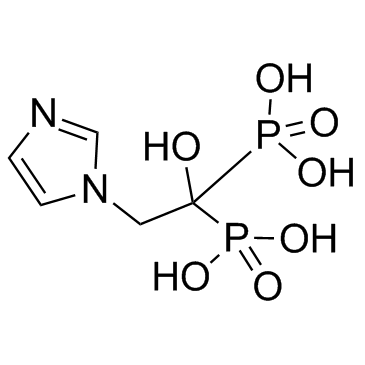
Zoledronic Acid
CAS No. 118072-93-8
Zoledronic Acid( Orazol | Reclast | Zoledronate | Zoledronic acid )
Catalog No. M10613 CAS No. 118072-93-8
Zoledronic acid induces apoptosis in osteoclasts by inhibiting enzymes of the mevalonate pathway and preventing the isoprenylation of small GTP-binding proteins such as Ras and Rho.
Purity : >98% (HPLC)
 COA
Datasheet
HNMR
HPLC
MSDS
Handing Instructions
COA
Datasheet
HNMR
HPLC
MSDS
Handing Instructions
| Size | Price / USD | Stock | Quantity |
| 10MG | 30 | In Stock |


|
| 25MG | 45 | In Stock |
|
| 50MG | 72 | In Stock |
|
| 100MG | 118 | In Stock |
|
| 200MG | 175 | In Stock |
|
| 500MG | 295 | In Stock |
|
| 1G | Get Quote | In Stock |
|
Biological Information
-
Product NameZoledronic Acid
-
NoteResearch use only, not for human use.
-
Brief DescriptionZoledronic acid induces apoptosis in osteoclasts by inhibiting enzymes of the mevalonate pathway and preventing the isoprenylation of small GTP-binding proteins such as Ras and Rho.
-
DescriptionZoledronic acid induces apoptosis in osteoclasts by inhibiting enzymes of the mevalonate pathway and preventing the isoprenylation of small GTP-binding proteins such as Ras and Rho.(In Vitro):Zoledronic Acid (0.1-1 μM; 48 hours) increases receptor activator of nuclear factor kB ligand (RANKL) and sclerostin mRNA expressions in osteocyte-like MLO-Y4 cells.Zoledronic Acid increases the expression of osteoclastogenesis supporting factor from MLO-Y4 cells.Zoledronic Acid enhances the RANKL expression via IL-6/ JAK2/STAT3 pathway in MLO-Y4 cells.Zoledronic acid inhibits osteoclast differentiation and function through the regulation of NF-κB and JNK signalling pathways.Zoledronic Acid (10-100 μM; 1-7 days) markedly reduces the viability of MC3T3-E1 cells.Zoledronic Acid (10-100 μM; 1-7 days) induces apoptosis in MC3T3-E1 cells.Zoledronic Acid (10-100 μM; 4 days) inhibits cell viability due to the induction of apoptosis.Zoledronic Acid exerts inhibitory effects on the differentiation and maturation of MC3T3-E1 cells at concentrations <1 μM.(In Vivo):Zoledronic Acid (0.05 mg/kg; i.p.; weekly; for 3 weeks) increases bone mineral density and content.Zoledronic Acid (0.5-1 mg/kg; i.p.; weekly; for 3 weeks) inhibits both osteoclast and osteoblasts function and bone remodeling in vivo interfering with bone mechanical properties.
-
In VitroZoledronic Acid (0.1-1 μM; 48 hours) increases receptor activator of nuclear factor kB ligand (RANKL) and sclerostin mRNA expressions in osteocyte-like MLO-Y4 cells.Zoledronic Acid increases the expression of osteoclastogenesis supporting factor from MLO-Y4 cells.Zoledronic Acid enhances the RANKL expression via IL-6/ JAK2/STAT3 pathway in MLO-Y4 cells.Zoledronic acid inhibits osteoclast differentiation and function through the regulation of NF-κB and JNK signalling pathways.Zoledronic Acid (10-100 μM; 1-7 days) markedly reduces the viability of MC3T3-E1 cells.Zoledronic Acid (10-100 μM; 1-7 days) induces apoptosis in MC3T3-E1 cells.Zoledronic Acid (10-100 μM; 4 days) inhibits cell viability due to the induction of apoptosis.Zoledronic Acid exerts inhibitory effects on the differentiation and maturation of MC3T3-E1 cells at concentrations <1 μM.Cell Viability Assay Cell Line:MC3T3-E1 cells Concentration:0.01 μM , 0.1 μM, 1 μM, 10 μM, 100 μMIncubation Time:1 day, 3 days, 5 days, 7 days Result:Reduced cells viability at 10 μM and 100 μM.Apoptosis Analysis Cell Line:MC3T3-E1 cells Concentration:0.01 μM , 0.1 μM, 1 μM, 10 μM, 100 μM Incubation Time:1 days, 4 days, 7 days Result:Increased the number of early apoptotic cells and late apoptotic or necrotic cells at dose-dependent and time-dependent (high concentrations).Western Blot Analysis Cell Line:MC3T3-E1 cells Concentration:0.01 μM , 0.1 μM, 1 μM, 10 μM, 100 μM Incubation Time:4 days Result:Down-regulated the protein level of inactive caspase-3 and up-regulated the protein level of active caspase-3 at the concentrations of 10 and 100 μM.
-
In VivoZoledronic Acid (0.05 mg/kg; i.p.; weekly; for 3 weeks) increases bone mineral density and content.Zoledronic Acid (0.5-1 mg/kg; i.p.; weekly; for 3 weeks) inhibits both osteoclast and osteoblasts function and bone remodeling in vivo interfering with bone mechanical properties. Animal Model:Five-week-old C57BL6 mice Dosage:0.05 mg/kg, 0.5 mg/kg, 1 mg/kg Administration:Intraperitoneal injection, weekly, for 3 weeks Result:Inhibited both osteoclast and osteoblasts function and bone remodeling at 0.5 mg/kg and 1 mg/kg.
-
SynonymsOrazol | Reclast | Zoledronate | Zoledronic acid
-
PathwayCell Cycle/DNA Damage
-
TargetRho
-
RecptorRho
-
Research AreaCancer
-
Indication——
Chemical Information
-
CAS Number118072-93-8
-
Formula Weight272.09
-
Molecular FormulaC5H10N2O7P2
-
Purity>98% (HPLC)
-
Solubility0.1M NaOH (aq): 40 mg/ml; DMSO: 0.004 mg/mL (0.01 mM)
-
SMILESOC(P(O)(O)=O)(P(O)(O)=O)CN1C=CN=C1
-
Chemical NamePhosphonic acid, (1-hydroxy-2-(1H-imidazol-1-yl)ethylidene)bis-
Shipping & Storage Information
-
Storage(-20℃)
-
ShippingWith Ice Pack
-
Stability≥ 2 years
Reference
1. Jagdev SP, et al. Br J Y, 2001, 84(8), 1126-1134.
molnova catalog



related products
-
(E/Z)-ZINC09659342
(E/Z)-ZINC09659342 is an inhibitor of Lbc-Rho A interaction.
-
EHT 1864
EHT 1864 is a potent Rac family GTPase inhibitor with Kd of 40 nM, 50 nM, 60 nM and 250 nM for Rac1, Rac1b, Rac2 and Rac3, respectively.
-
Z62954982
Z62954982 (ZINC08010136) is a selective inhibitor of Rac1, which stunts the growth and branching of neurons.
