


 Cart
Cart
 sales@molnova.com


 Home -
Products -
Immunology/Inflammation -
Amino Acids and Derivatives -
L-arginine monohydrochloride
Home -
Products -
Immunology/Inflammation -
Amino Acids and Derivatives -
L-arginine monohydrochloride
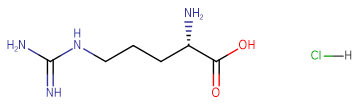
L-arginine monohydrochloride
CAS No. 1119-34-2
L-arginine monohydrochloride( L-(+)-Arginine | NSC 7914 | NSC 203450 )
Catalog No. M10428 CAS No. 1119-34-2
L-Arginine is the nitrogen donor for synthesis of nitric oxide, a potent vasodilator that is deficient during times of sickle cell crisis.
Purity : >98% (HPLC)
 COA
Datasheet
HNMR
HPLC
MSDS
Handing Instructions
COA
Datasheet
HNMR
HPLC
MSDS
Handing Instructions
| Size | Price / USD | Stock | Quantity |
| 100MG | Get Quote | In Stock |


|
| 200MG | Get Quote | In Stock |
|
| 500MG | Get Quote | In Stock |
|
| 1G | 31 | In Stock |
|
Biological Information
-
Product NameL-arginine monohydrochloride
-
NoteResearch use only, not for human use.
-
Brief DescriptionL-Arginine is the nitrogen donor for synthesis of nitric oxide, a potent vasodilator that is deficient during times of sickle cell crisis.
-
DescriptionL-Arginine is the nitrogen donor for synthesis of nitric oxide, a potent vasodilator that is deficient during times of sickle cell crisis.(In Vitro):Arginine is an α-amino acid. The L-form is one of the 20 most common natural amino acids. At the level of molecular genetics, in the structure of the messenger ribonucleic acid mRNA, CGU, CGC, CGA, CGG, AGA, and AGG, are the triplets of nucleotide bases or codons that code for arginine during protein synthesis. In mammals, arginine is classified as a semiessential or conditionally essential amino acid, depending on the developmental stage and health status of the individual. L-Arginine is associated with a decrease in cardiac index while stroke index is maintained in patients with severe sepsis. Resolution of shock at 72 hours is achieved by 40% and 24% of the patients in the L-Arginine and placebo cohorts, respectively. L-Arginine (450 mg/kg during a 15-minute period) amplifies and sustains the hyperemia (38%) and increases absolute brain blood flow after eNOS upregulation by chronic simvastatin treatment (2 mg/kg subcutaneously, daily for 14 days) in SV-129 mice.
-
In VitroArginine is an α-amino acid. The L-form is one of the 20 most common natural amino acids. At the level of molecular genetics, in the structure of the messenger ribonucleic acid mRNA, CGU, CGC, CGA, CGG, AGA, and AGG, are the triplets of nucleotide bases or codons that code for arginine during protein synthesis. In mammals, arginine is classified as a semiessential or conditionally essential amino acid, depending on the developmental stage and health status of the individual.L-Arginine is associated with a decrease in cardiac index while stroke index is maintained in patients with severe sepsis. Resolution of shock at 72 hours is achieved by 40% and 24% of the patients in the L-Arginine and placebo cohorts, respectively. L-Arginine (450 mg/kg during a 15-minute period) amplifies and sustains the hyperemia (38%) and increases absolute brain blood flow after eNOS upregulation by chronic simvastatin treatment (2 mg/kg subcutaneously, daily for 14 days) in SV-129 mice.
-
In Vivo——
-
SynonymsL-(+)-Arginine | NSC 7914 | NSC 203450
-
PathwayImmunology/Inflammation
-
TargetAmino Acids and Derivatives
-
RecptorAmino Acids and Derivatives
-
Research AreaOther Indications
-
Indication——
Chemical Information
-
CAS Number1119-34-2
-
Formula Weight210.66
-
Molecular FormulaC6H15ClN4O2
-
Purity>98% (HPLC)
-
SolubilityWater: 42 mg/mL (199.37 mM)
-
SMILESN[C@@H](CCCNC(N)=N)C(O)=O.[H]Cl
-
Chemical NameL-arginine hydrochloride
Shipping & Storage Information
-
Storage(-20℃)
-
ShippingWith Ice Pack
-
Stability≥ 2 years
Reference
1.Morris CR, et al. Am J Respir Crit Care Med, 2003, 168(1), 63-69.
molnova catalog



related products
-
H-Asp(OtBu)-OtBu HCl
H-Asp(OtBu)-OtBu HCl is an aspartic acid derivative that may be used to study comparative neurological function and metabolic disorders of non-alcoholic hepatitis.
-
L-(+)-Selenomethioni...
L-Selenomethionine is a naturally occurring amino acid. It promotes cell cycle progression and elevates the expression of the antioxidant enzymes thioredoxin reductase glutathione reductase.
-
Carvacrol
5-Isopropyl-2-methylphenol presents antidepressant effects, seems to be dependent on its interaction with the dopaminergic system, but not with the serotonergic and noradrenergic systems.
