


 Cart
Cart
 sales@molnova.com



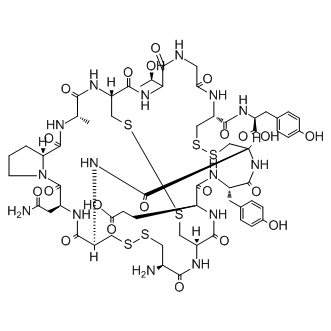
Linaclotide
CAS No. 851199-59-2
Linaclotide( —— )
Catalog No. M16183 CAS No. 851199-59-2
A potent and selective GC-C agonist (Ki=1.23-1.64 nM) that elicits pharmacological effects locally in the gastrointestinal tract.
Purity : >98% (HPLC)
 COA
Datasheet
HNMR
HPLC
MSDS
Handing Instructions
COA
Datasheet
HNMR
HPLC
MSDS
Handing Instructions
| Size | Price / USD | Stock | Quantity |
| 2MG | 77 | In Stock |


|
| 5MG | 115 | In Stock |
|
| 10MG | 177 | In Stock |
|
| 25MG | 312 | In Stock |
|
| 50MG | 464 | In Stock |
|
| 100MG | 662 | In Stock |
|
| 200MG | Get Quote | In Stock |
|
| 500MG | Get Quote | In Stock |
|
| 1G | Get Quote | In Stock |
|
Biological Information
-
Product NameLinaclotide
-
NoteResearch use only, not for human use.
-
Brief DescriptionA potent and selective GC-C agonist (Ki=1.23-1.64 nM) that elicits pharmacological effects locally in the gastrointestinal tract.
-
DescriptionA potent and selective GC-C agonist (Ki=1.23-1.64 nM) that elicits pharmacological effects locally in the gastrointestinal tract; induces a significant increase in fluid secretion, accompanied by a significant increase in intraluminal cGMP levels; has potential for the treatment of constipation-predominant irritable bowel syndrome (IBS-C) and chronic constipation.Irritable Bowel Syndrome Approved(In Vitro):Linaclotide inhibits in vitro [125I]-STa binding to intestinal mucosal membranes from wt mice in a concentration-dependent manner. In contrast, [125I]-STa binding to these membranes from GC-C null mice is significantly decreased. After incubation in vitro in jejunal fluid for 30 min, linaclotide is completely degraded. Linaclotide acts on guanylate cyclase-C receptors on the luminal membrane to increase chloride and bicarbonate secretions into the intestine and inhibit the absorption of sodium ions, thus increasing the secretion of water into the lumen and improving defecation; the drug is minimally absorbed into the systemic circulation. (In Vivo):Pharmacokinetic analysis shows very low oral bioavailability (0.10%). In intestinal secretion and transit models, linaclotide exhibits significant pharmacological effects in wt, but not in GC-C null mice: induction of increased fluid secretion into surgically ligated jejunal loops is accompanied by the secretion of elevated levels of cyclic guanosine-3',5-monophosphate and accelerated gastrointestinal transit. Linaclotide significantly increases weekly spontaneous bowel movements and complete spontaneous bowel movements (CSBMs) while reducing abdominal pain in patients with chronic constipation.
-
In VitroLinaclotide inhibits in vitro [125I]-STa binding to intestinal mucosal membranes from wt mice in a concentration-dependent manner. In contrast, [125I]-STa binding to these membranes from GC-C null mice is significantly decreased. After incubation in vitro in jejunal fluid for 30 min, linaclotide is completely degraded. Linaclotide acts on guanylate cyclase-C receptors on the luminal membrane to increase chloride and bicarbonate secretions into the intestine and inhibit the absorption of sodium ions, thus increasing the secretion of water into the lumen and improving defecation; the drug is minimally absorbed into the systemic circulation.
-
In VivoPharmacokinetic analysis shows very low oral bioavailability (0.10%). In intestinal secretion and transit models, linaclotide exhibits significant pharmacological effects in wt, but not in GC-C null mice: induction of increased fluid secretion into surgically ligated jejunal loops is accompanied by the secretion of elevated levels of cyclic guanosine-3',5-monophosphate and accelerated gastrointestinal transit. Linaclotide significantly increases weekly spontaneous bowel movements and complete spontaneous bowel movements (CSBMs) while reducing abdominal pain in patients with chronic constipation.
-
Synonyms——
-
PathwayMetabolic Enzyme/Protease
-
TargetGuanylate Cyclase
-
RecptorGuanylate Cyclase
-
Research AreaOther Indications
-
IndicationIrritable Bowel Syndrome
Chemical Information
-
CAS Number851199-59-2
-
Formula Weight1526.736
-
Molecular FormulaC59H79N15O21S6
-
Purity>98% (HPLC)
-
Solubility10 mM in DMSO
-
SMILESCC1C(=O)NC2CSSCC3C(=O)NC(C(=O)NC(C(=O)NC(CSSCC(NC(=O)CNC(=O)C(NC2=O)C(C)O)C(=O)NC(CC4=CC=C(C=C4)O)C(=O)O)C(=O)NC(CSSCC(C(=O)N3)N)C(=O)NC(C(=O)N5CCCC5C(=O)N1)CC(=O)N)CC6=CC=C(C=C6)O)CCC(=O)O
-
Chemical NameL-Tyrosine, L-cysteinyl-L-cysteinyl-L-α-glutamyl-L-tyrosyl-L-cysteinyl-L-cysteinyl-L-asparaginyl-L-prolyl-L-alanyl-L-cysteinyl-L-threonylglycyl-L-cysteinyl-, cyclic (1→6),(2→10),(5→13)-tris(disulfide)
Shipping & Storage Information
-
Storage(-20℃)
-
ShippingWith Ice Pack
-
Stability≥ 2 years
Reference
1. Bryant AP, et al. Life Sci. 2010 May 8;86(19-20):760-5.
2. Eutamene H, et al. Neurogastroenterol Motil. 2010 Mar;22(3):312-e84.
3. Busby RW, et al. Eur J Pharmacol. 2010 Dec 15;649(1-3):328-35.
molnova catalog



related products
-
BAY 41-8543
BAY 41-8543 is an NO-independent sGC (soluble guanylyl cyclase) stimulator, inhibits collagen-mediated aggregation in washed human platelets (IC50=90 nM).
-
MCUF-651
MCUF-651 is a guanylyl cyclase A receptor positive allosteric modulators, EC50=0.45 μM.
-
Nelociguat
Nelociguat(BAY60-4552) is a soluble guanylate cyclase stimulator (sGC stimulator). Soluble guanylate cyclase (sGC) is a key enzyme in the nitric oxide (NO) signalling pathway.
