


 Cart
Cart
 sales@molnova.com



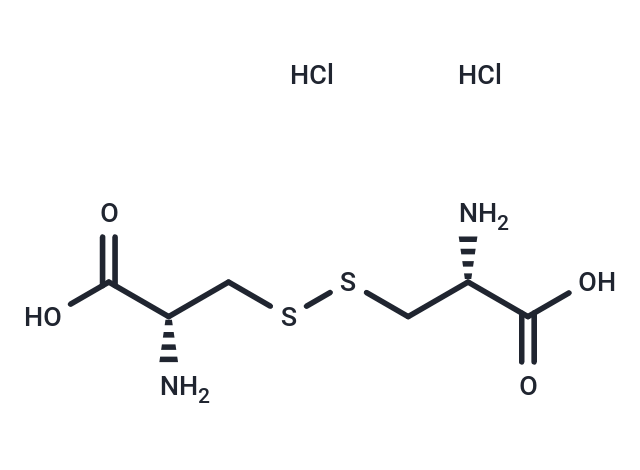
L-Cystine dihydrochloride
CAS No. 30925-07-6
L-Cystine dihydrochloride( —— )
Catalog No. M35473 CAS No. 30925-07-6
L-Cystine dihydrochloride is an Nrf2 inducer with whitening and anti-dark spot effects.L-Cystine dihydrochloride has cytoprotective effects in cells, and is often added to various fungal cultures as a carbon source.
Purity : >98% (HPLC)
 COA
Datasheet
HNMR
HPLC
MSDS
Handing Instructions
COA
Datasheet
HNMR
HPLC
MSDS
Handing Instructions
| Size | Price / USD | Stock | Quantity |
| 100MG | Get Quote | In Stock |


|
| 200MG | Get Quote | In Stock |
|
| 500MG | 37 | In Stock |
|
| 1G | 52 | In Stock |
|
Biological Information
-
Product NameL-Cystine dihydrochloride
-
NoteResearch use only, not for human use.
-
Brief DescriptionL-Cystine dihydrochloride is an Nrf2 inducer with whitening and anti-dark spot effects.L-Cystine dihydrochloride has cytoprotective effects in cells, and is often added to various fungal cultures as a carbon source.
-
DescriptionL-Cystine dihydrochloride can be used as a cell culture component and is a sulfur-containing precursor of glutathione (GSH) synthesis. L-Cystine dihydrochloride homeostasis is also important for GSH functions.
-
In Vitro——
-
In Vivo——
-
Synonyms——
-
PathwayNuclear Receptor/Transcription Factor
-
TargetKeap1-Nrf2
-
RecptorNrf2
-
Research Area——
-
Indication——
Chemical Information
-
CAS Number30925-07-6
-
Formula Weight313.22
-
Molecular FormulaC6H14Cl2N2O4S2
-
Purity>98% (HPLC)
-
SolubilityIn Vitro:?DMSO : 50 mg/mL (159.63 mM; Ultrasonic )
-
SMILESCl.Cl.N[C@@H](CSSC[C@H](N)C(O)=O)C(O)=O
-
Chemical Name——
Shipping & Storage Information
-
Storage(-20℃)
-
ShippingWith Ice Pack
-
Stability≥ 2 years
Reference
1. Pader I, et al. Thioredoxin-related protein of 14 kDa is an efficient L-cystine reductase and S-denitrosylase. Proc Natl Acad Sci U S A. 2014 May 13;111(19):6964-9.?
molnova catalog



related products
-
L-Cystine dihydrochl...
L-Cystine dihydrochloride is an Nrf2 inducer with whitening and anti-dark spot effects.L-Cystine dihydrochloride has cytoprotective effects in cells, and is often added to various fungal cultures as a carbon source.
-
DDO-7263
DDO-7263 is a 1,2,4-Oxadiazole derivative that upregulates Nrf2 through binding to Rpn6 to block the assembly of 26S proteasome and the subsequent degradation of ubiquitinated Nrf2.
-
Nrf2-IN-3
Nrf2-IN-3 is a mKEAP1-selective NRF2 inhibitor that selectively binds KEAP1 mutants and restores their NRF2 inhibitory function by repairing the disrupted KEAP1/NRF2 interaction, and selectively sensitizes cisplatin in xenografts of mouse mKEAP1 cancer cells.
