


 Cart
Cart
 sales@molnova.com



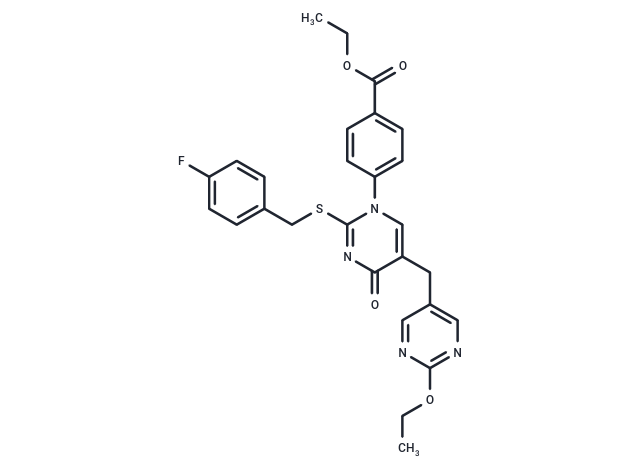
GW-1100
CAS No. 306974-70-9
GW-1100( —— )
Catalog No. M33377 CAS No. 306974-70-9
GW-1100 is a selective GPR40 and FFAR1 antagonist for the study of diabetes and metabolic diseases.
Purity : >98% (HPLC)
 COA
Datasheet
HNMR
HPLC
MSDS
Handing Instructions
COA
Datasheet
HNMR
HPLC
MSDS
Handing Instructions
| Size | Price / USD | Stock | Quantity |
| 2MG | 44 | Get Quote |


|
| 500MG | Get Quote | Get Quote |
|
| 1G | Get Quote | Get Quote |
|
Biological Information
-
Product NameGW-1100
-
NoteResearch use only, not for human use.
-
Brief DescriptionGW-1100 is a selective GPR40 and FFAR1 antagonist for the study of diabetes and metabolic diseases.
-
DescriptionGW-1100 is a selective GPR40 antagonist with a pIC50 of 6.9.
-
In Vitro——
-
In Vivo——
-
Synonyms——
-
PathwayCell Cycle/DNA Damage
-
TargetGPR
-
RecptorGPR
-
Research Area——
-
Indication——
Chemical Information
-
CAS Number306974-70-9
-
Formula Weight520.58
-
Molecular FormulaC27H25FN4O4S
-
Purity>98% (HPLC)
-
SolubilityIn Vitro:?DMSO : 50 mg/mL (96.05 mM; Ultrasonic )
-
SMILESCCOC(=O)c1ccc(cc1)-n1cc(Cc2cnc(OCC)nc2)c(=O)nc1SCc1ccc(F)cc1
-
Chemical Name——
Shipping & Storage Information
-
Storage(-20℃)
-
ShippingWith Ice Pack
-
Stability≥ 2 years
Reference
1. Stoddart LA, et al. Uncovering the pharmacology of the G protein-coupled receptor GPR40: high apparent constitutive activity in guanosine 5'-O-(3-[35S]thio)triphosphate binding studies reflects binding of an endogenous agonist. Mol Pharmacol. 2007 Apr;71(?
molnova catalog



related products
-
YE 120
YE 120 is a highly potent GPR35 agonist (EC50: 32.5 nM) with potential anti-inflammatory and anti-cancer activities, which can be used to study G protein-coupled receptor-related diseases.
-
TAK-875 hemihydrate
Fasiglifam (TAK-875) is a selective GPR40 agonist with EC50 of 14 nM in human GPR40 expressing CHO cell line.
-
BI-671800
BI-671800 is a highly specific and potent antagonist of chemoattractant receptor-homologous molecule on Th2 cells (DP2/CRTH2).
