


 Cart
Cart
 sales@molnova.com



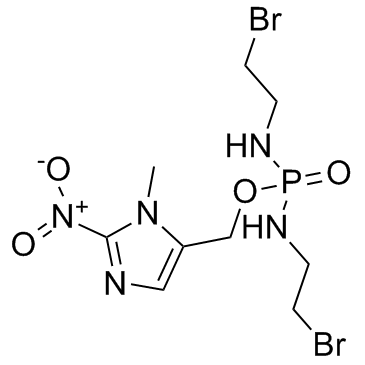
Evofosfamide
CAS No. 918633-87-1
Evofosfamide( TH302 | TH 302 | TH-302 )
Catalog No. M16596 CAS No. 918633-87-1
A potent and selective hypoxia-activated phosphoramidate DNA cross-linking mustard; selectively potent under hypoxia and stable to liver microsomes.
Purity : >98% (HPLC)
 COA
Datasheet
HNMR
HPLC
MSDS
Handing Instructions
COA
Datasheet
HNMR
HPLC
MSDS
Handing Instructions
| Size | Price / USD | Stock | Quantity |
| 2MG | 64 | In Stock |


|
| 5MG | 104 | In Stock |
|
| 10MG | 142 | In Stock |
|
| 25MG | 248 | In Stock |
|
| 50MG | 397 | In Stock |
|
| 100MG | 612 | In Stock |
|
| 200MG | Get Quote | In Stock |
|
| 500MG | Get Quote | In Stock |
|
| 1G | Get Quote | In Stock |
|
Biological Information
-
Product NameEvofosfamide
-
NoteResearch use only, not for human use.
-
Brief DescriptionA potent and selective hypoxia-activated phosphoramidate DNA cross-linking mustard; selectively potent under hypoxia and stable to liver microsomes.
-
DescriptionA potent and selective hypoxia-activated phosphoramidate DNA cross-linking mustard; selectively potent under hypoxia and stable to liver microsomes; inhibits H246 cells and HT29 cells with IC50 of 0.1 uM and 0.2 uM respectively; active in an in vivo MIA PaCa-2 pancreatic cancer orthotopic xenograft model.Pancreatic Cancer,Phase 3 Clinical(In Vitro):Evofosfamide (TH-302) induces γH2AX and apoptosis. Evofosfamide displays hypoxia-selective and concentration-dependent cytotoxic activity that is comparable in both p53-proficient and -deficient cells. Treatment with Evofosfamide (TH-302) alone causes an accumulation of G2/M cells. Inhibition of Chk1 by PF47736 in cells treated with Evofosfamide reduces Evofosfamide (TH-302)-mediated G2/M arrest under both normoxia and hypoxia.(In Vivo):Evofosfamide (TH-302) is a hypoxia-activated prodrug known to activate selectively under the hypoxic conditions commonly found in solid tumors. The mean values of normalized Ktrans decrease 69.2% for Evofosfamide (TH-302)-treated mice in Hs766t tumors, decrease 46.1% for Mia PaCa-2 tumors and increase 4.9% in SU.86.86 tumors. Both changes for Hs766t and Mia PaCa-2 treatment groups are statistically significant (P<0.01) when compare to their own control group. A significant reduction in the hypoxic fraction (HF) to 2.1%±4.7% is seen after 95% oxygen breathing (P<0.001), whereas 7% oxygen breathing significantly increase the HF to 29.5%±14.7% (P=0.029). Exposing rhabdomyosarcoma-bearing rats to increasing oxygen conditions abolish the effect of TH-302 and reduce the T4×SV from 20.4±3.5 to 15.3±2.5 days (P=0.007), whereas control animals have an increased T4×SV. Upon combination with radiotherapy, the T4×SV of TH-302-treated tumors decrease from 30.8±5.9 (Evofosfamide (TH-302)+radiotherapy) to 25.7±2.9 days (Evofosfamide (TH-302)+radiotherapy+95% O2).
-
In VitroEvofosfamide (TH-302) induces γH2AX and apoptosis. Evofosfamide displays hypoxia-selective and concentration-dependent cytotoxic activity that is comparable in both p53-proficient and -deficient cells. Treatment with Evofosfamide (TH-302) alone causes an accumulation of G2/M cells. Inhibition of Chk1 by PF47736 in cells treated with Evofosfamide reduces Evofosfamide (TH-302)-mediated G2/M arrest under both normoxia and hypoxia.
-
In VivoEvofosfamide (TH-302) is a hypoxia-activated prodrug known to activate selectively under the hypoxic conditions commonly found in solid tumors. The mean values of normalized Ktrans decrease 69.2% for Evofosfamide (TH-302)-treated mice in Hs766t tumors, decrease 46.1% for Mia PaCa-2 tumors and increase 4.9% in SU.86.86 tumors. Both changes for Hs766t and Mia PaCa-2 treatment groups are statistically significant (P<0.01) when compare to their own control group. A significant reduction in the hypoxic fraction (HF) to 2.1%±4.7% is seen after 95% oxygen breathing (P<0.001), whereas 7% oxygen breathing significantly increase the HF to 29.5%±14.7% (P=0.029). Exposing rhabdomyosarcoma-bearing rats to increasing oxygen conditions abolish the effect of TH-302 and reduce the T4×SV from 20.4±3.5 to 15.3±2.5 days (P=0.007), whereas control animals have an increased T4×SV. Upon combination with radiotherapy, the T4×SV of TH-302-treated tumors decrease from 30.8±5.9 (Evofosfamide (TH-302)+radiotherapy) to 25.7±2.9 days (Evofosfamide (TH-302)+radiotherapy+95% O2).
-
SynonymsTH302 | TH 302 | TH-302
-
PathwayCell Cycle/DNA Damage
-
TargetDNA Alkylator
-
RecptorHypoxia-activatedprodrug
-
Research AreaCancer
-
IndicationPancreatic Cancer
Chemical Information
-
CAS Number918633-87-1
-
Formula Weight449.0362
-
Molecular FormulaC9H16Br2N5O4P
-
Purity>98% (HPLC)
-
SolubilityDMSO; H2O: 0.14 mg/mL
-
SMILESO=P(NCCBr)(NCCBr)OCC1=CN=C([N+]([O-])=O)N1C
-
Chemical NamePhosphorodiamidic acid, N,N'-bis(2-bromoethyl)-, (1-methyl-2-nitro-1H-imidazol-5-yl)methyl ester
Shipping & Storage Information
-
Storage(-20℃)
-
ShippingWith Ice Pack
-
Stability≥ 2 years
Reference
1. Duan JX, et al. J Med Chem. 2008 Apr 24;51(8):2412-20.
2. Hu J, et al. Blood. 2010 Sep 2;116(9):1524-7.
3. Meng F, et al. Mol Cancer Ther. 2012 Mar;11(3):740-51.
molnova catalog



related products
-
Mitomycin C
Mitomycin C (Ametycine) is a chemotherapeutic antibiotic that acts as a double-stranded DNA alkylating agent.
-
Cyclophosphamide hyd...
A synthetic alkylating agent chemically related to the nitrogen mustards with antineoplastic and immunosuppressive activities; used to treat cancers and autoimmune diseases.
-
Glufosfamide
A conjugate of glucose and active alkylating moiety of ifosfamide with potentially enhanced selectivity for tumors that overexpress transmembrane glucose transporters.
