


 Cart
Cart
 sales@molnova.com



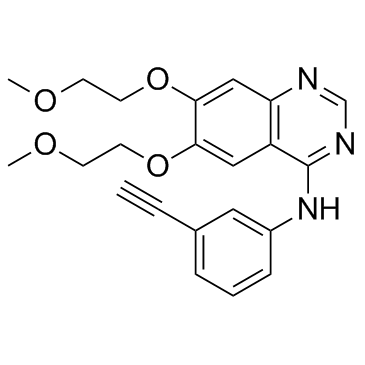
Erlotinib
CAS No. 183321-74-6
Erlotinib( NSC-718781 | OSI-744 | R-1415 | CP-358774 )
Catalog No. M12829 CAS No. 183321-74-6
A potent, selective inhibitor of EGFR with IC50 of 2 nM; reduces EGFR autophosphorylation in intact tumor cells with an IC50 of 20 nM.
Purity : >98% (HPLC)
 COA
Datasheet
HNMR
HPLC
MSDS
Handing Instructions
COA
Datasheet
HNMR
HPLC
MSDS
Handing Instructions
| Size | Price / USD | Stock | Quantity |
| 50MG | 36 | In Stock |


|
| 100MG | 43 | In Stock |
|
| 500MG | 65 | In Stock |
|
| 1G | Get Quote | In Stock |
|
Biological Information
-
Product NameErlotinib
-
NoteResearch use only, not for human use.
-
Brief DescriptionA potent, selective inhibitor of EGFR with IC50 of 2 nM; reduces EGFR autophosphorylation in intact tumor cells with an IC50 of 20 nM.
-
DescriptionA potent, selective inhibitor of EGFR with IC50 of 2 nM; reduces EGFR autophosphorylation in intact tumor cells with an IC50 of 20 nM; inhibits the proliferation of DiFi human colon tumor cells at submicromolar concentrations in cell culture and blocks cell cycle progression at the G1 phase; 100mg/kg completely prevents EGF-induced autophosphorylation of EGFR in human HN5 tumors growing as xenografts in athymic mice and of the hepatic EGFR of the treated mice; orally active.Lung Cancer Approved(In Vitro):Erlotinib (CP-358774) is also a potent inhibitor of the recombinant intracellular (kinase) domain of the EGFR, with an IC50 of 1 nM. The proliferation of DiFi cells is strongly inhibited by Erlotinib with an IC50 of 100 nM for an 8-day proliferation assay. The combination of B-DIM and Erlotinib (2 μM) results in a significant inhibition of colony formation in BxPC-3 cells when compared with either agent alone. The combination of B-DIM and Erlotinib (2 μM) results in a significant induction of apoptosis only in BxPC-3 cells when compare with the apoptotic effect of either agent alone. (In Vivo):Under the experimental conditions, the combination of B-DIM and Erlotinib (50 mg/kg, i.p.) treatment shows significant decrease (P <0.01) in tumor weight compared with untreated control. Erlotinib (20 mg/kg, p.o.) significantly attenuates Cisplatin (CP)-induced body weight (BW) loss when compared to the CP+vehicle (V) rats (P<0.05). Erlotinib treatment significantly improves renal function in CP-N(normal control group, NC) rats. The CP+Erlotinib (E) rats show significant reduction of the levels of Serum creatinine (s-Cr) (P<0.05), blood urea nitrogen (BUN) (P<0.05), urinary N-acetyl-尾-D-glucosaminidase (NAG) index (P<0.05), and significant increase of urine volume (UV) (P<0.05) and Cr clearance (Ccr) (P<0.05) compare to the CP+V rats.
-
In VitroErlotinib (CP-358774) is also a potent inhibitor of the recombinant intracellular (kinase) domain of the EGFR, with an IC50 of 1 nM. The proliferation of DiFi cells is strongly inhibited by Erlotinib with an IC50 of 100 nM for an 8-day proliferation assay. The combination of B-DIM and Erlotinib (2 μM) results in a significant inhibition of colony formation in BxPC-3 cells when compared with either agent alone. The combination of B-DIM and Erlotinib (2 μM) results in a significant induction of apoptosis only in BxPC-3 cells when compare with the apoptotic effect of either agent alone.
-
In VivoUnder the experimental conditions, the combination of B-DIM and Erlotinib (50 mg/kg, i.p.) treatment shows significant decrease (P <0.01) in tumor weight compared with untreated control. Erlotinib (20 mg/kg, p.o.) significantly attenuates Cisplatin (CP)-induced body weight (BW) loss when compared to the CP+vehicle (V) rats (P<0.05). Erlotinib treatment significantly improves renal function in CP-N(normal control group, NC) rats. The CP+Erlotinib (E) rats show significant reduction of the levels of Serum creatinine (s-Cr) (P<0.05), blood urea nitrogen (BUN) (P<0.05), urinary N-acetyl-β-D-glucosaminidase (NAG) index (P<0.05), and significant increase of urine volume (UV) (P<0.05) and Cr clearance (Ccr) (P<0.05) compare to the CP+V rats
-
SynonymsNSC-718781 | OSI-744 | R-1415 | CP-358774
-
PathwayAngiogenesis
-
TargetEGFR
-
RecptorEGFR
-
Research AreaCancer
-
IndicationLung Cancer
Chemical Information
-
CAS Number183321-74-6
-
Formula Weight393.4357
-
Molecular FormulaC22H23N3O4
-
Purity>98% (HPLC)
-
Solubility10 mM in DMSO
-
SMILESCOCCOC1=C(OCCOC)C=C2C(NC3=CC=CC(=C3)C#C)=NC=NC2=C1
-
Chemical Name4-Quinazolinamine, N-(3-ethynylphenyl)-6,7-bis(2-methoxyethoxy)-
Shipping & Storage Information
-
Storage(-20℃)
-
ShippingWith Ice Pack
-
Stability≥ 2 years
Reference
1. Ng SS, et al. Mol Cancer Ther. 2002 Aug;1(10):777-83.
2. Moyer JD, et al. Cancer Res. 1997 Nov 1;57(21):4838-48.
3. Pollack VA, et al. J Pharmacol Exp Ther. 1999 Nov;291(2):739-48.
molnova catalog



related products
-
HKI-357
HKI-357 is an irreversible dual inhibitor of EGFR and ERBB2 (IC50s: 34 nM and 33 nM). HKI-357 suppresses EGFR autophosphorylation (at Y1068), and AKT and MAPK phosphorylation.
-
Erlotinib
A potent, selective inhibitor of EGFR with IC50 of 2 nM; reduces EGFR autophosphorylation in intact tumor cells with an IC50 of 20 nM.
-
Leonurine hydrochlor...
Leonurine (hydrochloride), a major alkaloid compound extracted from?Leonurus japonicas?Houtt. (Labiatae), is considered to have antitumor roles.
