


 Cart
Cart
 sales@molnova.com



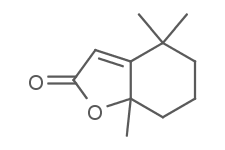
Dihydroactinidiolide
CAS No. 17092-92-1
Dihydroactinidiolide( —— )
Catalog No. M18118 CAS No. 17092-92-1
Dihydroactinidiolideis avolatileterpene. It has a sweet,tea-likeodorand is used as a fragrance.
Purity : >98% (HPLC)
 COA
Datasheet
HNMR
HPLC
MSDS
Handing Instructions
COA
Datasheet
HNMR
HPLC
MSDS
Handing Instructions
| Size | Price / USD | Stock | Quantity |
| 50MG | 45 | In Stock |


|
| 100MG | 59 | In Stock |
|
| 200MG | Get Quote | In Stock |
|
| 500MG | Get Quote | In Stock |
|
| 1G | Get Quote | In Stock |
|
Biological Information
-
Product NameDihydroactinidiolide
-
NoteResearch use only, not for human use.
-
Brief DescriptionDihydroactinidiolideis avolatileterpene. It has a sweet,tea-likeodorand is used as a fragrance.
-
DescriptionDihydroactinidiolideis avolatileterpene. It has a sweet,tea-likeodorand is used as a fragrance.
-
In Vitro——
-
In Vivo——
-
Synonyms——
-
PathwayChromatin/Epigenetic
-
TargetEpigenetic Reader Domain
-
RecptorOthers
-
Research Area——
-
Indication——
Chemical Information
-
CAS Number17092-92-1
-
Formula Weight180.24
-
Molecular FormulaC11H16O2
-
Purity>98% (HPLC)
-
SolubilityIn Vitro:?DMSO : 100 mg/mL (554.82 mM)
-
SMILESCC1(CCC[C@@]2(C1=CC(=O)O2)C)C
-
Chemical Name——
Shipping & Storage Information
-
Storage(-20℃)
-
ShippingWith Ice Pack
-
Stability≥ 2 years
Reference
1. Shumbe L, et al. Dihydroactinidiolide, a high light-induced β-carotene derivative that can regulate gene expression and photoacclimation in Arabidopsis. Mol Plant. 2014 Jul;7(7):1248-51.
molnova catalog



related products
-
BRD4?Inhibitor-27
BRD4?Inhibitor-27 is a potent BRD4 inhibitor that inhibits BRD4 BD1 and BRD4 BD2 with IC50s of 9.6 and 11.3 μM, respectively.BRD4?Inhibitor-27 has anticancer activity and can be used for breast cancer research.
-
SRX3177
SRX3177 is a novel and potent inhibitor of BRD4, PI3K and CDK.SRX3177 has potential anticancer activity.
-
OTX015
OTX015 is a potent BET bromodomain inhibitor with EC50 ranging from 10 to 19 nM for BRD2, BRD3, and BRD4. Phase 1.
