


 Cart
Cart
 sales@molnova.com



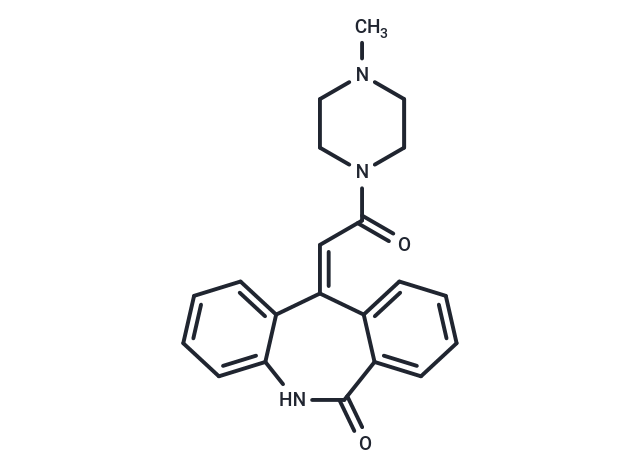
Darenzepine
CAS No. 84629-61-8
Darenzepine( —— )
Catalog No. M32876 CAS No. 84629-61-8
Darenzepine is a muscarinic receptor inhibitor.
Purity : >98% (HPLC)
 COA
Datasheet
HNMR
HPLC
MSDS
Handing Instructions
COA
Datasheet
HNMR
HPLC
MSDS
Handing Instructions
| Size | Price / USD | Stock | Quantity |
| 2MG | 344 | Get Quote |


|
| 5MG | 427 | Get Quote |
|
| 10MG | 599 | Get Quote |
|
| 25MG | 861 | Get Quote |
|
| 50MG | 1150 | Get Quote |
|
| 100MG | 1521 | Get Quote |
|
| 500MG | Get Quote | Get Quote |
|
| 1G | Get Quote | Get Quote |
|
Biological Information
-
Product NameDarenzepine
-
NoteResearch use only, not for human use.
-
Brief DescriptionDarenzepine is a muscarinic receptor inhibitor.
-
DescriptionDarenzepine is a muscarinic receptor inhibitor extracted from patent US 20170095465 A1.
-
In VitroDarenzepine is a muscarinic receptor inhibitor which is useful for the treatment of CNS disorders.
-
In Vivo——
-
Synonyms——
-
PathwayCell Cycle/DNA Damage
-
TargetAChR
-
RecptorAChR
-
Research Area——
-
Indication——
Chemical Information
-
CAS Number84629-61-8
-
Formula Weight347.41
-
Molecular FormulaC21H21N3O2
-
Purity>98% (HPLC)
-
Solubility——
-
SMILESC(\C(=O)N1CCN(C)CC1)=C/2\C=3C(C(=O)NC=4C2=CC=CC4)=CC=CC3
-
Chemical Name——
Shipping & Storage Information
-
Storage(-20℃)
-
ShippingWith Ice Pack
-
Stability≥ 2 years
Reference
1. Eric Elenko, et al. Methods and compositions for treatment of disorders ameliorated by muscarinic receptor activation. US 20170095465 A1.
molnova catalog



related products
-
Lobelanidine
Lobelanidine (8,10-Diphenyllobelidiol), which can be extracted from the above-ground parts of Lobelia chinensis Lour and Lobelia tupa, is an analogue of lobeline and shows a moderate affinity for nAChR.
-
VU0152099
VU0152099 is a potent and selective M4 mAChR allosteric potentiator(EC50 = 380 ± 93 nM).
-
Cynandione A
Cynandione A, an acetophenone derived from Cynanchum wilfordii, has anti-inflammatory activity and significantly reduces pro-inflammatory cytokine overexpression via macrophage α7 nAChR activation and subsequent IL-10 expression.
