


 Cart
Cart
 sales@molnova.com



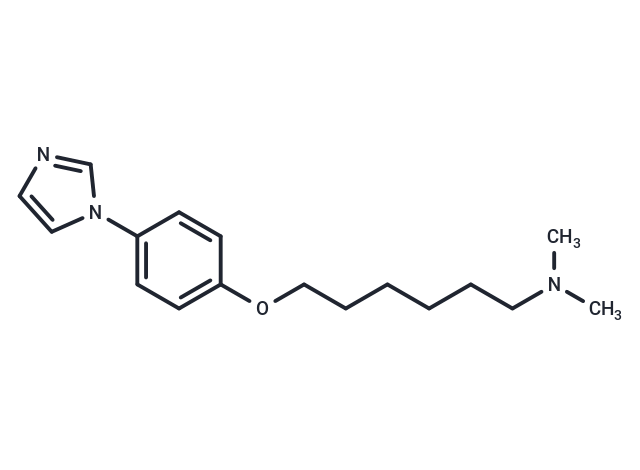
CAY10434
CAS No. 769917-29-5
CAY10434( —— )
Catalog No. M34985 CAS No. 769917-29-5
CAY10434 is an active inhibitor of CYP4A hydroxylase with an IC50 value of 8.8 nM in human kidney microsomal test.
Purity : >98% (HPLC)
 COA
Datasheet
HNMR
HPLC
MSDS
Handing Instructions
COA
Datasheet
HNMR
HPLC
MSDS
Handing Instructions
| Size | Price / USD | Stock | Quantity |
| 2MG | 53 | Get Quote |


|
| 5MG | 76 | Get Quote |
|
| 10MG | 133 | Get Quote |
|
| 25MG | 274 | Get Quote |
|
| 50MG | 401 | Get Quote |
|
| 100MG | 533 | Get Quote |
|
| 200MG | 705 | Get Quote |
|
| 500MG | Get Quote | Get Quote |
|
| 1G | Get Quote | Get Quote |
|
Biological Information
-
Product NameCAY10434
-
NoteResearch use only, not for human use.
-
Brief DescriptionCAY10434 is an active inhibitor of CYP4A hydroxylase with an IC50 value of 8.8 nM in human kidney microsomal test.
-
DescriptionCAY 10434 is a potent CYP4A hydroxylase inhibitor. CAY 10434 improves contractile response to angiotensin II with the maximal contractile response (Emax) 6764 mg.
-
In Vitro——
-
In Vivo——
-
Synonyms——
-
PathwayMetabolic Enzyme/Protease
-
TargetP450
-
RecptorP450
-
Research Area——
-
Indication——
Chemical Information
-
CAS Number769917-29-5
-
Formula Weight287.4
-
Molecular FormulaC17H25N3O
-
Purity>98% (HPLC)
-
Solubility——
-
SMILESO(CCCCCCN(C)C)C1=CC=C(C=C1)N2C=CN=C2
-
Chemical Name——
Shipping & Storage Information
-
Storage(-20℃)
-
ShippingWith Ice Pack
-
Stability≥ 2 years
Reference
1. Jerez S, et al. 17-Octadecynoic acid improves contractile response to angiotensin II by releasing vasocontrictor prostaglandins. Prostaglandins Other Lipid Mediat. 2012 Jan;97(1-2):36-42. ?
molnova catalog



related products
-
AG 045572
AG 045572 is a potent GnRH receptor antagonist that inhibits the GnRH receptor in humans and rats with Ki values of 6.0 nM and 3.8 nM, respectively.AG 045572 is metabolized by CYP3A and inhibits testosterone.
-
NSC 207895
NSC 207895 suppresses MDMX with IC50 of 2.5 μM, leading to enhanced p53 stabilization/activation and DNA damage, and also regulates MDM2, an E3 ligase.
-
2,6-Dimethoxyquinone
2, 6-dimethoxy-1, 4-benzoquinone is a member of the class of compounds known as P-benzoquinones.
