


 Cart
Cart
 sales@molnova.com



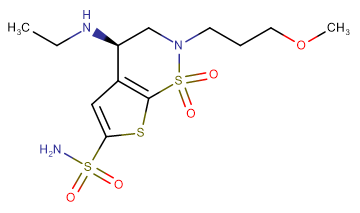
Brinzolamide
CAS No. 138890-62-7
Brinzolamide( AL 4862 | Azopt )
Catalog No. M11614 CAS No. 138890-62-7
Brinzolamide is a highly specific, non-competitive, reversible carbonic anhydrase inhibitor.
Purity : >98% (HPLC)
 COA
Datasheet
HNMR
HPLC
MSDS
Handing Instructions
COA
Datasheet
HNMR
HPLC
MSDS
Handing Instructions
| Size | Price / USD | Stock | Quantity |
| 5MG | 31 | In Stock |


|
| 10MG | 45 | In Stock |
|
| 25MG | 86 | In Stock |
|
| 50MG | 133 | In Stock |
|
| 100MG | 194 | In Stock |
|
| 200MG | 243 | In Stock |
|
| 500MG | Get Quote | In Stock |
|
| 1G | Get Quote | In Stock |
|
Biological Information
-
Product NameBrinzolamide
-
NoteResearch use only, not for human use.
-
Brief DescriptionBrinzolamide is a highly specific, non-competitive, reversible carbonic anhydrase inhibitor.
-
DescriptionBrinzolamide is a highly specific, non-competitive, reversible carbonic anhydrase inhibitor. Carbonic anhydrase (CA) is an enzyme found in many tissues of the body including the eye. It catalyzes the reversible reaction involving the hydration of carbon dioxide and the dehydration of carbonic acid. In humans, carbonic anhydrase exists as a number of isoenzymes, the most active being carbonic anhydrase II (CA-II). Inhibition of carbonic anhydrase in the ciliary processes of the eye decreases aqueous humor secretion, presumably by slowing the formation of bicarbonate ions with subsequent reduction in sodium and fluid transport. The result is a reduction in intraocular pressure. Brinzolamide is indicated in the treatment of elevated intraocular pressure in patients with ocular hypertension or open-angle glaucoma. (In Vivo):Brinzolamide (7.5 mg or 12 mg) implanted in a silicone matrix is extremely well tolerated and provides sustained release of brinzolamide and significant reduction in intraocular pressure (IOP) for up to 28 days with no adverse effects or signs of toxicity in normotensive NZW rabbits.
-
In Vitro——
-
In VivoBrinzolamide (7.5 mg or 12 mg) implanted in a silicone matrix is extremely well tolerated and provides sustained release of brinzolamide and significant reduction in intraocular pressure (IOP) for up to 28 days with no adverse effects or signs of toxicity in normotensive NZW rabbits.The pharmacokinetic parameters of Brinzolamide in rabbits.Animal Model:Rabbits Dosage:7.5 mg, 12 mg Administration:Brinzolamide silicone matrix implant placed in the episcleral space Result:Resulted in a significant IOP reduction of 4.6 mmHg on days 10-28, with concentrations of 12 mg.
-
SynonymsAL 4862 | Azopt
-
PathwayMembrane Transporter/Ion Channel
-
TargetCarbonic Anhydrase
-
RecptorCarbonic anhydrase II
-
Research AreaOther Indications
-
Indication——
Chemical Information
-
CAS Number138890-62-7
-
Formula Weight383.51
-
Molecular FormulaC12H21N3O5S3
-
Purity>98% (HPLC)
-
SolubilityDMSO: 77 mg/mL (200.77 mM)
-
SMILESCCN[C@H]1CN(S(=O)(=O)C2=C1C=C(S2)S(=O)(=O)N)CCCOC
-
Chemical Name——
Shipping & Storage Information
-
Storage(-20℃)
-
ShippingWith Ice Pack
-
Stability≥ 2 years
Reference
1.Stams T, et al. Protein Sci. 1998 Mar;7(3):556-63.
molnova catalog



related products
-
Enpp/Carbonic anhydr...
Enpp/Carbonic anhydrase-IN-1 (compound 1e) is a potent inhibitor of Enpp and carbonic anhydrase, exhibiting IC50s of 1.36, 1.35, 3.00, 0.88, and 1.02 μM for NPP1, NPP2, NPP3, CA-II, and CA-IX respectively.
-
hCAIX-IN-5
hCAIX-IN-5 was a selective hCAIX inhibitor, inhibiting hCAI, hCAII, hCAIV, and hCAIX with Ki values of >10000, >10000, 130.7, and 829.1 nM, respectively.
-
Dorzolamide hydrochl...
Dorzolamide Hcl(L671152 Hcl; MK507 Hcl) is an anti-glaucoma agent, which is a carbonic anhydrase inhibitor.
