


 Cart
Cart
 sales@molnova.com



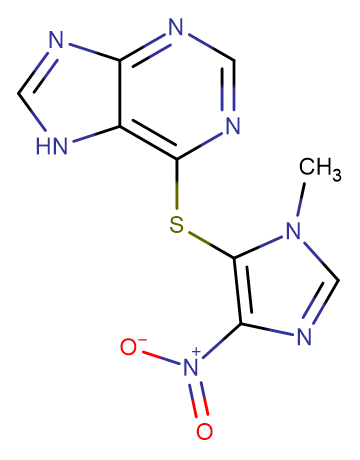
Azathioprine
CAS No. 446-86-6
Azathioprine( Azamune | Azoran | BW 57-322 | Imuran | NSC 39084 )
Catalog No. M14531 CAS No. 446-86-6
Azathioprine is an immunosuppressive drug, inhibiting purine synthesis and GTP-binding protein Rac1 activation, used in the treatment of organ transplantation and autoimmune diseases.
Purity : >98% (HPLC)
 COA
Datasheet
HNMR
HPLC
MSDS
Handing Instructions
COA
Datasheet
HNMR
HPLC
MSDS
Handing Instructions
| Size | Price / USD | Stock | Quantity |
| 500MG | 41 | In Stock |


|
| 1G | 53 | In Stock |
|
Biological Information
-
Product NameAzathioprine
-
NoteResearch use only, not for human use.
-
Brief DescriptionAzathioprine is an immunosuppressive drug, inhibiting purine synthesis and GTP-binding protein Rac1 activation, used in the treatment of organ transplantation and autoimmune diseases.
-
DescriptionAzathioprine is an immunosuppressive drug, inhibiting purine synthesis and GTP-binding protein Rac1 activation, used in the treatment of organ transplantation and autoimmune diseases.(In Vitro):Azathioprine (0-50 μM, 48 hours) can induce severe intracellular GSH depletion with relevant concentrations in both primary rat and human hepatocytes.(In Vivo):Azathioprine (oral gavage, 25-400 mg/kg, everyday, 10days) can affect bone marrow cells, red blood cells, and peripheral blood cytokines and other related parameters in a dose-dependent manner, and can induce apoptosis in female CD-1 mice and ICR mice.
-
In VitroAzathioprine (0-50 μM, 48 hours) can induce severe intracellular GSH depletion with relevant concentrations in both primary rat and human hepatocytes. Cell Viability Assay Cell Line:Rat hepatocytes, Human hepatocytes Concentration:0-50 μM Incubation Time:24-48 hours Result:Showed the decrease in cell viability and intracellular GSH levels in rat hepatocytes as low concentration of 0.5 μM but no significant decrease in cell viability at concentrations below 50 μM as well as GSH depletion was obviously noted at a concentration as low as 1 μM in human hepatocytes.
-
In VivoAzathioprine (oral gavage, 25-400 mg/kg, everyday, 10days) can affect bone marrow cells, red blood cells, and peripheral blood cytokines and other related parameters in a dose-dependent manner, and can induce apoptosis in female CD-1 mice and ICR mice. Animal Model:Outbred female CD-1 mice, Female ICR mice Dosage:25-400 mg/kg Administration:Oral gavage; everyday; 10 days Result:Induced a decrease in erythrocyte-related parameters as well as leukocyte-related parameters in a dose-dependent manner.Induced 52.4%, 35.4%, 17.9%, 16.1% and 15.2% reduction in bone marrow cells at concentrations of 40, 60, 80, 100 and 120 mg/kg, respectively while fms-like tyrosine kinase-3(FLT-3) ligand (FL)-related cytokines were increased.
-
SynonymsAzamune | Azoran | BW 57-322 | Imuran | NSC 39084
-
PathwayCell Cycle/DNA Damage
-
TargetGPR
-
RecptorHGPRT| Rac1
-
Research AreaInflammation/Immunology
-
Indication——
Chemical Information
-
CAS Number446-86-6
-
Formula Weight277.26
-
Molecular FormulaC9H7N7O2S
-
Purity>98% (HPLC)
-
SolubilityDMSO: 54 mg/mL (194.76 mM)
-
SMILESO=[N+](C1=C(SC2=C3NC=NC3=NC=N2)N(C)C=N1)[O-]
-
Chemical Name6-((1-methyl-4-nitro-1H-imidazol-5-yl)thio)-7H-purine
Shipping & Storage Information
-
Storage(-20℃)
-
ShippingWith Ice Pack
-
Stability≥ 2 years
Reference
1.Tiede I, et al. J Clin Invest, 2003, 111(8), 1133-1145.
molnova catalog



related products
-
CRTh2 antagonist 2
CRTh2 antagonist 2 is a selective and potent CRTH2 antagonist, IC50≤10 nM. CRTh2 antagonist 2 can be used to study the direction of androgenic alopecia.
-
PFK-158
PFK-158 is an effective and specific inhibitor PFKFB3.
-
G-1
G-1 is a nonsteroidal, high-affinity and selective GPR30 agonist (Ki: 11 nM).
