


 Cart
Cart
 sales@molnova.com



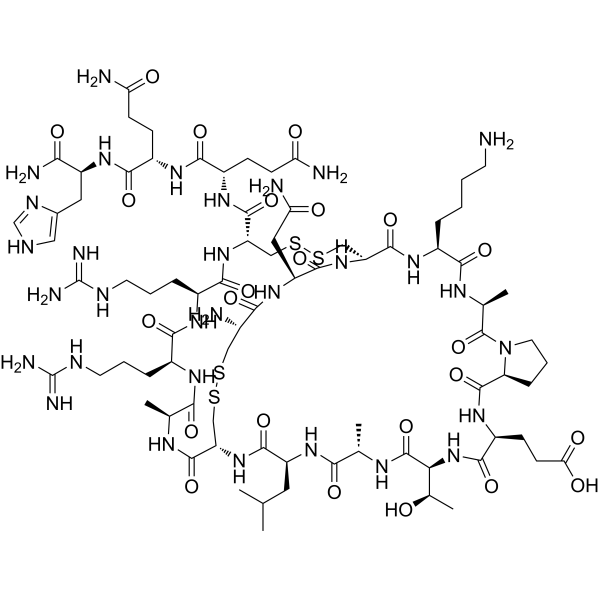
Apamin
CAS No. 24345-16-2
Apamin( Apamine )
Catalog No. M29922 CAS No. 24345-16-2
Apamin (Apamine) is an 18 amino acid peptide neurotoxin found in apitoxin (bee venom), is known as a specifically selective blocker of Ca2+-activated K+ (SK) channels and exhibits anti-inflammatory and anti-fibrotic activity. Apamin is a bee venom component and is strongly basic in nature.
Purity : >98% (HPLC)
 COA
Datasheet
HNMR
HPLC
MSDS
Handing Instructions
COA
Datasheet
HNMR
HPLC
MSDS
Handing Instructions
| Size | Price / USD | Stock | Quantity |
| 100MG | Get Quote | Get Quote |


|
| 200MG | Get Quote | Get Quote |
|
| 500MG | Get Quote | Get Quote |
|
Biological Information
-
Product NameApamin
-
NoteResearch use only, not for human use.
-
Brief DescriptionApamin (Apamine) is an 18 amino acid peptide neurotoxin found in apitoxin (bee venom), is known as a specifically selective blocker of Ca2+-activated K+ (SK) channels and exhibits anti-inflammatory and anti-fibrotic activity. Apamin is a bee venom component and is strongly basic in nature.
-
DescriptionApamin (Apamine) is an 18 amino acid peptide neurotoxin found in apitoxin (bee venom), is known as a specifically selective blocker of Ca2+-activated K+ (SK) channels and exhibits anti-inflammatory and anti-fibrotic activity. Apamin is a bee venom component and is strongly basic in nature. (In Vitro):Apamin (0.5-2 μg/mL; 24 hours; HSC-T6 cells) treatment markedly reduces the expression of α-SMA in the TGF-β1-induced HSC-T6 cells. Apamin treatment abrogats the activation of p-Smad2/3 and Smad4 induced by TGF-β1.(In Vivo):Apamin (0.1 mg/kg; intraperitoneal injection; twice a week; for 4 weeks; C57BL/6 male mice) treatment results in decreased liver injury and proinflammatory cytokine levels. Apamin suppresses the deposition of collagen, proliferation of BECs and expression of fibrogenic genes in the 3,5-diethoxycarbonyl-1,4-dihydrocollidine (DDC)-fed mice.
-
In VitroApamin (0.5-2 μg/mL; 24 hours; HSC-T6 cells) treatment markedly reduces the expression of α-SMA in the TGF-β1-induced HSC-T6 cells. Apamin treatment abrogats the activation of p-Smad2/3 and Smad4 induced by TGF-β1. Western Blot Analysis Cell Line:HSC-T6 cells Concentration:0.5 μg/mL, 1 μg/mL and 2 μg/mL Incubation Time:24 hours Result:Markedly reduced the expression of α-SMA in the TGF-β1-induced HSC-T6 cells. Abrogated the activation of p-Smad2/3 and Smad4 induced by TGF-β1.
-
In VivoApamin (0.1 mg/kg; intraperitoneal injection; twice a week; for 4 weeks; C57BL/6 male mice) treatment results in decreased liver injury and proinflammatory cytokine levels. Apamin suppresses the deposition of collagen, proliferation of BECs and expression of fibrogenic genes in the 3,5-diethoxycarbonyl-1,4-dihydrocollidine (DDC)-fed mice. Animal Model:8-week-old C57BL/6 male mice (20-25 g) with DDC feeding Dosage:0.1 mg/kg Administration:Intraperitoneal injection; twice a week; for 4 weeks Result:Resulted in decreased liver injury and proinflammatory cytokine levels. Suppressed the deposition of collagen, proliferation of BECs and expression of fibrogenic genes in the DDC-fed mice.
-
SynonymsApamine
-
PathwayCell Cycle/DNA Damage
-
TargetPotassium Channel
-
RecptorK+ channel
-
Research Area——
-
Indication——
Chemical Information
-
CAS Number24345-16-2
-
Formula Weight2027.34
-
Molecular FormulaC79H131N31O24S4
-
Purity>98% (HPLC)
-
SolubilityIn Vitro:?H2O : 100 mg/mL (49.33 mM)
-
SMILES——
-
Chemical NameSequence:Cys-Asn-Cys-Lys-Ala-Pro-Glu-Thr-Ala-Leu-Cys-Ala-Arg-Arg-Cys-Gln-Gln-His-NH2 (Disulfide bridge: Cys1-Cys11;Cys3-Cys15)
Shipping & Storage Information
-
Storage(-20℃)
-
ShippingWith Ice Pack
-
Stability≥ 2 years
Reference
Kim JY, et al. Apamin suppresses biliary fibrosis and activation of hepatic stellate cells. Int J Mol Med. 2017 May;39(5):1188-1194.
molnova catalog



related products
-
NS6180
NS6180 is a novel potent and selective KCa3.1 channel inhibitor(IC50= 9 nM) prevents T-cell activation and inflammation.
-
Linopirdine
Linopirdine (DUP-996;Linopirine) is a potent Kv7 (KCNQ) voltage-gated potassium channels blcoker; blocks KV7.1+7.3 (KCNQ2+3)/M-currents (IC50=4-7 uM) and KV7.1 (KCNQ1) homomeric channels (IC50=8.9 uM).
-
A2764 dihydrochlorid...
A2764 dihydrochloride is a highly selective inhibitor of TRESK.
