


 Cart
Cart
 sales@molnova.com



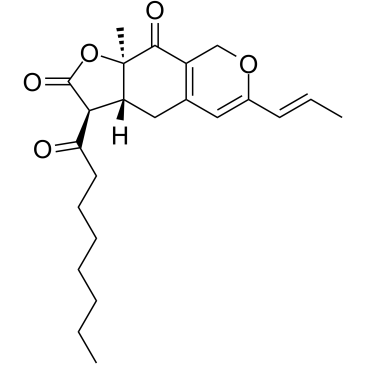
Ankaflavin
CAS No. 50980-32-0
Ankaflavin( —— )
Catalog No. M21782 CAS No. 50980-32-0
Ankaflavin, isolated from Monascus-Fermented red rice, is a PPARγ agonist with anti-inlfammatory activity.
Purity : >98% (HPLC)
 COA
Datasheet
HNMR
HPLC
MSDS
Handing Instructions
COA
Datasheet
HNMR
HPLC
MSDS
Handing Instructions
| Size | Price / USD | Stock | Quantity |
| 5MG | 732 | In Stock |


|
| 10MG | 1224 | In Stock |
|
| 100MG | Get Quote | In Stock |
|
| 200MG | Get Quote | In Stock |
|
| 500MG | Get Quote | In Stock |
|
| 1G | Get Quote | In Stock |
|
Biological Information
-
Product NameAnkaflavin
-
NoteResearch use only, not for human use.
-
Brief DescriptionAnkaflavin, isolated from Monascus-Fermented red rice, is a PPARγ agonist with anti-inlfammatory activity.
-
DescriptionAnkaflavin, isolated from Monascus-Fermented red rice, is a PPARγ agonist with anti-inlfammatory activity. Ankaflavin exhibits selective cytotoxic effect and induces cell death on cancer cells.
-
In VitroAnkaflavin (0-50 μg/mL, 48 h) shows cytotoxicity against cancer cells with no significant toxicity toward normal cells.Ankaflavin (0-30 μg/mL, 0-48 h) arrests Hep G2 cell cycle at sub-G1 phase in a dose- and time-dependent manner.Ankaflavin (25 μg/mL, 48 h) induces Hep G2 cell apoptosis. Cell Cytotoxicity Assay Cell Line:A549, Hep G2, MRC-5 and WI-38 Concentration:1, 10, 25, and 50 μg/mL Incubation Time:48 h Result:Showed cytotoxicity against A549 and Hep G2 cells in a dose-dependent manner with no significant toxicity toward normal cells (MRC-5 and WI-38).Cell Cycle Analysis Cell Line:Hep G2 cells Concentration:15, 20, 25, and 30 μg/mLIncubation Time:12, 24, 36, and 48 hResult:Induced a distinct sub-G1 peak in Hep G2 cells in a dose- and time-dependent manner.Apoptosis AnalysisCell Line:Hep G2 cells Concentration:25 μg/mL Incubation Time:48 h Result:Exhibited significant chromatin condensation (fluorescent spot) through Hoechst staining.
-
In VivoAnkaflavin (10 mg/kg; p.o.; daily for 28 days) shows antidiabetic and anti-inflammatory activity, improves liver function and pancreatic function. Animal Model:Wistar rats (4 weeks of age), diabetes was induced by treating them with Methylglyoxal (MG) (600 mg/kg; oral) for 4 weeks Dosage:10 mg/kg Administration:Oral administration for 28 days Result:Exerted PPARγ agonist activity. Effectively reduced AGE (advanced glycation end-products) levels in serum, liver, and pancreas of MG-induced rats.
-
Synonyms——
-
PathwayMetabolic Enzyme/Protease
-
TargetPPAR
-
RecptorPPARγ
-
Research Area——
-
Indication——
Chemical Information
-
CAS Number50980-32-0
-
Formula Weight386.48
-
Molecular FormulaC??H??O?
-
Purity>98% (HPLC)
-
Solubility——
-
SMILESO=C([C@@H]1C(CCCCCCC)=O)O[C@]2(C)[C@]1([H])CC(C=C(/C=C/C)OC3)=C3C2=O
-
Chemical Name——
Shipping & Storage Information
-
Storage(-20℃)
-
ShippingWith Ice Pack
-
Stability≥ 2 years
Reference
1. Su NW, et al. Ankaflavin from Monascus-fermented red rice exhibits selective cytotoxic effect and induces cell death on Hep G2 cells. J Agric Food Chem. 2005 Mar 23;53(6):1949-54.
2. Lee BH, et al. Ankaflavin: a natural novel PPARγ agonist upregulates Nrf2 to attenuate methylglyoxal-induced diabetes in vivo. Free Radic Biol Med. 2012 Dec 1;53(11):2008-16.
molnova catalog



related products
-
DS-6930
DS-6930 (DS 6930, DS6930) is a novel potent, selective PPARγ agonist with EC50 of 41 nM.
-
Arhalofenate
Arhalofenate is a selective partial agonist of peroxisome proliferator-activated receptor PPARγ. It is used for the treatment of type 2 diabetes.
-
Pioglitazone
Pioglitazone is a selective peroxisome proliferator-activated receptor-gamma (PPARgamma) agonist, used to treat diabetes.
