


 Cart
Cart
 sales@molnova.com



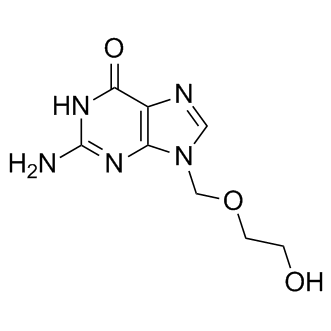
Acyclovir
CAS No. 59277-89-3
Acyclovir( Aciclovir | Acycloguanosine )
Catalog No. M15197 CAS No. 59277-89-3
An antiviral agent that competitively inhibits and inactivates HSV-specified DNA polymerases preventing further viral DNA synthesis without affecting the normal cellular processes.
Purity : >98% (HPLC)
 COA
Datasheet
HNMR
HPLC
MSDS
Handing Instructions
COA
Datasheet
HNMR
HPLC
MSDS
Handing Instructions
| Size | Price / USD | Stock | Quantity |
| 25MG | 35 | In Stock |


|
| 50MG | 46 | In Stock |
|
| 100MG | 72 | In Stock |
|
| 200MG | 94 | In Stock |
|
| 500MG | 118 | In Stock |
|
| 1G | Get Quote | In Stock |
|
Biological Information
-
Product NameAcyclovir
-
NoteResearch use only, not for human use.
-
Brief DescriptionAn antiviral agent that competitively inhibits and inactivates HSV-specified DNA polymerases preventing further viral DNA synthesis without affecting the normal cellular processes.
-
DescriptionAn antiviral agent that competitively inhibits and inactivates HSV-specified DNA polymerases preventing further viral DNA synthesis without affecting the normal cellular processes; primarily used for the treatment of HSV infections.HSV Infection Approved(In Vitro):Acyclovir (Aciclovir, 3-100 μM; 24-72 hours; Jurkat, U937, and K562 leukemia cells) reduces cell viability in a dose- and time-dependent.Acyclovir (Aciclovir, 10-100 μM; 24-72 hours; Jurkat cells) blocks DNA synthesis, thereby arresting the cell cycle in G2/M and S phases and increasing the sub-G1 hypodiploid peak in a dose-dependent manner.Acyclovir (Aciclovir, 10-100 μM; 24-72 hours; Jurkat cells) induces apoptosis through activates caspase-3 and presences nuclear DNA fragmentation.(In Vivo):Acyclovir (20 mg/kg; p.o.; three times daily; for 10 days; BALB/c mice) treatment in infected mice suppresses the development of skin lesions and results in a dissociation between DTH response and antibody production.
-
In VitroAcyclovir (Aciclovir, 3-100 μM; 24-72 hours; Jurkat, U937, and K562 leukemia cells) reduces cell viability in a dose- and time-dependent.?Acyclovir (Aciclovir, 10-100 μM; 24-72 hours; Jurkat cells) blocks DNA synthesis, thereby arresting the cell cycle in G2/M and S phases and increasing the sub-G1 hypodiploid peak in a dose-dependent manner.Acyclovir (Aciclovir, 10-100 μM; 24-72 hours; Jurkat cells) induces apoptosis through activates caspase-3 and presences nuclear DNA fragmentation. Cell Viability Assay Cell Line:Jurkat, U937 and K562 leukemia cells Concentration:3, 10, 30 and 100 μM Incubation Time:24, 48 and 72 hours Result:Showed a dose- and time-dependent reduction of cell viability.Apoptosis Analysis Cell Line:Jurkat cells Concentration:10 and 100 μM Incubation Time:24, 48 and 72 hours Result:Increased of caspase-3 activity and cleavaged the internucleosomal DNA.Cell Cycle Analysis Cell Line:Jurkat cells Concentration:10 and 100 μM Incubation Time:24, 48 and 72 hours Result:Revealed a dose-dependent accumulation of cells in S phase after 24 and 48 h. Showed a dose-dependent increase of the sub-G1 hypodiploid peak after 72 h.
-
In VivoAcyclovir (20 mg/kg; p.o.; three times daily; for 10 days; BALB/c mice) treatment in infected mice suppresses the development of skin lesions and results in a dissociation between DTH response and antibody production. Animal Model:Specific-pathogen-free BALB/c mice (7-week-old) infected with HSV-1 Dosage:20 mg/kg Administration:Oral administration; three times daily; for 10 days Result:Suppressed the development of skin lesions and resulted in a dissociation between DTH response and antibody production.
-
SynonymsAciclovir | Acycloguanosine
-
PathwayMicrobiology/Virology
-
TargetHSV
-
RecptorDNAsynthesis
-
Research AreaInfection
-
IndicationHSV Infection
Chemical Information
-
CAS Number59277-89-3
-
Formula Weight225.2046
-
Molecular FormulaC8H11N5O3
-
Purity>98% (HPLC)
-
Solubility10 mM in DMSO
-
SMILESNC1=NC(=O)C2=C(N1)N(COCCO)C=N2
-
Chemical Name6H-Purin-6-one, 2-amino-1,9-dihydro-9-[(2-hydroxyethoxy)methyl]-
Shipping & Storage Information
-
Storage(-20℃)
-
ShippingWith Ice Pack
-
Stability≥ 2 years
Reference
molnova catalog



related products
-
Histone H4 (2-21)
Histone H4 (2-21) is the core histones associated with chromatinization of herpes simplex virus 1 (HSV-1) genomes.
-
Famciclovir
A guanine analogue antiviral agent used for the treatment of various herpesvirus (HSV) infections.
-
B220
B220, an antiviral agent, inhibits the growth of HSV-1, HSV-2, and human cytomegalovirus (CMV).
