


 Cart
Cart
 sales@molnova.com



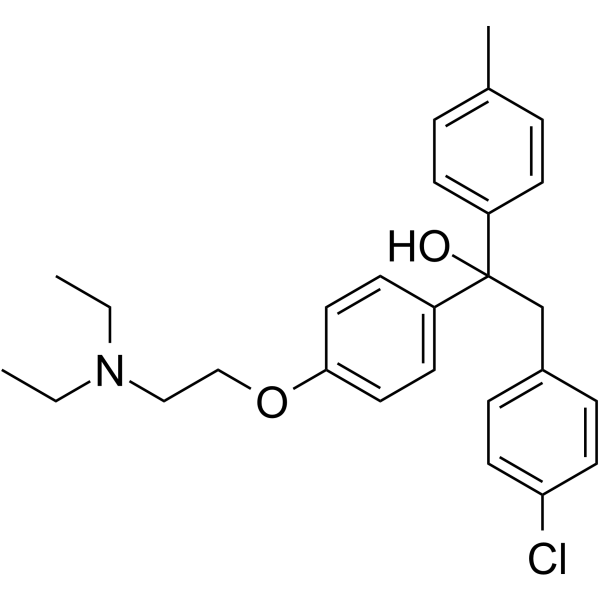
Triparanol
CAS No. 78-41-1
Triparanol( NSC 65345 | NSC-65345 | NSC65345 )
Catalog No. M27836 CAS No. 78-41-1
Triparanol interferes with posttranslational modification of Hedgehog signaling molecules as well as the sterol sensing domain of its receptor PTCH1, leading to down-regulation of Hedgehog signaling.
Purity : >98% (HPLC)
 COA
Datasheet
HNMR
HPLC
MSDS
Handing Instructions
COA
Datasheet
HNMR
HPLC
MSDS
Handing Instructions
| Size | Price / USD | Stock | Quantity |
| 5MG | 1017 | Get Quote |


|
| 10MG | 1368 | Get Quote |
|
| 25MG | 2034 | Get Quote |
|
| 50MG | 2691 | Get Quote |
|
| 100MG | 3708 | Get Quote |
|
| 200MG | Get Quote | Get Quote |
|
| 500MG | Get Quote | Get Quote |
|
| 1G | Get Quote | Get Quote |
|
Biological Information
-
Product NameTriparanol
-
NoteResearch use only, not for human use.
-
Brief DescriptionTriparanol interferes with posttranslational modification of Hedgehog signaling molecules as well as the sterol sensing domain of its receptor PTCH1, leading to down-regulation of Hedgehog signaling.
-
DescriptionTriparanol interferes with posttranslational modification of Hedgehog signaling molecules as well as the sterol sensing domain of its receptor PTCH1, leading to down-regulation of Hedgehog signaling. Triparanol suppresses human tumor growth and is an antilipemic agent with high ophthalmic toxicity.(In Vitro):Triparanol is an effective cholesterol biosynthesis inhibitor blocking the 24-dehydrocholesterol reductase. Triparanol can block proliferation and induce apoptosis in multiple human cancer cells including lung, breast, liver, pancreatic, prostate cancer, and melanoma cells, and growth inhibition can be rescued by the exogenous addition of cholesterol.
-
In VitroTriparanol can block proliferation and induce apoptosis in multiple human cancer cells including lung, breast, liver, pancreatic, prostate cancer and melanoma cells, and growth inhibition can be rescued by exogenous addition of cholesterol.
-
In Vivo——
-
SynonymsNSC 65345 | NSC-65345 | NSC65345
-
PathwayApoptosis
-
TargetApoptosis
-
RecptorA2A/A1
-
Research Area——
-
Indication——
Chemical Information
-
CAS Number78-41-1
-
Formula Weight438.01
-
Molecular FormulaC27H32ClNO2
-
Purity>98% (HPLC)
-
SolubilityIn Vitro:?DMSO : 50 mg/mL (114.16 mM)
-
SMILESCCN(CC)CCOc1ccc(cc1)C(O)(Cc1ccc(Cl)cc1)c1ccc(C)cc1
-
Chemical Name——
Shipping & Storage Information
-
Storage(-20℃)
-
ShippingWith Ice Pack
-
Stability≥ 2 years
Reference
1.Gillespie RJ, et al. Antagonists of the human adenosine A2A receptor. Part 3: Design and synthesis of pyrazolo[3,4-d]pyrimidines, pyrrolo[2,3-d]pyrimidines and 6-arylpurines. Bioorg Med Chem Lett. 2008 May 1;18(9):2924-9.
molnova catalog



related products
-
Valinomycin
Valinomycin is a cyclic depsipeptide antibiotic and a potassium-specific ionophore.Valinomycin induces PINK1 activation and promotes Parkin phosphorylation at Ser65.
-
2’-OMe-Guanosine
2'-OMe-Guanosine is a modified nucleoside produced by the action of tRNA guanosine-2'-o-methyltransferase. 2'-OMe-Guanosine has a certain pro-apoptotic effect.
-
SPOP-IN-6lc
SPOP-IN-6lc is a potent SPOP inhibitor with multiple roles in cancer, oncostatic in a variety of tumors, but functions as an oncogene in renal cancer.SPOP-IN-6lc can be used to study cell signaling and apoptosis.
