


 Cart
Cart
 sales@molnova.com



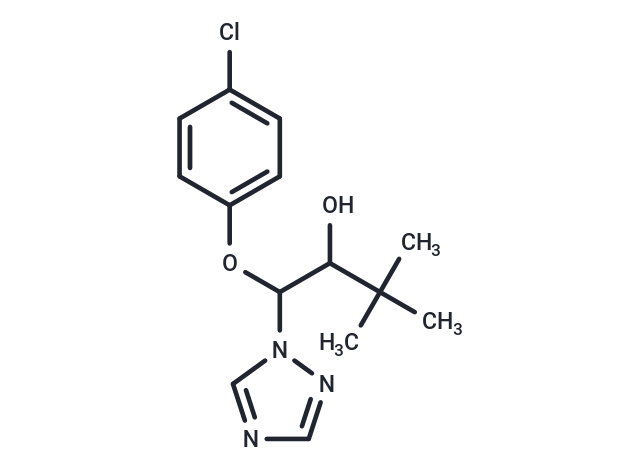
Triadimenol
CAS No. 55219-65-3
Triadimenol( —— )
Catalog No. M34724 CAS No. 55219-65-3
Triadimenol (UK 199) is a triazole fungicide that is cardiotoxic, promotes reactive oxygen species (ROS) production and apoptosis in zebrafish, and induces morphologic changes in zebrafish eyes and body length, as well as yolk sac and cardiac edema.
Purity : >98% (HPLC)
 COA
Datasheet
HNMR
HPLC
MSDS
Handing Instructions
COA
Datasheet
HNMR
HPLC
MSDS
Handing Instructions
| Size | Price / USD | Stock | Quantity |
| 100MG | 57 | Get Quote |


|
| 500MG | 142 | Get Quote |
|
| 1G | Get Quote | Get Quote |
|
Biological Information
-
Product NameTriadimenol
-
NoteResearch use only, not for human use.
-
Brief DescriptionTriadimenol (UK 199) is a triazole fungicide that is cardiotoxic, promotes reactive oxygen species (ROS) production and apoptosis in zebrafish, and induces morphologic changes in zebrafish eyes and body length, as well as yolk sac and cardiac edema.
-
DescriptionTriadimenol is a triazole fungicide and has been widely used in agriculture. Triadimenol has certain toxicity to animals.
-
In Vitro——
-
In VivoAnimal Model:9.5 day-old Rat embryosDosage:6.25-125 μM Administration:Cultured for 48 h in rat serum Result:Showed specific cranial nerve and ganglia abnormalities.
-
Synonyms——
-
PathwayMicrobiology/Virology
-
TargetAntifungal
-
RecptorAntifungal
-
Research Area——
-
Indication——
Chemical Information
-
CAS Number55219-65-3
-
Formula Weight295.77
-
Molecular FormulaC14H18ClN3O2
-
Purity>98% (HPLC)
-
Solubility——
-
SMILESClC1=CC=C(OC(N2N=CN=C2)C(O)C(C)(C)C)C=C1
-
Chemical Name——
Shipping & Storage Information
-
Storage(-20℃)
-
ShippingWith Ice Pack
-
Stability≥ 2 years
Reference
1. Menegola E, et al. In vitro teratogenic potential of two antifungal triazoles: triadimefon and triadimenol. In Vitro Cell Dev Biol Anim. 2000 Feb;36(2):88-95.?
molnova catalog



related products
-
Asebogenin
Asebogenin is a compound fractionated from Salvia miltiorrhiza with antifungal activity, inhibition of GPVI-induced platelet reactions, and inhibition of NET formation induced by pro-inflammatory stimuli.
-
Biapenem
Biapenem is a 1-beta-methylcarbapenem antibiotic with a wide range of antibacterial activity.
-
Lauryl betaine
Lauryl betaine (n-Dodecyl-N) has antifungal activity and inhibits Malassezia spp. Lauryl betaine is used as a surfactant and emulsifier and is commonly used in the skin care industry.
