


 Cart
Cart
 sales@molnova.com



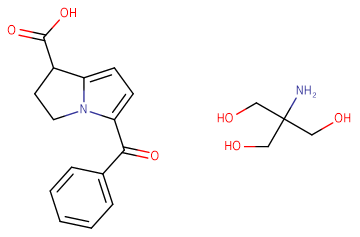
Toradol
CAS No. 74103-07-4
Toradol( Toradol )
Catalog No. M15828 CAS No. 74103-07-4
Ketorolac (Ketorolac tromethamine, Toradol) is a non-selective COX inhibitor with strong analgesic activity.
Purity : >98% (HPLC)
 COA
Datasheet
HNMR
HPLC
MSDS
Handing Instructions
COA
Datasheet
HNMR
HPLC
MSDS
Handing Instructions
| Size | Price / USD | Stock | Quantity |
| 500MG | 41 | In Stock |


|
| 1G | 71 | In Stock |
|
Biological Information
-
Product NameToradol
-
NoteResearch use only, not for human use.
-
Brief DescriptionKetorolac (Ketorolac tromethamine, Toradol) is a non-selective COX inhibitor with strong analgesic activity.
-
DescriptionKetorolac (Ketorolac tromethamine, Toradol) is a non-selective COX inhibitor with strong analgesic activity.(In Vitro):Ketorolac is a non-steroidal anti-inflammatory agent, acting as a nonselective COX inhibitor, with IC50s of 20 nM for COX-1 and 120 nM for COX-2.(In Vivo):Ketorolac tromethamine (0.4%) causes nearly complete inhibition on LPS endotoxin-induced increases in FITC-dextran in the anterior chamber, and increases in aqueous PGE2 concentrations in the aqueous humor in rabbits. Ketorolac (30 mg/kg, i.v.) rapidly reverses hyperalgesia in rats. Ketorolac also reduces carrageenan-induced hyperalgesia and paw PG production, and causes reduction in PGE2 levels in rats. Ketorolac (4 mg/kg/day, p.o.) has no detrimental effect in the volume fraction of bone trabeculae formed inside the alveolar socket in rats. Ketorolac (60 μg/10 μL) reduces the histological changes such as ischemic cell death, including cytoplasmic eosinophilia with disintegration of cytoarchitecture and nuclear pyknosis in rats. Ketorolac also effectively reduces neuronal death and improves hindlimb motor function, and the long-term survival is similar to that in the control group.
-
In VitroKetorolac is a non-steroidal anti-inflammatory agent, acting as a nonselective COX inhibitor, with IC50s of 20 nM for COX-1 and 120 nM for COX-2.
-
In VivoKetorolac tromethamine (0.4%) causes nearly complete inhibition on LPS endotoxin-induced increases in FITC-dextran in the anterior chamber, and increases in aqueous PGE2 concentrations in the aqueous humor in rabbits.Ketorolac (30 mg/kg, i.v.) rapidly reverses hyperalgesia in rats. Ketorolac also reduces carrageenan-induced hyperalgesia and paw PG production, and causes reduction in PGE2 levels in rats. Ketorolac (4 mg/kg/day, p.o.) has no detrimental effect in the volume fraction of bone trabeculae formed inside the alveolar socket in rats. Ketorolac (60 μg/10 μL) reduces the histological changes such as ischemic cell death, including cytoplasmic eosinophilia with disintegration of cytoarchitecture and nuclear pyknosis in rats. Ketorolac also effectively reduces neuronal death and improves hindlimb motor function, and the long-term survival is similar to that in the control group.
-
SynonymsToradol
-
PathwayChromatin/Epigenetic
-
TargetCOX
-
RecptorCOX-1| COX-2
-
Research AreaInflammation/Immunology
-
Indication——
Chemical Information
-
CAS Number74103-07-4
-
Formula Weight376.4
-
Molecular FormulaC19H24N2O6
-
Purity>98% (HPLC)
-
SolubilityEthanol: 75 mg/mL warmed (293.8 mM); DMSO: 75 mg/mL (293.8 mM)
-
SMILESO=C(C1C2=CC=C(C(C3=CC=CC=C3)=O)N2CC1)O.OCC(CO)(N)CO
-
Chemical Name2-amino-2-(hydroxymethyl)propane-1,3-diol 5-benzoyl-2,3-dihydro-1H-pyrrolizine-1-carboxylate
Shipping & Storage Information
-
Storage(-20℃)
-
ShippingWith Ice Pack
-
Stability≥ 2 years
Reference
1.Hocherl K, et al. Am J Physiol Renal Physiol. 2002 Aug;283(2):F294-30
molnova catalog



related products
-
sphondin
Sphondin has anticonvulsant anti-inflammatory and anti-proliferative activities it possessed an inhibitory effect on IL-1beta-induced increase in the level of COX-2 protein and PGE(2) release in A549 cells.
-
Emapalumab
Emapalumab (NI-0501) is an IgG1 monoclonal antibody that humanizes human monoclonal antibodies against interferon gamma, blocking its binding to cell surface receptors and activating inflammatory signaling.
-
Ampiroxicam
The prodrug of piroxicam that is a nonsteroidal anti-inflammatory drug (NSAID).
