


 Cart
Cart
 sales@molnova.com



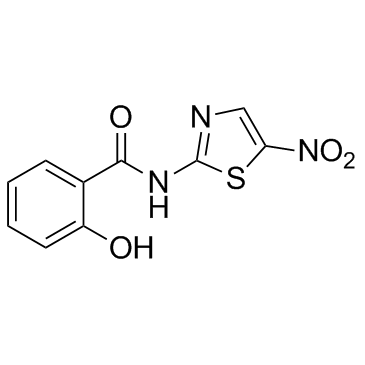
Tizoxanide
CAS No. 173903-47-4
Tizoxanide( NSC697856 | Tizoxanide | Desacetylnitazoxanide | Desacetyl-nitazoxanide )
Catalog No. M12638 CAS No. 173903-47-4
Tizoxanide is the main metabolite of nitazoxanide, which is a synthetic nitrothiazolyl-salicylamide derivative and an antiprotozoal agent.
Purity : >98% (HPLC)
 COA
Datasheet
HNMR
HPLC
MSDS
Handing Instructions
COA
Datasheet
HNMR
HPLC
MSDS
Handing Instructions
| Size | Price / USD | Stock | Quantity |
| 5MG | 41 | In Stock |


|
| 10MG | 65 | In Stock |
|
| 25MG | 133 | In Stock |
|
| 50MG | 210 | In Stock |
|
| 100MG | 311 | In Stock |
|
| 200MG | Get Quote | In Stock |
|
| 500MG | Get Quote | In Stock |
|
| 1G | Get Quote | In Stock |
|
Biological Information
-
Product NameTizoxanide
-
NoteResearch use only, not for human use.
-
Brief DescriptionTizoxanide is the main metabolite of nitazoxanide, which is a synthetic nitrothiazolyl-salicylamide derivative and an antiprotozoal agent.
-
DescriptionTizoxanide is the main metabolite of nitazoxanide, which is a synthetic nitrothiazolyl-salicylamide derivative and an antiprotozoal agent.Parasite Infection Approved(In Vitro):Tizoxanide (TIZ) induces mild mitochondrial uncoupling and activate AMPK in hepatocytes.Tizoxanide (TIZ) inhibits hepatitis C virus (HCV) replication in HCV replicon systems.(In Vivo):Tizoxanide (TIZ) (10 mg/kg; i.v.) can pass the BBB and distribute to the brain tissue. Tizoxanide retains in brain is obviously longer than that in plasma.
-
In VitroTizoxanide (TIZ)induces mild mitochondrial uncoupling and activate AMPK in hepatocytes.Tizoxanide (TIZ)inhibits hepatitis C virus (HCV) replication in HCV replicon systems.Cell Viability Assay Cell Line:HepG2 cells Concentration:1-25 μmol/L Incubation Time:24 h Result:Induced mitochondrial uncoupling and AMPK activation not due to the non-specific cytotoxicity in HepG2 cells at concentrations less than 25 μmol/L. Immunofluorescence Cell Line:HepG2 cells Concentration:10 μmol/L Incubation Time:24 h Result:Promoted the nuclear translocation of TFEB by activating AMPK in HepG2 cells.RT-PCR Cell Line:HepG2 cells Concentration:1-25 μmol/L Incubation Time:24 h Result:Induced the increase transcription of SQSTM1/P62 in HepG2 cells.Western Blot Analysis Cell Line:HepG2 cells Concentration:1-25 μmol/L Incubation Time:24 h Result:Activated AMPK and increased phosphorylation of ACC in HepG2 cells.Cell Cytotoxicity Assay Cell Line:RP7 cells, NTZ-11 and TIZ-9 cell lines Concentration:The initial drug concentration was 0.02 μM, followed by 0.05, 0.1, 0.5, and 1 μM, and subsequent weekly increases of 1 μM until a final concentration of 11 μM.Incubation Time:3 days Result:Againsted HCV replication in RP7 cells (IC50: 0.16), NTZ-11 (IC50:1.2) and TIZ-9 cell lines (IC50: 1.5)
-
In VivoTizoxanide (TIZ)(10 mg/kg; i.v.) can pass the BBB and distribute to the brain tissue. Tizoxanide retains in brain is obviously longer than that in plasma. Animal Model:Sprague Dawley rats Dosage:10 mg/kg Administration:Tizoxanide (10 mg/kg; i.v.)Result:Could pass the BBB and distribute to the brain tissue.
-
SynonymsNSC697856 | Tizoxanide | Desacetylnitazoxanide | Desacetyl-nitazoxanide
-
PathwayGPCR/G Protein
-
TargetAntibacterial
-
RecptorAntiviral
-
Research AreaInfection
-
IndicationParasite Infection
Chemical Information
-
CAS Number173903-47-4
-
Formula Weight265.2453
-
Molecular FormulaC10H7N3O4S
-
Purity>98% (HPLC)
-
SolubilityDMSO: ≥ 38 mg/mL
-
SMILESO=C(NC1=NC=C([N+]([O-])=O)S1)C2=CC=CC=C2O
-
Chemical NameBenzamide, 2-hydroxy-N-(5-nitro-2-thiazolyl)-
Shipping & Storage Information
-
Storage(-20℃)
-
ShippingWith Ice Pack
-
Stability≥ 2 years
Reference
1. Dubreuil L, et al. Antimicrob Agents Chemother. 1996 Oct;40(10):2266-70.
2. Gargala G, et al. J Antimicrob Chemother. 2000 Jul;46(1):57-60.
3. Adagu IS, et al. J Antimicrob Chemother. 2002 Jan;49(1):103-11.
4. Pankuch GA, et al. Antimicrob Agents Chemother. 2006 Mar;50(3):1112-7.
molnova catalog



related products
-
Sodium citrate dihyd...
Sodium citrate dihydrate is an anticoagulant, and also used as a buffer and food preservatives.
-
Buramate
Buramate is an antipsychotic and anticonvulsant.
-
LED-209
LED-209 is a bacterial conserved membrane histidine sensor kinase QseC inhibitor.
