


 Cart
Cart
 sales@molnova.com



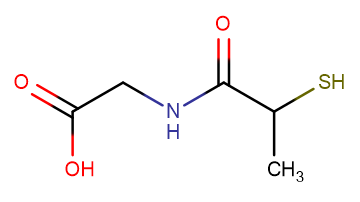
Tiopronin
CAS No. 1953-02-2
Tiopronin( BRN 1859822 | (±)-Tiopronin )
Catalog No. M13057 CAS No. 1953-02-2
Tiopronin (trade name Thiola) is a prescription thiol drug used to control the rate of cystine precipitation and excretion in the disease cystinuria.
Purity : >98% (HPLC)
 COA
Datasheet
HNMR
HPLC
MSDS
Handing Instructions
COA
Datasheet
HNMR
HPLC
MSDS
Handing Instructions
| Size | Price / USD | Stock | Quantity |
| 50MG | 38 | In Stock |


|
| 100MG | 53 | In Stock |
|
| 200MG | 76 | In Stock |
|
| 500MG | Get Quote | In Stock |
|
| 1G | Get Quote | In Stock |
|
Biological Information
-
Product NameTiopronin
-
NoteResearch use only, not for human use.
-
Brief DescriptionTiopronin (trade name Thiola) is a prescription thiol drug used to control the rate of cystine precipitation and excretion in the disease cystinuria.
-
DescriptionTiopronin (trade name Thiola) is a prescription thiol drug used to control the rate of cystine precipitation and excretion in the disease cystinuria. Due to the rarity of the disorder, tioronin falls under the classification of an orphan drug.(In Vitro):In in vitro Von Hippel-Lindau protein binding assay, the inhibitory effect of Tiopronin (NMPG) on HPH-2 was attenuated by escalating dose of ascorbate but not 2-ketoglutarate, cofactors of the enzyme.(In Vivo):Tiopronin (NMPG) alleviates colonic injury and effectively lowered myeloperoxidase activity. Moreover, NMPG substantially attenuates expression of pro-inflammatory mediators in the inflamed colon. NMPG induces hypoxia-inducible factor-1α (HIF-1α) in human colon carcinoma cells, leading to elevated secretion of vascular endothelial growth factor (VEGF), a target gene product of HIF-1 involved in ulcer healing of gastrointestinal mucosa. NMPG induces HIF-1α occurred by inhibiting HIF prolyl hydroxylase-2 (HPH-2), an enzyme that plays a major role in negatively regulating HIF-1α protein stability.
-
In VitroIn in vitro Von Hippel-Lindau protein binding assay, the inhibitory effect of Tiopronin (NMPG) on HPH-2 was attenuated by escalating dose of ascorbate but not 2-ketoglutarate, cofactors of the enzyme.
-
In VivoTiopronin (NMPG) alleviates colonic injury and effectively lowered myeloperoxidase activity. Moreover, NMPG substantially attenuates expression of pro-inflammatory mediators in the inflamed colon. NMPG induces hypoxia-inducible factor-1α (HIF-1α) in human colon carcinoma cells, leading to elevated secretion of vascular endothelial growth factor (VEGF), a target gene product of HIF-1 involved in ulcer healing of gastrointestinal mucosa. NMPG induces HIF-1α occurred by inhibiting HIF prolyl hydroxylase-2 (HPH-2), an enzyme that plays a major role in negatively regulating HIF-1α protein stability.
-
SynonymsBRN 1859822 | (±)-Tiopronin
-
PathwayOthers
-
TargetOther Targets
-
RecptorOthers
-
Research AreaMetabolic Disease
-
Indication——
Chemical Information
-
CAS Number1953-02-2
-
Formula Weight163.19
-
Molecular FormulaC5H9NO3S
-
Purity>98% (HPLC)
-
SolubilityEthanol: 32 mg/mL (196.09 mM); Water: 32 mg/mL (196.09 mM); DMSO: 32 mg/mL (196.09 mM)
-
SMILESO=C(O)CNC(C(S)C)=O
-
Chemical NameGlycine, N-(2-mercapto-1-oxopropyl)- (9CI)
Shipping & Storage Information
-
Storage(-20℃)
-
ShippingWith Ice Pack
-
Stability≥ 2 years
Reference
1.Zheng Z, et al. Ren Fail. 2014 Oct;36(9):1455-60.
molnova catalog



related products
-
Atacicept
Atacicept (TACI-Ig) is a homodimeric fusion protein that inhibits B-cell stimulation by binding to B-lymphocyte stimulatory factors and proliferation-inducing ligands, and can be used in the study of systemic lupus erythematosus, lupus nephritis, rheumatoid arthritis, multiple sclerosis, and various B-cell malignancies.
-
Marginatoxin
Marginatoxin may be a promising chemopreventive agent for treating hepatocellular carcinoma, it induces human hepatoma BEL-7402 cells apoptosis in vitro and in vivo via activation of Fas/FasL-mediated apoptotic pathway.
-
6-O-acetylsaikosapon...
6''-O-acetylsaikosaponin A is an acetyl saikosaponin isolated from the roots of Bupleurum chinense. Itshows some osteoclast-inhibiting activities.
