


 Cart
Cart
 sales@molnova.com



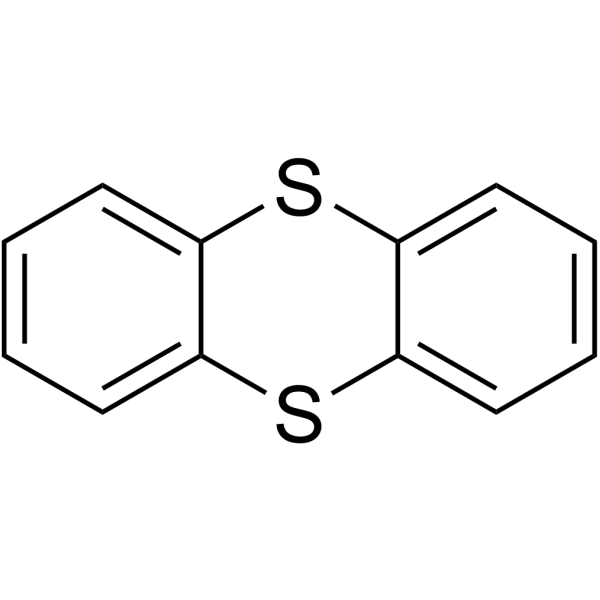
Thianthrene
CAS No. 92-85-3
Thianthrene( AI3-00638 | 9,10-Dithiaanthracene | dibenzo-1,4-dithiin | NSC 439 | NSC-439 | Dibenzodithiodioxane )
Catalog No. M27242 CAS No. 92-85-3
Thianthrene is a sulfur-containing heterocyclic chemical compound that is a derivative of the parent heterocycle called dithiin and is easy to oxidize.
Purity : >98% (HPLC)
 COA
Datasheet
HNMR
HPLC
MSDS
Handing Instructions
COA
Datasheet
HNMR
HPLC
MSDS
Handing Instructions
| Size | Price / USD | Stock | Quantity |
| 1G | 26 | In Stock |


|
Biological Information
-
Product NameThianthrene
-
NoteResearch use only, not for human use.
-
Brief DescriptionThianthrene is a sulfur-containing heterocyclic chemical compound that is a derivative of the parent heterocycle called dithiin and is easy to oxidize.
-
DescriptionThianthrene is a sulfur-containing heterocyclic chemical compound that is a derivative of the parent heterocycle called dithiin and is easy to oxidize.
-
In Vitro——
-
In Vivo——
-
SynonymsAI3-00638 | 9,10-Dithiaanthracene | dibenzo-1,4-dithiin | NSC 439 | NSC-439 | Dibenzodithiodioxane
-
PathwayOthers
-
TargetOther Targets
-
RecptorAcetyl-CoA Carboxylase
-
Research Area——
-
Indication——
Chemical Information
-
CAS Number92-85-3
-
Formula Weight216.32
-
Molecular FormulaC12H8S2
-
Purity>98% (HPLC)
-
Solubility——
-
SMILESS1c2ccccc2Sc2ccccc12
-
Chemical Name——
Shipping & Storage Information
-
Storage(-20℃)
-
ShippingWith Ice Pack
-
Stability≥ 2 years
Reference
1.Wu WZ, Shan ZJ, Kong Y, He J. Degradation and adsorption of tralkoxydim in Chinese soils and water-sediment environments. Environ Monit Assess. 2017 Jun;189(6):273. doi: 10.1007/s10661-017-5984-5. Epub 2017 May 17. PubMed PMID: 28516406.
molnova catalog



related products
-
Fibronectin Adhesion...
Fibronectin Adhesion-promoting Peptide (Heparin Binding Peptide) is one of the heparin-binding amino acid sequences found in the carboxy-terminal heparin-binding domain of fibronectin. It promotes assembly of mesenchymal stem cell (MSC) spheroids into larger aggregates.
-
Senkyunolide I
Senkyunolide I has neuroprotective effect, associated with its anti-oxidation and anti-apoptosis properties.
-
C-Peptide, dog
C-Peptide, dog is a component of proinsulin, released from pancreatic beta cells into blood together with insulin. The C-peptide of proinsulin is important for the biosynthesis of insulin but has for a long time been considered to be biologically inert.
