


 Cart
Cart
 sales@molnova.com



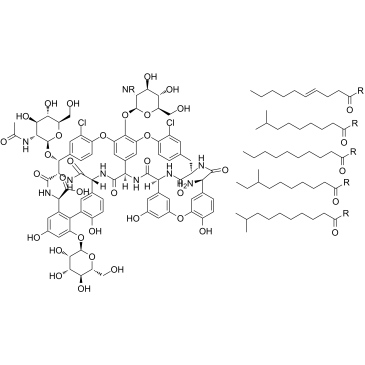
Teicoplanin
CAS No. 61036-62-2
Teicoplanin( Antibiotic 8327A | Antibiotic MDL 507 | MDL 507 )
Catalog No. M15294 CAS No. 61036-62-2
Teicoplanin is a semisynthetic glycopeptide antibiotic used in the prophylaxis and treatment of serious infections caused by Gram-positive bacteria.
Purity : >98% (HPLC)
 COA
Datasheet
HNMR
HPLC
MSDS
Handing Instructions
COA
Datasheet
HNMR
HPLC
MSDS
Handing Instructions
| Size | Price / USD | Stock | Quantity |
| 25MG | 40 | In Stock |


|
| 50MG | 53 | In Stock |
|
| 100MG | 80 | In Stock |
|
| 200MG | Get Quote | In Stock |
|
| 500MG | Get Quote | In Stock |
|
| 1G | Get Quote | In Stock |
|
Biological Information
-
Product NameTeicoplanin
-
NoteResearch use only, not for human use.
-
Brief DescriptionTeicoplanin is a semisynthetic glycopeptide antibiotic used in the prophylaxis and treatment of serious infections caused by Gram-positive bacteria.
-
DescriptionTeicoplanin is a semisynthetic glycopeptide antibiotic used in the prophylaxis and treatment of serious infections caused by Gram-positive bacteria, including Methicillin-resistant Staphylococcus aureus and Enterococcus faecalis.
-
In Vitro——
-
In VivoAnimal Model:20-30 g, Male CD1 mice (2?*?106 cfu/mL MRSA (43?300) 50 μL; murine thigh infection model)Dosage:10, 30 mg/kg Administration:I.v.; once every 12?h Result:Showed a dose-dependent decline in the total bacterial density with the total bactericidal effect was achieved with dosages of ≥10?mg/kg/day and suppression of resistance with dosages ≥30?mg/kg/day.
-
SynonymsAntibiotic 8327A | Antibiotic MDL 507 | MDL 507
-
PathwayOthers
-
TargetOther Targets
-
RecptorOthers
-
Research AreaInfection
-
Indication——
Chemical Information
-
CAS Number61036-62-2
-
Formula Weight1709.39
-
Molecular FormulaC77H77N5O31CI2R
-
Purity>98% (HPLC)
-
SolubilityWater: 100 mg/mL (58.5 mM)
-
SMILESCCCCCCCCC/C(O)=N/[C@]([C@@](OC1=C2C=C([C@](/N=C(O)\[C@](/N=C(O)/[C@@](/N=C(O)\[C@@](N)([H])C3=CC4=C(O)C=C3)([H])CC5=CC(Cl)=C(O2)C=C5)([H])C6=CC(O)=CC(O4)=C6)([H])/C(O)=N/[C@](/C(O)=N/7)([H])C8=CC(C9=C([C@@]%10([H])C(O)=O)C=C(O)C=C9OC%11([H])[C@](O)([H])[C@](O)([H])[C@@](O)([H])[C@@](O%11)([H])CO)=C(O)C=C8)C=C1OC%12=C(Cl)C=C([C@](O[C@@]%13([H])[C@@](/N=C(O)/C)([H])[C@](O)([H])[C@@](O)([H])[C@@](O%13)([H])CO)([H])[C@@]7([H])/C(O)=N/%10)C=C%12)([H])O%14)([H])[C@](O)([H])[C@@](O)([H])[C@@]%14([H])CO
-
Chemical Name34-O-[2-(acetylamino)-2-deoxy-.beta.-D-glucopyranosyl]-22,31-dichloro-7-demethyl-64-O-demethyl-19-deoxy-56-O-[2-deoxy-2-[(8-methyl-1-oxononyl)amino]-.beta.-D-glucopyranosyl]-42-O-.alpha.-D-mannopyranosyl-
Shipping & Storage Information
-
Storage(-20℃)
-
ShippingWith Ice Pack
-
Stability≥ 2 years
Reference
1.Bereczki I, et al. Bioorg Med Chem Lett. 2014 Aug 1;24(15):3251-4.
molnova catalog



related products
-
Senecioic acid
Senecioic acid appears in the urine of patients with 3-Methylcrotonic aciduria which is a disorder characterized by urine that contains increased amounts of 3-methylcrotonic acid (Senecioic acid).
-
(Z)-Tenilapine
(Z)-Tenilapine is trans-Tenilapine, cis-Tenilapine has sedative activity.
-
Safflower-yellow
Safflower yellow is extracted from the flowers of the plant safflower (Carthamus tinctorius) and as the traditional Chinese medicine it has been extensively used for the treatment of cardio cerebrovascular diseases.
