


 Cart
Cart
 sales@molnova.com



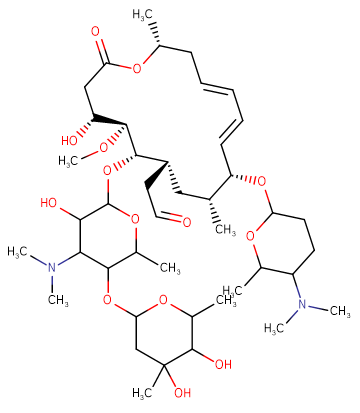
Spiramycin
CAS No. 8025-81-8
Spiramycin( Formacidine | NSC 55926 | Rovamycine )
Catalog No. M16005 CAS No. 8025-81-8
A macrolide antibiotic produced by Streptomyces ambofaciens.
Purity : >98% (HPLC)
 COA
Datasheet
HNMR
HPLC
MSDS
Handing Instructions
COA
Datasheet
HNMR
HPLC
MSDS
Handing Instructions
| Size | Price / USD | Stock | Quantity |
| 100MG | 50 | In Stock |


|
| 200MG | Get Quote | In Stock |
|
| 500MG | Get Quote | In Stock |
|
| 1G | Get Quote | In Stock |
|
Biological Information
-
Product NameSpiramycin
-
NoteResearch use only, not for human use.
-
Brief DescriptionA macrolide antibiotic produced by Streptomyces ambofaciens.
-
DescriptionA macrolide antibiotic produced by Streptomyces ambofaciens. The drug is effective against gram-positive aerobic pathogens, N. gonorrhoeae, and staphylococci. It is used to treat infections caused by bacteria and Toxoplasma gondii. (In Vitro):Spiramycin (24 hours; 1-1000 μM; T. gondii infected HeLa cells and HeLa cells) treatment reduces the cytotoxicity, and shows anti-Toxoplasma gondii activity, with IC50 values of 189 μM for HeLa cells; and 262 μM for T. gondii-infected HeLa cells.(In Vivo):Spiramycin (100 mg/kg; intraperitoneal injection; every day; for 4 days; female KM mice) treatment reduces the number of tachyzoites, and reduces hepatotoxicity and significantly enhances antioxidative effects. Spiramycin treatment also decreases in the degree of granulomatous inflammation in the liver.
-
In VitroSpiramycin (24 hours; 1-1000 μM; T. gondii infected HeLa cells and HeLa cells) treatment reduces the cytotoxicity, and shows anti-Toxoplasma gondii activity, with IC50 values of 189 μM for HeLa cells; and 262 μM for T. gondii-infected HeLa cells. Cell Cytotoxicity Assay Cell Line:T. gondii infected HeLa cells and HeLa cells Concentration:1-1000 μM Incubation Time:24 hours Result:Reduced the cytotoxicity.
-
In VivoSpiramycin (100 mg/kg; intraperitoneal injection; every day; for 4 days; female KM mice) treatment reduces the number of tachyzoites, and reduces hepatotoxicity and significantly enhances antioxidative effects. Spiramycin treatment also decreases in the degree of granulomatous inflammation in the liver. Animal Model:36 female KM mice with T.gondiiDosage:100 mg/kgAdministration:Intraperitoneal injection; every day; for 4 daysResult:The number of tachyzoites was significantly reduced. Reduced hepatotoxicity and significantly enhanced antioxidative effects. Granuloma and cyst formation were inhibitied.
-
SynonymsFormacidine | NSC 55926 | Rovamycine
-
PathwayOthers
-
TargetOther Targets
-
RecptorOthers
-
Research AreaOther Indications
-
Indication——
Chemical Information
-
CAS Number8025-81-8
-
Formula Weight843.07
-
Molecular FormulaC43H74N2O14
-
Purity>98% (HPLC)
-
SolubilityEthanol: 100 mg/mL (118.61 mM); DMSO: 100 mg/mL (118.61 mM)
-
SMILESC[C@@H]1C/C=C/C=C/[C@@H]([C@@H](C[C@@H]([C@@H]([C@H]([C@@H](CC(=O)O1)O)OC)OC2C(C(C(C(O2)C)OC3CC(C(C(O3)C)O)(C)O)N(C)C)O)CC=O)C)OC4CCC(C(O4)C)N(C)C
-
Chemical Name——
Shipping & Storage Information
-
Storage(-20℃)
-
ShippingWith Ice Pack
-
Stability≥ 2 years
Reference
1.Poulsen SM, et al. J Mol Biol, 2000, 304(3), 471-48
molnova catalog



related products
-
Pipecolinic acid
Pipecolic acid a metabolite of lysine found in human physiological fluids such as urine plasma and CSF is an important regulator of immunity in plants and humans alike.
-
(-)-JNJ-A07
(-)-JNJ-A07 is a selective and potent dengue virus (DENV) inhibitor with an EC50 of 31 nM, exhibiting significant antiviral activity for the study of dengue virus infections.
-
(E)-Coniferin
(E)-Coniferin is the isomer of Coniferin. Coniferin is a glucoside of coniferyl alcohol. Coniferin inhibits?fungal?growth and melanization.
