


 Cart
Cart
 sales@molnova.com



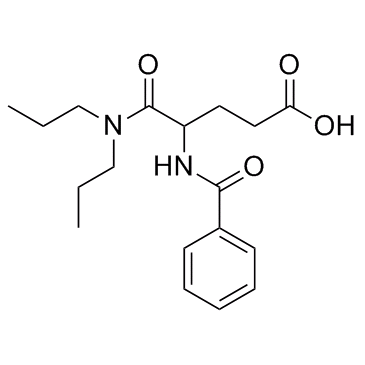
Proglumide
CAS No. 6620-60-6
Proglumide( Proglumide | W 5219 | W-5219 | CR 242 )
Catalog No. M15522 CAS No. 6620-60-6
Proglumide (Milid) is a drug that inhibits gastrointestinal motility and reduces gastric secretions.
Purity : >98% (HPLC)
 COA
Datasheet
HNMR
HPLC
MSDS
Handing Instructions
COA
Datasheet
HNMR
HPLC
MSDS
Handing Instructions
| Size | Price / USD | Stock | Quantity |
| 25MG | 30 | In Stock |


|
| 50MG | 42 | In Stock |
|
| 100MG | 80 | In Stock |
|
| 200MG | 109 | In Stock |
|
| 500MG | Get Quote | In Stock |
|
| 1G | Get Quote | In Stock |
|
Biological Information
-
Product NameProglumide
-
NoteResearch use only, not for human use.
-
Brief DescriptionProglumide (Milid) is a drug that inhibits gastrointestinal motility and reduces gastric secretions.
-
DescriptionProglumide (Milid) is a drug that inhibits gastrointestinal motility and reduces gastric secretions. It acts as a cholecystokinin antagonist, which blocks both the CCKA and CCKB subtypes. It was used mainly in the treatment of stomach ulcers. (In Vitro):In an in vitro study, Proglumide at concentrations between 0.3-10 mM inhibits CCK-stimulated amylase release dose-dependently, while Proglumide does not influence the basal amylase release at concentrations between 0-3 mM. Dose-response curves to CCK for amylase release shifted to the right with increase in Proglumide concentration. This inhibition by Proglumide is reversible. In addition, the effect of Proglumide is selective for CCK and its related peptide.The incubation of HT29 cells with Proglumide significantly reduces the [3H]-thymidine incorporation to HT29 cells in a dose-dependent manner, with an IC50 of 6.5 mM. Proglumide reduces in a dose-dependent manner the percentage of necrosis with a parallel increase of apoptosis up to 70%.(In Vivo):Proglumide (250-750?mg/kg; intraperitoneal injection; adult male Sprague Dawley rats) treatment is significantly effective in ameliorating the seizure activities, cognitive dysfunctions, and cerebral oxidative stress.
-
In VitroIn an in vitro study, Proglumide at concentrations between 0.3-10 mM inhibits CCK-stimulated amylase release dose-dependently, while Proglumide does not influence the basal amylase release at concentrations between 0-3 mM. Dose-response curves to CCK for amylase release shifted to the right with increase in Proglumide concentration. This inhibition by Proglumide is reversible. In addition, the effect of Proglumide is selective for CCK and its related peptide.The incubation of HT29 cells with Proglumide significantly reduces the [3H]-thymidine incorporation to HT29 cells in a dose-dependent manner, with an IC50 of 6.5 mM. Proglumide reduces in a dose-dependent manner the percentage of necrosis with a parallel increase of apoptosis up to 70%.
-
In VivoProglumide (250-750?mg/kg; intraperitoneal injection; adult male Sprague Dawley rats) treatment is significantly effective in ameliorating the seizure activities, cognitive dysfunctions, and cerebral oxidative stress. Animal Model:Adult male Sprague Dawley rats (200-250?g; 2 months old) are induced status epilepticus (SE)Dosage:250 mg/kg, 500 mg/kg, and 750?mg/kg Administration:Intraperitoneal injection Result:Dose-dependently and significantly increased the latencies to seizure and SE. Significantly and dose-dependently attenuated Li-PC (SE) induced increase in thiobarbituric acid (TBARS) and catalase (CAT), attenuated Li-Pc induced decrease in SOD, and attenuated depletion of GSH and glutathione-S transferase (GST) in the hippocampus and striatum.
-
SynonymsProglumide | W 5219 | W-5219 | CR 242
-
PathwayGPCR/G Protein
-
TargetCholecystokinin Receptor
-
RecptorCCK
-
Research Area——
-
Indication——
Chemical Information
-
CAS Number6620-60-6
-
Formula Weight334.42
-
Molecular FormulaC18H26N2O4
-
Purity>98% (HPLC)
-
SolubilityDMSO: 10 mM
-
SMILESO=C(O)CCC(NC(C1=CC=CC=C1)=O)C(N(CCC)CCC)=O
-
Chemical NamePentanoic acid, 4-(benzoylamino)-5-(dipropylamino)-5-oxo-, (+-)-
Shipping & Storage Information
-
Storage(-20℃)
-
ShippingWith Ice Pack
-
Stability≥ 2 years
Reference
1.Bunney BS,et al. Ann N Y Acad Sci. 1985;448:345-5
molnova catalog



related products
-
Spiroglumide
Spiroglumide, a CCKB-gastrin antagonist that inhibits dose-dependent pentagastrin-induced acid hypersecretion with an ID50 of 20.1 (8.67-46.4) mg / kg, could be used to explore the physiological role of gastrin in the regulation of human gastric acid secretion.
-
Lorglumide sodium sa...
Lorglumide sodium salt is a potent cholecystokinin (CCK) receptor antagonist.
-
Methyl Linoleate
Methyl linoleate has antioxidant activity.
