


 Cart
Cart
 sales@molnova.com



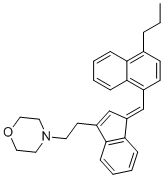
PrNMI
CAS No. 1541244-33-0
PrNMI( —— )
Catalog No. M12180 CAS No. 1541244-33-0
PrNMI is a peripherally restricted cannabinoid 1 receptor (CB1R) agonist.
Purity : >98% (HPLC)
 COA
Datasheet
HNMR
HPLC
MSDS
Handing Instructions
COA
Datasheet
HNMR
HPLC
MSDS
Handing Instructions
| Size | Price / USD | Stock | Quantity |
| 5MG | 745 | Get Quote |


|
| 10MG | 1017 | Get Quote |
|
| 25MG | 1431 | Get Quote |
|
| 50MG | 1782 | Get Quote |
|
| 100MG | 2250 | Get Quote |
|
| 200MG | Get Quote | Get Quote |
|
| 500MG | Get Quote | Get Quote |
|
| 1G | Get Quote | Get Quote |
|
Biological Information
-
Product NamePrNMI
-
NoteResearch use only, not for human use.
-
Brief DescriptionPrNMI is a peripherally restricted cannabinoid 1 receptor (CB1R) agonist.
-
DescriptionPrNMI is a peripherally restricted cannabinoid 1 receptor (CB1R) agonist, significantly alleviates spontaneous pain behaviors in the animals.
-
In Vitro——
-
In Vivo——
-
Synonyms——
-
PathwayGPCR/G Protein
-
TargetCannabinoid Receptor
-
RecptorCannabinoid Receptor
-
Research Area——
-
Indication——
Chemical Information
-
CAS Number1541244-33-0
-
Formula Weight409.573
-
Molecular FormulaC29H31NO
-
Purity>98% (HPLC)
-
Solubility——
-
SMILES——
-
Chemical Name4-{2-[-(1E)-1[(4-propylnaphthalen-1-yl)methylidene]-1H-inden-3-yl]ethyl}morpholine
Shipping & Storage Information
-
Storage(-20℃)
-
ShippingWith Ice Pack
-
Stability≥ 2 years
Reference
1. Zhang H, et al. Pain. 2018 May 16. doi: 10.1097/j.pain.0000000000001278.
molnova catalog



related products
-
AM-1221
A potent and selective agonist for the cannabinoid receptor CB1 with Ki of 0.28 nM, 180-fold selectivity over CB2.
-
AM-2201
A synthetic cannabinoid that acts as a potent, nonselective full agonist for the cannabinoid receptor with EC50 of 38 and 58 nM for CB1 and CB2, respectively.
-
CB2R PAM
CB2R PAM is an orally active cannabinoid type 2 receptor (CB2Rs) positive allosteric modulator that enhances CP 55940 and 2-Arachidonylglycerol-stimulated [35S]GTPγS binding to CB2 receptors without affecting receptor activity in the absence of agonists.
