


 Cart
Cart
 sales@molnova.com



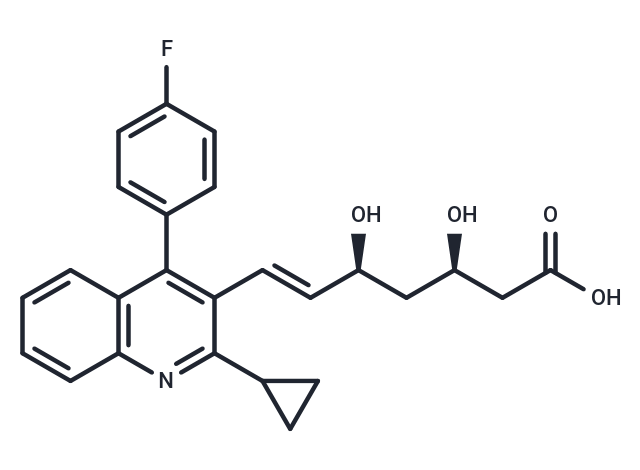
Pitavastatin
CAS No. 147511-69-1
Pitavastatin( —— )
Catalog No. M36352 CAS No. 147511-69-1
Pitavastatin (NK-104) is a potent inhibitor of hydroxymethylglutaryl-CoA (HMG-CoA) reductase, effectively inhibiting cholesterol synthesis from acetic acid in HepG2 cells with an IC50 of 5.8 nM.
Purity : >98% (HPLC)
 COA
Datasheet
HNMR
HPLC
MSDS
Handing Instructions
COA
Datasheet
HNMR
HPLC
MSDS
Handing Instructions
| Size | Price / USD | Stock | Quantity |
| 5MG | 922 | Get Quote |


|
| 25MG | 1398 | Get Quote |
|
| 50MG | 1822 | Get Quote |
|
| 500MG | Get Quote | Get Quote |
|
| 1G | Get Quote | Get Quote |
|
Biological Information
-
Product NamePitavastatin
-
NoteResearch use only, not for human use.
-
Brief DescriptionPitavastatin (NK-104) is a potent inhibitor of hydroxymethylglutaryl-CoA (HMG-CoA) reductase, effectively inhibiting cholesterol synthesis from acetic acid in HepG2 cells with an IC50 of 5.8 nM.
-
DescriptionPitavastatin (NK-104) is a potent hydroxymethylglutaryl-CoA (HMG-CoA) reductase inhibitor. Pitavastatin inhibits cholesterol synthesis from acetic acid with an IC50 of 5.8 nM in HepG2 cells. Pitavastatin is an efficient hepatocyte low-density lipoprotein-cholesterol (LDL-C) receptor inducer. Pitavastatin also possesses anti-atherosclerotic, anti-asthmatic, anti-osteoarthritis, antineoplastic, neuroprotective, hepatoprotective and reno-protective effects.
-
In VitroPitavastatin inhibits the growth of a panel of ovarian cancer cells, including those considered most likely to represent HGSOC, grown as a monolayers (IC50=0.4-5?μM) or as spheroids (IC50?=?0.6-4?μM).?Pitavastatin (1 μM; 48 hours) induces apoptosis, evidenced by the increased activity of executioner caspases-3,7 as well as caspase-8 and caspase-9 in?Ovcar-8 cells and Ovcar-3 cells.Pitavastatin (1?μM, 48?hours) causes PARP cleavage in Ovcar-8 cells.Pitavastatin (0.1 and 1 μM; 1 h, then cells incubate with TNF-α for 6 h) increases the expression of ICAM-1 mRNA through suppressing NF-κB pathway in TNF-α-stimulated human saphenous vein endothelial cells..Western Blot Analysis Cell Line:Ovcar-8 cells Concentration:1?μM Incubation Time:48 hours Result:Induced PARP cleavage.
-
In VivoPitavastatin (59?mg/kg; p.o.; twice daily for 28 days) causes significant tumour regression.Pitavastatin (0.1 mg/kg; p.o; daily for 12 weeks) retards the progression of atherosclerosis formation and improves NO bioavailability by eNOS up-regulation and decrease of O2- in diet induced severe hyperlipidemia rabbit model.Animal Model:4 week old female NCR Nu/Nu female mice?(bearing Ovcar-4 tumours)Dosage:59 mg/kg Administration:p.o.; twice daily for 28 days Result:Caused significant tumour regression.Animal Model:Female New Zealand white rabbits (diet induced severe hyperlipidemia)Dosage:0.1 mg/kg Administration:p.o; daily for 12 weeks Result:Retarded the progression of atherosclerosis formation and improved NO bioavailability by eNOS up-regulation and decrease of O2-.
-
Synonyms——
-
PathwayAutophagy
-
TargetAutophagy
-
RecptorAutophagy | HMG-CoA Reductase | Apoptosis | Mitophagy
-
Research Area——
-
Indication——
Chemical Information
-
CAS Number147511-69-1
-
Formula Weight421.46
-
Molecular FormulaC25H24FNO4
-
Purity>98% (HPLC)
-
SolubilityIn Vitro:?DMSO : 100 mg/mL (237.27 mM; Ultrasonic )
-
SMILESC(=C/[C@H](C[C@H](CC(O)=O)O)O)\C1=C(C2=C(N=C1C3CC3)C=CC=C2)C4=CC=C(F)C=C4
-
Chemical Name——
Shipping & Storage Information
-
Storage(-20℃)
-
ShippingWith Ice Pack
-
Stability≥ 2 years
Reference
1. Morikawa S, et al. Relative induction of mRNA for HMG CoA reductase and LDL receptor by five different HMG-CoA reductase inhibitors in cultured human cells. J Atheroscler Thromb. 2000;7(3):138-44.?
molnova catalog



related products
-
Talarozole
Talarozole is an oral systemic all-trans retinoic acid metabolism blocking agent (RAMBA). Talarozole inhibits both CYP26A1 and CYP26B1 with IC50s of 5.4 and 0.46 nM respectively.Talarozole for the treatment of acne psoriasis and other keratinization disorders.
-
Sulfuretin
Sulfuretin is a potent anti-oxidant, has protective effect against t-BHP-induced oxidative damage in human liver-derived HepG2 cells is attributable to its ability to scavenge ROS and up-regulate the activity of HO-1 through the Nrf2/ARE and JNK/ERK signaling pathways.
-
Indophagolin
Indophagolin is a potent, indoline-containing autophagy inhibitor with IC50 of 140 nM.?
