


 Cart
Cart
 sales@molnova.com



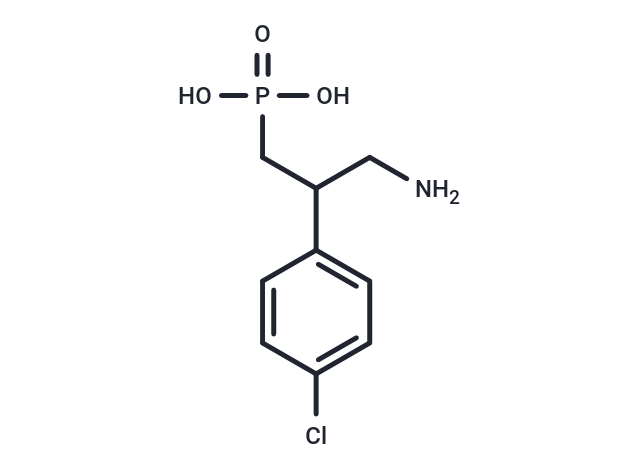
Phaclofen
CAS No. 114012-12-3
Phaclofen( —— )
Catalog No. M33907 CAS No. 114012-12-3
Phaclofen (3-Amino-2-(4-chlorophenyl)propanephosphonic acid) is a selective GABAB receptor antagonist, which can partially antagonize the sedative effect of (-)-baclofen, and reversibly antagonize the inhibition of cholinergic convulsive response of guinea pig ileum and distal colon by baclofen or GABA.
Purity : >98% (HPLC)
 COA
Datasheet
HNMR
HPLC
MSDS
Handing Instructions
COA
Datasheet
HNMR
HPLC
MSDS
Handing Instructions
| Size | Price / USD | Stock | Quantity |
| 2MG | 112 | Get Quote |


|
| 5MG | 170 | Get Quote |
|
| 10MG | 282 | Get Quote |
|
| 25MG | 632 | Get Quote |
|
| 50MG | 879 | Get Quote |
|
| 100MG | 1152 | Get Quote |
|
| 200MG | 1557 | Get Quote |
|
| 500MG | Get Quote | Get Quote |
|
| 1G | Get Quote | Get Quote |
|
Biological Information
-
Product NamePhaclofen
-
NoteResearch use only, not for human use.
-
Brief DescriptionPhaclofen (3-Amino-2-(4-chlorophenyl)propanephosphonic acid) is a selective GABAB receptor antagonist, which can partially antagonize the sedative effect of (-)-baclofen, and reversibly antagonize the inhibition of cholinergic convulsive response of guinea pig ileum and distal colon by baclofen or GABA.
-
DescriptionPhaclofen is a selective GABAB receptor antagonist. Phaclofen is a peripheral and central baclofen antagonist. Phaclofen maybe a potential compound in determining the physiological significance of central and peripheral bicuculline-insensitive receptors with which GABA and (-)-baclofen interact.
-
In VitroThe GABAB antagonist phaclofen (500 μM) partly prevents the effect of 1 μM of (R+) baclofen.
-
In VivoPhaclofen (2 mg/kg; i.p) shows that fewer neuropeptide Y-like immunoreactive fibers are detected in the stimulated cuneate nucleus. Phaclofen (2 mg/kg; s.c) antagonizes the effects of 6 mg/kg R(+) baclofen in dorsal striatum.Phaclofen (100 nmol; intrathecal injection) antagonizes the depressant effect of baclofen. Phaclofen (100 nmol) is devoid of stimulatory or depressant effects on spinal reflexes.Animal Model:Sprague–Dawley rats (180–250 g)Dosage:2 mg/kg Administration:I.p.Result:Fewer neuropeptide Y-like immunoreactive fibers were detected in the stimulated cuneate nucleus.Animal Model:Male Wistar rats (280–320 g)Dosage:2 mg/kg Administration:S.c.Result:Antagonized the effects of 6 mg/kg R(+) baclofen in dorsal striatum.
-
Synonyms——
-
PathwayOthers
-
TargetOther Targets
-
RecptorGABA Receptor
-
Research Area——
-
Indication——
Chemical Information
-
CAS Number114012-12-3
-
Formula Weight249.63
-
Molecular FormulaC9H13ClNO3P
-
Purity>98% (HPLC)
-
SolubilityIn Vitro:?1M NaOH : 50 mg/mL (200.30 mM; Ultrasonic)DMSO : < 1 mg/mL (insoluble or slightly soluble)
-
SMILESO=P(O)(O)CC(C1=CC=C(Cl)C=C1)CN
-
Chemical Name——
Shipping & Storage Information
-
Storage(-20℃)
-
ShippingWith Ice Pack
-
Stability≥ 2 years
Reference
1.Johnson CM, et al. The antitussive cloperastine improves breathing abnormalities in a Rett Syndrome mouse model by blocking presynaptic GIRK channels and enhancing GABA release. Neuropharmacology. 2020;176:108214.?
molnova catalog



related products
-
8-Hydroxypinoresinol...
The barks of Eucommia ulmoides.
-
HO-PEG13-OH
HO-PEG13-OH is a PEG-based PROTAC linker that can be used in the synthesis of PROTACs.
-
Tilomisole
Tilomisole (Wy 18251) is an orally available benzimidazole thiazole with anti-inflammatory activity and immunomodulatory activity.Tilomisole is used in the study of cancer and inflammation.
