


 Cart
Cart
 sales@molnova.com



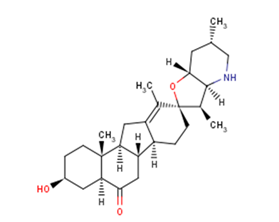
Peimisine
CAS No. 19773-24-1
Peimisine( Ebeiensine )
Catalog No. M18193 CAS No. 19773-24-1
Peimisine can affect M-receptor, excit β-receptor, restrain the release of internal calcium, and promote to releaseing nitrogen monoxidum in order to relax tracheal smooth muscle and relieve asthma.
Purity : >98% (HPLC)
 COA
Datasheet
HNMR
HPLC
MSDS
Handing Instructions
COA
Datasheet
HNMR
HPLC
MSDS
Handing Instructions
| Size | Price / USD | Stock | Quantity |
| 1 mL x 10 mM in DMSO | 102 | In Stock |


|
| 5MG | 79 | In Stock |
|
| 10MG | 113 | In Stock |
|
| 25MG | 193 | In Stock |
|
| 50MG | 276 | In Stock |
|
| 100MG | 410 | In Stock |
|
| 200MG | Get Quote | In Stock |
|
| 500MG | Get Quote | In Stock |
|
| 1G | Get Quote | In Stock |
|
Biological Information
-
Product NamePeimisine
-
NoteResearch use only, not for human use.
-
Brief DescriptionPeimisine can affect M-receptor, excit β-receptor, restrain the release of internal calcium, and promote to releaseing nitrogen monoxidum in order to relax tracheal smooth muscle and relieve asthma.
-
DescriptionPeimisine can affect M-receptor, excit β-receptor, restrain the release of internal calcium, and promote to releaseing nitrogen monoxidum in order to relax tracheal smooth muscle and relieve asthma. Peimisine can attenuate lung tissue injury( ALI), LDH and MDA amount in ALI mice in a dose dependent manner, it also lower the total protein, total white blood cells, lymphocyte and neutrophilic leukocyte in bronchoalveolar lavage fluid( BALF); suggests that peimisine can play a protective role against LPS-induced acute lung injury. Peimisine has the protective effect on the experimental hepatic fibrosis formation, the possible mechanisms are associated with inhibiting fibrogenesis and fibrosis accumulation, and decreasing lipid peroxidation. Peimisine can inhibit angiotensin I converting enzyme activity in a dose-dependent manner, displaying 5 % inhibitory concentration values of 526.5 microM, thus, it may have antihypertensive action.
-
In VitroPeimisine (17.43-92.07 μg/mL; 72 h) shows significant cytotoxic effects.Peimisine (15 μg/mL; 24, 48 and 72 h) induces G0/G1 phase arrest and rising apoptosis rate. Apoptosis Analysis Cell Line:A2780 cells Concentration:15 μg/mL Incubation Time:24, 48 and 72 hours Result:Induced G0/G1 phase arrest of A2780 cells in a time-dependent manner.Cell Cytotoxicity Assay Cell Line:LLC, A2780, HepG2 and A549 cells Concentration:17.43-92.07 μg/mL Incubation Time:72 hours Result:Inhibited LLC, A2780, HepG2 and A549 cells with the IC50 values of 20.75 μg/mL, 17.43 μg/mL, 92.07 μg/mL, 36.11 μg/mL, respectively.
-
In Vivo——
-
SynonymsEbeiensine
-
PathwayGPCR/G Protein
-
TargetAntibacterial
-
RecptorOthers
-
Research AreaOthers-Field
-
Indication——
Chemical Information
-
CAS Number19773-24-1
-
Formula Weight427.62
-
Molecular FormulaC27H41NO3
-
Purity>98% (HPLC)
-
SolubilityIn Vitro:?DMSO : 12.5 mg/mL (29.23 mM)
-
SMILESCC1CC2C(C(C3(O2)CCC4C5CC(=O)C6CC(CCC6(C5CC4=C3C)C)O)C)NC1
-
Chemical Name——
Shipping & Storage Information
-
Storage(-20℃)
-
ShippingWith Ice Pack
-
Stability≥ 2 years
Reference
molnova catalog



related products
-
Levofloxacin Hydroch...
Levofloxacin Hydrochloride Impurity A I, one of the quinolones, has a broad spectrum of antibacterial action.
-
MSX-127
MSX-127 elicites positive response in peptide CXCR4.
-
ANY1
ANY1 (FosA inhibitor ANY1) is a small molecule active site inhibitor of FosA (metal-dependent glutathione S-transferase) with IC50 of 5.1 uM (K. pneumoniae FosA).
