


 Cart
Cart
 sales@molnova.com



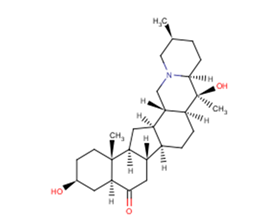
Peiminine
CAS No. 18059-10-4
Peiminine( Verticinone | Raddeanine )
Catalog No. M18142 CAS No. 18059-10-4
Peiminine is an effective inhibitor for lung inflammation and pulmonary fibrosis in a rat model of bleomycin-induced lung injury.
Purity : >98% (HPLC)
 COA
Datasheet
HNMR
HPLC
MSDS
Handing Instructions
COA
Datasheet
HNMR
HPLC
MSDS
Handing Instructions
| Size | Price / USD | Stock | Quantity |
| 5MG | 64 | In Stock |


|
| 10MG | 100 | In Stock |
|
| 25MG | 167 | In Stock |
|
| 50MG | 248 | In Stock |
|
| 100MG | 374 | In Stock |
|
| 200MG | Get Quote | In Stock |
|
| 500MG | Get Quote | In Stock |
|
| 1G | Get Quote | In Stock |
|
Biological Information
-
Product NamePeiminine
-
NoteResearch use only, not for human use.
-
Brief DescriptionPeiminine is an effective inhibitor for lung inflammation and pulmonary fibrosis in a rat model of bleomycin-induced lung injury.
-
DescriptionPeiminine is an effective inhibitor for lung inflammation and pulmonary fibrosis in a rat model of bleomycin-induced lung injury.
-
In VitroCell Cytotoxicity Assay Cell Line:HepG2, Hela, SW480, MCF-7 Concentration:2 μg/mL, 4 μg/mL, 6 μg/mL, 8 μg/mL, 10 μg/mL, 12μg/mL, and 14 μg/mL Incubation Time:24 h, 48 h, 72 h Result:Exhibited a significant inhibition on the survival of HepG2, Hela, SW480 and MCF-7 cells with the IC50 values were 4.58, 4.89, 5.07 and 5.12 μg/mL at 24 h, respectively.Apoptosis Analysis Cell Line:HepG2 Concentration:2 μg/mL, 4 μg/mL, 6 μg/mL, 8 μg/mL Incubation Time:24 h Result:Dissociated chromosome to produce DNA fragments dose-dependently.Cell Cycle Analysis Cell Line:HepG2 Concentration:2 μg/mL, 4 μg/mL, 6 μg/mL Incubation Time:24 h Result:Decreased the percentage of G1 phases from 65.15% ± 0.78 to 49.55% ± 0.17 with the increase of concentrations. Increased the percentage of G2/M phases from 17.32% ± 0.20 to 39.99% ± 0.47 with the increase of concentrations.Western Blot Analysis Cell Line:HepG2 Concentration:2 μg/mL, 4 μg/mL, 6 μg/mL Incubation Time:24 h Result:Reduced the expression of procaspase-3, PARP1, procaspases-8 and -9, and Bcl-2 at 2-6 μg/mL.
-
In VivoAnimal Model:ulcerative colitis model Dosage:3mg/kg Administration:Intraperitoneal injection (i.p.)Result:Reduced inflammation, mucosal ulcers, involvement of digestive system layers, and infltration of inflammatory cells.Reduced the levels of MPO and NO generated in the rectal tissue.Reduced cell proliferation in spleen cell.Decreased the production of f IL-1β, IL-6, and TNF-α cytokines.Reduced expression levels of genes IL-1β, IL-6, TNF-α, iNOS, and COX2.Animal Model:Ovariectomized (OVX) rat model Dosage:10 mg/kg Administration:Intraperitoneal injection (i.p.)Result:Alleviated the bone loss caused by surgical castration.Improved the expression of COL1A1 and β-catenin and reduced the increase expression of PPAR-γ in trabecular bone.Animal Model:Allergic dermatitis model Dosage:1 mg/kg, 5 mg/kg Administration:were applied to the dorsal skin Result:Alleviated the bone loss caused by surgical castration.Improved the expression of COL1A1 and β-catenin and reduced the increase expression of PPAR-γ in trabecular bone.
-
SynonymsVerticinone | Raddeanine
-
PathwayAngiogenesis
-
TargetEGFR
-
RecptorOthers
-
Research AreaInflammation/Immunology
-
Indication——
Chemical Information
-
CAS Number18059-10-4
-
Formula Weight429.64
-
Molecular FormulaC27H43NO3
-
Purity>98% (HPLC)
-
SolubilityDMSO : ≥ 100 mg/mL; 232.75 mM
-
SMILESCC1CCC2C(C3CCC4C(C3CN2C1)CC5C4CC(=O)C6C5(CCC(C6)O)C)(C)O
-
Chemical Name——
Shipping & Storage Information
-
Storage(-20℃)
-
ShippingWith Ice Pack
-
Stability≥ 2 years
Reference
molnova catalog



related products
-
Epertinib
Epertinib (S-222611) is a novel potent, orally active, reversible EGFR and HER2 inhibitor with IC50 of 1.48, 7.15 and 2.49 nM for EGFR, HER2 and HER4, respectively.
-
Poziotinib hydrochlo...
Poziotinib hydrochloride irreversibly inhibits EGFR (HER1 or ErbB1), including EGFR mutants, HER2, and HER4, thereby inhibiting the proliferation of tumor cells that overexpress these receptors.?It is an orally bioavailable, quinazoline-based pan epidermal growth factor receptor (EGFR or HER) inhibitor with potential antineoplastic activity.?
-
TX1-85-1
TX1-85-1 induces partial degradation of Her3 protein and attenuates Her3-dependent signaling.
