


 Cart
Cart
 sales@molnova.com



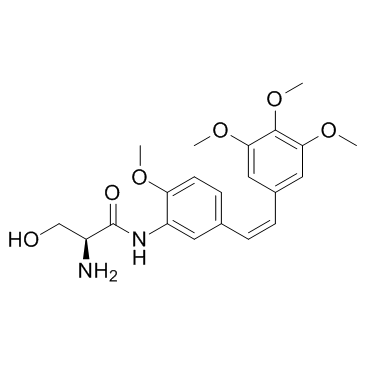
Ombrabulin
CAS No. 181816-48-8
Ombrabulin( AVE 8062 | AVE 8062A | AC 7700 | RPR 258063 )
Catalog No. M12793 CAS No. 181816-48-8
A novel combretastatin A-4 derivative and tubulin polymerization inhibitor that strongly stanches tumour blood flows and inhibits growth of tumours developing in various tissues and organ.
Purity : >98% (HPLC)
 COA
Datasheet
HNMR
HPLC
MSDS
Handing Instructions
COA
Datasheet
HNMR
HPLC
MSDS
Handing Instructions
| Size | Price / USD | Stock | Quantity |
| 100MG | Get Quote | Get Quote |


|
| 200MG | Get Quote | Get Quote |
|
| 500MG | Get Quote | Get Quote |
|
| 1G | Get Quote | Get Quote |
|
Biological Information
-
Product NameOmbrabulin
-
NoteResearch use only, not for human use.
-
Brief DescriptionA novel combretastatin A-4 derivative and tubulin polymerization inhibitor that strongly stanches tumour blood flows and inhibits growth of tumours developing in various tissues and organ.
-
DescriptionA novel combretastatin A-4 derivative and tubulin polymerization inhibitor that strongly stanches tumour blood flows and inhibits growth of tumours developing in various tissues and organ; a vascular-disrupting agent under clinical investigation combined with cisplatin/docetaxel or carboplatin/paclitaxel in patients with advanced solid tumors.Chemotherapeutic Agents Phase 2 Clinical.
-
In VitroThe effect of Ombrabulin (AC-7700) on endothelial or tumor cell viability is examined using the MTT assay. The IC50 of Ombrabulin for the mouse mesenteric endothelial cells (MMEC) is 10 nM and ranges between 7 and 20 nM for the tumor cell lines (HeyA8, SKOV3ip1, and HeyA8-MDR). Comparative analysis of the nonlinear least-squares regression of the dose-response curves for each agent alone and combination Ombrabulin (AC-7700)/Docetaxel show a significantly lower IC50 than either agent alone (P<0.005, all cell lines). The cytotoxicity of Docetaxel is 2- to 4-fold greater in combination with Ombrabulin (AC-7700) for the endothelial and tumor cells compared with Docetaxel alone.
-
In VivoBefore performing therapy experiments, the tolerability of various doses of Ombrabulin (AC-7700) ranging from 10 to 100 mg/kg is tested given twice weekly via i.v., i.p., or s.c. routes in nude mice (n=3 per group). The i.v. and s.c. routes are not pursued further due to problems with skin or tail vein necrosis. The i.p. route is well tolerated with doses up to 100 mg/kg. Next, preliminary experiments are done to determine the lowest dose for in vivo therapeutic efficacy. Starting 7 days after tumor cell injection, nude mice (n=5 per group) bearing HeyA8 ovarian cancer cells are treated with either vehicle or Ombrabulin 10, 30, 50, and 100 mg/kg twice weekly i.p. for 3 weeks. There is 65% reduction in tumor weight in the 30 mg/kg group compared with the vehicle control group (P<0.02). The 10 mg/kg dose is not effective. The antitumor effects at doses >30 mg/kg are not significantly better; therefore, the 30 mg/kg dose is selected for subsequent therapy experiments.
-
SynonymsAVE 8062 | AVE 8062A | AC 7700 | RPR 258063
-
PathwayCytoskeleton/Cell Adhesion Molecules
-
TargetMicrotubule/Tubulin
-
RecptorMicrotubule/Tubulin
-
Research AreaCancer
-
IndicationChemotherapeutic
Chemical Information
-
CAS Number181816-48-8
-
Formula Weight402.45
-
Molecular FormulaC21H26N2O6
-
Purity>98% (HPLC)
-
SolubilityIn Vitro:?DMSO : 100 mg/mL (248.48 mM)
-
SMILESO=C(NC1=CC(/C=C\C2=CC(OC)=C(OC)C(OC)=C2)=CC=C1OC)[C@@H](N)CO
-
Chemical Name(2S)-2-Amino-3-hydroxy-N-[2-methoxy-5-[(1Z)-2-(3,4,5-trimethoxyphenyl)ethenyl]phenyl]propanamide
Shipping & Storage Information
-
Storage(-20℃)
-
ShippingWith Ice Pack
-
Stability≥ 2 years
Reference
1. Kim TJ, et al. Cancer Res. 2007 Oct 1;67(19):9337-45.
2. Hori K, et al. Cancer Sci. 2008 Jul;99(7):1485-91.
3. Hori K, et al. Br J Cancer. 2002 May 20;86(10):1604-14.
molnova catalog



related products
-
Raspberry ketone
4-(4-Hydroxyphenyl)-2-butanone(RK) is cytotoxic to melanocytes through the binding of RK-derived quinones to thiol proteins and the pro-oxidant activity of the RK-oligomer.
-
Tubulin inhibitor 6
Tubulin inhibitor 6 is an inhibitor of tubulin and a potent inhibitor of multiple cancer cell lines. Tubulin inhibitor 6 exhibits submicromolar antiproliferative activity.
-
Cephalomannine
A taxol derivative with antitumor, antiproliferative properties.
