


 Cart
Cart
 sales@molnova.com



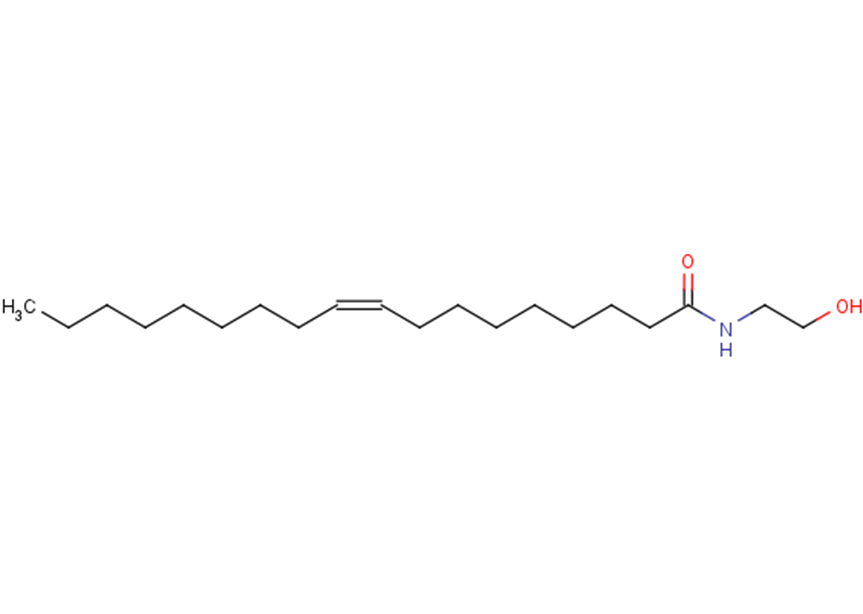
Oleoylethanolamide
CAS No. 111-58-0
Oleoylethanolamide( N-Oleoylethanolamide,Oleamide MEA,Oleic acid monoethanolamide )
Catalog No. M22670 CAS No. 111-58-0
Oleoylethanolamide is a high affinity endogenous agonist of PPAR-α.In vitro studies showed that OEA inhibited transforming growth factor β1-stimulated HSCs activation through suppressing Smad2/3 phosphorylation, α-SMA expression and myofibroblast transformation.
Purity : >98% (HPLC)
 COA
Datasheet
HNMR
HPLC
MSDS
Handing Instructions
COA
Datasheet
HNMR
HPLC
MSDS
Handing Instructions
| Size | Price / USD | Stock | Quantity |
| 2MG | 35 | In Stock |


|
| 5MG | 58 | In Stock |
|
| 10MG | 87 | In Stock |
|
| 25MG | 170 | In Stock |
|
| 50MG | 312 | In Stock |
|
| 100MG | 500 | In Stock |
|
| 200MG | 695 | In Stock |
|
| 500MG | 1062 | In Stock |
|
| 1G | Get Quote | In Stock |
|
Biological Information
-
Product NameOleoylethanolamide
-
NoteResearch use only, not for human use.
-
Brief DescriptionOleoylethanolamide is a high affinity endogenous agonist of PPAR-α.In vitro studies showed that OEA inhibited transforming growth factor β1-stimulated HSCs activation through suppressing Smad2/3 phosphorylation, α-SMA expression and myofibroblast transformation.
-
DescriptionOleoylethanolamide is a high affinity endogenous agonist of PPAR-α.In vitro studies showed that OEA inhibited transforming growth factor β1-stimulated HSCs activation through suppressing Smad2/3 phosphorylation, α-SMA expression and myofibroblast transformation.Treatment with OEA (5 mg/kg/day, intraperitoneal injection, i.p.) significantly attenuated the progress of liver fibrosis in both two experimental animal models by blocking the activation of hepatic stellate cells (HSCs).?Gene expression analysis of hepatic tissues indicated that OEA inhibited the expression of α-smooth muscle action (α-SMA) and collagen matrix, fibrosis markers, and genes involved in inflammation and extracellular matrix remodeling.?(In Vitro):Oleoylethanolamide (OEA), an endogenous PPAR-α ligand, attenuates liver fibrosis targeting hepatic stellate cells. Oleoylethanolamide suppresses TGF-β1 induced hepatic stellate cells (HSCs) activation in vitro via PPAR-α. To assess the impact of Oleoylethanolamide on HSCs activation, the expression levels of α-SMA and Col1a in TGF-β1-stimulated HSCs are examined by qPCR. The mRNA levels of α-SMA and Col1a are markedly induced in the group of CFSC cells with TGF-β1 (5 ng/mL) stimulation for 48h, while the mRNA levels are suppressed when treated with Oleoylethanolamide in a dose-dependent manner. Immunofluorescence and western blot results show that Oleoylethanolamide treatment dose-dependently inhibits the protein expression of α-SMA, the marker of HSC activation. The inhibitory effects of Oleoylethanolamide on HSCs activation are completely blocked by PPAR-α antagonist MK886 (10 μM). Moreover, the mRNA and protein expression levels of PPAR-α are down-regulated with TGF-β1 stimulation, while Oleoylethanolamide treatment restores these changes in dose-dependent manner. In addition, the phosphorylation of Smad 2/3 is upregulated in the presence of TGF-β1 stimulation, consistent with the observed effects on HSC activation, while Oleoylethanolamide (10 μM) reduces the phosphorylation of Smad2/3 in CFSC simulated with TGF-β1.(In Vivo):Oleoylethanolamide (OEA) can significantly suppress the pro-fibrotic cytokine TGF-β1 negatively regulate genes in the TGF-β1 signaling pathway (α-SMA, collagen 1a, and collagen 3a) in mice models of hepatic fibrosis. Treatment with Oleoylethanolamide (5 mg/kg/day, intraperitoneal injection, i.p.) significantly attenuates the progress of liver fibrosis in both two experimental animal models by blocking the activation of hepatic stellate cells (HSCs).
-
In VitroOleoylethanolamide (OEA), an endogenous PPAR-α ligand, attenuates liver fibrosis targeting hepatic stellate cells. Oleoylethanolamide suppresses TGF-β1 induced hepatic stellate cells (HSCs) activation in vitro via PPAR-α. To assess the impact of Oleoylethanolamide on HSCs activation, the expression levels of α-SMA and Col1a in TGF-β1-stimulated HSCs are examined by qPCR. The mRNA levels of α-SMA and Col1a are markedly induced in the group of CFSC cells with TGF-β1 (5 ng/mL) stimulation for 48h, while the mRNA levels are suppressed when treated with Oleoylethanolamide in a dose-dependent manner. Immunofluorescence and western blot results show that Oleoylethanolamide treatment dose-dependently inhibits the protein expression of α-SMA, the marker of HSC activation. The inhibitory effects of Oleoylethanolamide on HSCs activation are completely blocked by PPAR-α antagonist MK886 (10 μM). Moreover, the mRNA and protein expression levels of PPAR-α are down-regulated with TGF-β1 stimulation, while Oleoylethanolamide treatment restores these changes in dose-dependent manner. In addition, the phosphorylation of Smad 2/3 is upregulated in the presence of TGF-β1 stimulation, consistent with the observed effects on HSC activation, while Oleoylethanolamide (10 μM) reduces the phosphorylation of Smad2/3 in CFSC simulated with TGF-β1.
-
In VivoOleoylethanolamide (OEA) can significantly suppress the pro-fibrotic cytokine TGF-β1 negatively regulate genes in the TGF-β1 signaling pathway (α-SMA, collagen 1a, and collagen 3a) in mice models of hepatic fibrosis. Treatment with Oleoylethanolamide (5 mg/kg/day, intraperitoneal injection, i.p.) significantly attenuates the progress of liver fibrosis in both two experimental animal models by blocking the activation of hepatic stellate cells (HSCs).
-
SynonymsN-Oleoylethanolamide,Oleamide MEA,Oleic acid monoethanolamide
-
PathwayProteasome/Ubiquitin
-
TargetEndogenous Metabolite
-
RecptorHuman Endogenous Metabolite|PPARα
-
Research Area——
-
Indication——
Chemical Information
-
CAS Number111-58-0
-
Formula Weight325.53
-
Molecular FormulaC20H39NO2
-
Purity>98% (HPLC)
-
SolubilityDMSO:19.83 mg/mL (60.92 mM; Need ultrasonic);H2O:< 0.1 mg/mL (insoluble)
-
SMILESCCCCCCCC\C=C/CCCCCCCC(=O)NCCO
-
Chemical Name——
Shipping & Storage Information
-
Storage(-20℃)
-
ShippingWith Ice Pack
-
Stability≥ 2 years
Reference
1. Chen L, et al. Oleoylethanolamide, an endogenous PPAR-α ligand, attenuates liver fibrosis targeting hepatic stellate cells. Oncotarget. 2015 Dec 15;6(40):42530-40
molnova catalog



related products
-
3-Amino-2-piperidino...
3-Amino-2-piperidinone is a metabolite from all living organisms and can be used as a cyclic ornithine analogue.
-
FPI-1523 sodium
FPI-1523 sodium, a derivative of avibactam, is a potent β-lactamase inhibitor with Kd values of 4 nM and 34 nM for CTX-M-15 and OXA-48, respectively.
-
Coenzyme Q9
Coenzyme Q9 (CoQ9) is a normal constituent of human plasma.?CoQ9 in human plasma may originate as a product of incomplete CoQ10 biosynthesis or from the diet.
