


 Cart
Cart
 sales@molnova.com



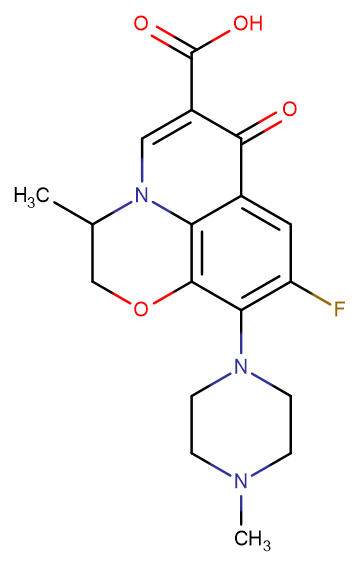
Ofloxacin
CAS No. 82419-36-1
Ofloxacin( DL-8280 | WP0405 )
Catalog No. M16061 CAS No. 82419-36-1
Ofloxacin is a fluoroquinolone whose primary mechanism of action is inhibition of bacterial DNA gyrase.
Purity : >98% (HPLC)
 COA
Datasheet
HNMR
HPLC
MSDS
Handing Instructions
COA
Datasheet
HNMR
HPLC
MSDS
Handing Instructions
| Size | Price / USD | Stock | Quantity |
| 1G | 45 | In Stock |


|
Biological Information
-
Product NameOfloxacin
-
NoteResearch use only, not for human use.
-
Brief DescriptionOfloxacin is a fluoroquinolone whose primary mechanism of action is inhibition of bacterial DNA gyrase.
-
DescriptionOfloxacin is a fluoroquinolone whose primary mechanism of action is inhibition of bacterial DNA gyrase.(In Vitro):Ofloxacin (Hoe-280) is a fluoroquinolone whose primary mechanism of action is inhibition of bacterial DNA gyrase. In vitro it has a broad spectrum of activity against aerobic Gram-negative and Gram-positive bacteria, although it is poorly active against anaerobes. Ofloxacin (Hoe-280), like other 4-quinolones, is unusual among front line drugs available to treat bacterial infections since it affects bacterial DNA synthesis, rather than cell wall or protein synthesis.(In Vivo):Ofloxacin (Hoe-280) (20 mg/kg), norfloxacin (40 mg/kg), pefloxacin mesylate dihydrate (40 mg/kg)and ciprofloxacin (50 mg/kg) are administered by gavage twice daily for three consecutive weeks. 6 weeks after treatment, the test animals are euthanised and Achilles tendon specimens are collected. A computer monitored tensile testing machine was utilised for biomechanical testing. The mean elastic modulus of the control group was significantly higher than that of the norfloxacin and pefloxacin groups (p<0.05 and p<0.01, respectively). The mean yield force (YF) of the control group was significantly higher than those of ciprofloxacin, norfloxacin and pefloxacin groups (p<0.001, p<0.05 and p<0.01, respectively). The mean ultimate tensile force (UTF) of the control group was significantly higher than of the ciprofloxacin, norfloxacin, and pefloxacin groups (p<0.001, p<0.05 and p<0.01, respectively). Hyaline degeneration and fibre disarrangement were observed in the tendons of the ciprofloxacin, pefloxacin, and ofloxacin treated-groups, whereas myxomatous degeneration was observed only in the ciprofloxacin and pefloxacin groups.
-
In VitroOfloxacin (Hoe-280) is a fluoroquinolone whose primary mechanism of action is inhibition of bacterial DNA gyrase. In vitro it has a broad spectrum of activity against aerobic Gram-negative and Gram-positive bacteria, although it is poorly active against anaerobes. Ofloxacin (Hoe-280), like other 4-quinolones, is unusual among front line drugs available to treat bacterial infections since it affects bacterial DNA synthesis, rather than cell wall or protein synthesis.
-
In VivoOfloxacin (Hoe-280) (20 mg/kg), norfloxacin (40 mg/kg), pefloxacin mesylate dihydrate (40 mg/kg)and ciprofloxacin (50 mg/kg) are administered by gavage twice daily for three consecutive weeks. 6 weeks after treatment, the test animals are euthanised and Achilles tendon specimens are collected. A computer monitored tensile testing machine was utilised for biomechanical testing. The mean elastic modulus of the control group was significantly higher than that of the norfloxacin and pefloxacin groups (p<0.05 and p<0.01, respectively). The mean yield force (YF) of the control group was significantly higher than those of ciprofloxacin, norfloxacin and pefloxacin groups (p<0.001, p<0.05 and p<0.01, respectively). The mean ultimate tensile force (UTF) of the control group was significantly higher than of the ciprofloxacin, norfloxacin, and pefloxacin groups (p<0.001, p<0.05 and p<0.01, respectively). Hyaline degeneration and fibre disarrangement were observed in the tendons of the ciprofloxacin, pefloxacin, and ofloxacin treated-groups, whereas myxomatous degeneration was observed only in the ciprofloxacin and pefloxacin groups.
-
SynonymsDL-8280 | WP0405
-
PathwayCell Cycle/DNA Damage
-
TargetTopoisomerase
-
RecptorTopo
-
Research AreaInfection
-
Indication——
Chemical Information
-
CAS Number82419-36-1
-
Formula Weight361.37
-
Molecular FormulaC18H20FN3O4
-
Purity>98% (HPLC)
-
SolubilityDMSO: 0.4 mg/mL (1.1 mM)
-
SMILESCC1COC2=C3N1C=C(C(=O)C3=CC(=C2N4CCN(CC4)C)F)C(=O)O
-
Chemical Name9-fluoro-3-methyl-10-(4-methylpiperazin-1-yl)-7-oxo-3,7-dihydro-2H-[1,4]oxazino[2,3,4-ij]quinoline-6-carboxylic acid
Shipping & Storage Information
-
Storage(-20℃)
-
ShippingWith Ice Pack
-
Stability≥ 2 years
Reference
1.Divo AA, et al. Antimicrob Agents ChemOthers. 1988 Aug;32(8):1182-6.
molnova catalog



related products
-
IndiMitecan
IndiMitecan (LMP776) is an inhibitor of topoisomerase I (Top1) with anticancer activities .
-
Amenamevir
Amenamevir is a novel helicase-primase inhibitor that is active against varicella-zoster virus and herpes simplex virus types 1 and 2 (EC50: 14 ng/mL).
-
Daniquidone
Daniquidone (Batracylin) is a potent dual inhibitor of DNA topoisomerase I and DNA topoisomerase II with cytotoxic and antiproliferative activity that induces DNA fragmentation for the study of neoplasms, immune disorders, and lymphatic disorders.
