


 Cart
Cart
 sales@molnova.com



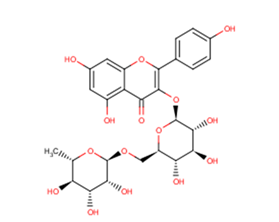
Nicotiflorin
CAS No. 17650-84-9
Nicotiflorin( —— )
Catalog No. M18129 CAS No. 17650-84-9
Nicotiflorin has protective effects on reducing memory dysfunction, energy metabolism failure and oxidative stress in multi-infarct dementia model rats.
Purity : >98% (HPLC)
 COA
Datasheet
HNMR
HPLC
MSDS
Handing Instructions
COA
Datasheet
HNMR
HPLC
MSDS
Handing Instructions
| Size | Price / USD | Stock | Quantity |
| 5MG | 133 | In Stock |


|
| 10MG | 195 | In Stock |
|
| 25MG | 327 | In Stock |
|
| 50MG | 484 | In Stock |
|
| 100MG | 701 | In Stock |
|
| 200MG | Get Quote | In Stock |
|
| 500MG | Get Quote | In Stock |
|
| 1G | Get Quote | In Stock |
|
Biological Information
-
Product NameNicotiflorin
-
NoteResearch use only, not for human use.
-
Brief DescriptionNicotiflorin has protective effects on reducing memory dysfunction, energy metabolism failure and oxidative stress in multi-infarct dementia model rats.
-
DescriptionNicotiflorin has potential therapeutic effects on cerebral ischemic illness. Nicotiflorin has protective effects on reducing memory dysfunction, energy metabolism failure and oxidative stress in multi-infarct dementia model rats.
-
In VitroFor primarily cultured neurons suffered 2 h hypoxia followed by 24 h reoxygenation, nicotiflorin significantly attenuates cell death and reduces LDH release. Morphological observation also directly confirms its protective effect on neuron. After total 4 h hypoxia and 12 h reoxygenation, eNOS activity, mRNA and protein levels in the primarily cultured rat cerebral blood vessel endothelial cells treated with nicotiflorin (25-100 g/mL) 2 h after onset of hypoxia are significantly higher than eNOS activity, mRNA and protein levels in the pure H-R cells and also higher than eNOS activity, mRNA and protein levels in cells cultured under normoxic conditions.
-
In VivoAt doses of 2.5, 5 and 10 mg/kg, nicotiflorin administered immediately after the onset of ischemia markedly reduces brain infarct volume and neurological deficits. Nicotiflorin (2.5-10 mg/kg) administered after onset of ischemia markedly reduces brain infarct volume by 24.5-63.2% and neurological deficits.
-
Synonyms——
-
PathwayImmunology/Inflammation
-
TargetTLR
-
RecptorOthers
-
Research AreaNeurological Disease
-
Indication——
Chemical Information
-
CAS Number17650-84-9
-
Formula Weight594.52
-
Molecular FormulaC27H30O15
-
Purity>98% (HPLC)
-
SolubilityIn Vitro:?DMSO : 250 mg/mL (420.51 mM)
-
SMILESCC1C(C(C(C(O1)OCC2C(C(C(C(O2)OC3=C(OC4=CC(=CC(=C4C3=O)O)O)C5=CC=C(C=C5)O)O)O)O)O)O)O
-
Chemical Name——
Shipping & Storage Information
-
Storage(-20℃)
-
ShippingWith Ice Pack
-
Stability≥ 2 years
Reference
molnova catalog



related products
-
CU-CPT22
CU-CPT22 is the first probe for the complex between toll-like receptors TLR1 and TLR2.?CU-CPT22 binds at the interface of TLR1 and TLR2 (IC50 = 0.58 μM).?It competes with the synthetic triacylated lipoprotein (Pam3CSK4) binding to TLR1/2 (Ki: 0.41 μM).?
-
EPZ020411 2HCl
EPZ020411 is an effective and specific small molecule PRMT6 inhibitor (IC50=10 nM).
-
Chloranil
Chloranil (tetrachloro-p-benzoquinone) triggers inflammation and neurological dysfunction through Toll-like receptor 4 signaling and can be used to model inflammation in mice.
