


 Cart
Cart
 sales@molnova.com



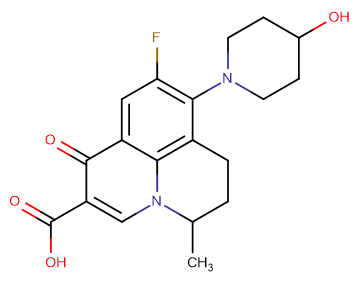
Nadifloxacin
CAS No. 124858-35-1
Nadifloxacin( OPC 7251 )
Catalog No. M11005 CAS No. 124858-35-1
Nadifloxacin(OPC7251) is a topical fluoroquinolone antibiotic for the treatment of acne vulgaris.
Purity : >98% (HPLC)
 COA
Datasheet
HNMR
HPLC
MSDS
Handing Instructions
COA
Datasheet
HNMR
HPLC
MSDS
Handing Instructions
| Size | Price / USD | Stock | Quantity |
| 50MG | 30 | In Stock |


|
| 100MG | 41 | In Stock |
|
| 200MG | 52 | In Stock |
|
| 500MG | Get Quote | In Stock |
|
| 1G | Get Quote | In Stock |
|
Biological Information
-
Product NameNadifloxacin
-
NoteResearch use only, not for human use.
-
Brief DescriptionNadifloxacin(OPC7251) is a topical fluoroquinolone antibiotic for the treatment of acne vulgaris.
-
DescriptionNadifloxacin(OPC7251) is a topical fluoroquinolone antibiotic for the treatment of acne vulgaris.
-
In Vitro——
-
In Vivo——
-
SynonymsOPC 7251
-
PathwayOthers
-
TargetOther Targets
-
RecptorOthers
-
Research AreaInflammation/Immunology
-
Indication——
Chemical Information
-
CAS Number124858-35-1
-
Formula Weight360.39
-
Molecular FormulaC19H21FN2O4
-
Purity>98% (HPLC)
-
SolubilityDMSO: 20 mg/mL (55.49 mM)
-
SMILESO=C(C1=CN2C(C)CCC3=C2C(C1=O)=CC(F)=C3N4CCC(O)CC4)O
-
Chemical Name9-fluoro-8-(4-hydroxypiperidin-1-yl)-5-methyl-1-oxo-6,7-dihydro-1H,5H-pyrido[3,2,1-ij]quinoline-2-carboxylic acid
Shipping & Storage Information
-
Storage(-20℃)
-
ShippingWith Ice Pack
-
Stability≥ 2 years
Reference



-
Methyl retinoate
Methyl retinoate (Retinoic acid, methyl ester) induces aseptic inflammation at the site of administration in in vivo experiments, which causes an increase in the number of leukocytes in the blood and a decrease in the levels of red blood cells and Hb.Methyl retinoate promotes spontaneous leukemia.Methyl retinoate can be Used in the treatment of gastric hypertrophy and ulcers due to vitamin A deficiency.
-
HA Peptide
Influenza Hemagglutinin (HA) Peptide is a tag peptide derived from an epitope of the influenza hemagglutinin protein.HA Peptide is a highly immunoreactive tag generally used for the separation of tagged proteins from cell culture supernatants and cell lysate under neutral pH conditions and thus are handy tools for coimmunoprecipitation but are also easily detected via western blot.
-
2,4-Dihydroxy-6-meth...
2,4-Dihydroxy-6-methoxyacetophenone exhibits a moderate antispasmodic activity.
