


 Cart
Cart
 sales@molnova.com



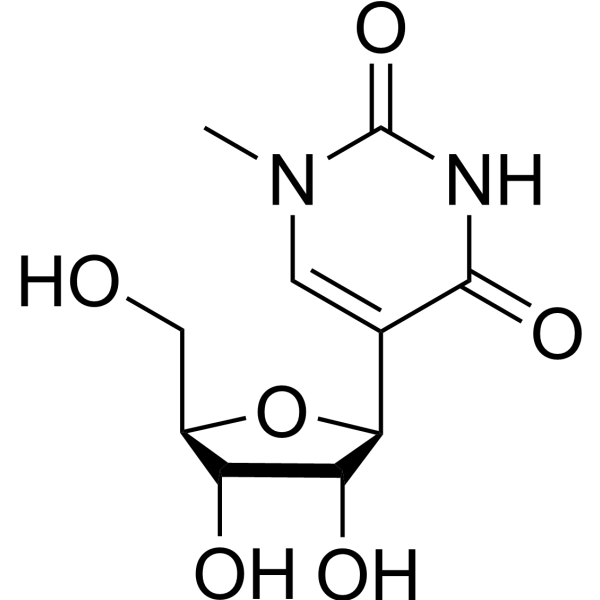
N1-Methylpseudouridine
CAS No. 13860-38-3
N1-Methylpseudouridine( 1-Methylpseudouridine )
Catalog No. M27095 CAS No. 13860-38-3
N1-Methylpseudouridine is a methylpseudouridine and enhances translation through eIF2α-dependent and independent mechanisms by increasing ribosome density in mRNA.
Purity : >98% (HPLC)
 COA
Datasheet
HNMR
HPLC
MSDS
Handing Instructions
COA
Datasheet
HNMR
HPLC
MSDS
Handing Instructions
| Size | Price / USD | Stock | Quantity |
| 10MG | 35 | In Stock |


|
| 25MG | 72 | In Stock |
|
| 50MG | 115 | In Stock |
|
| 100MG | 174 | In Stock |
|
| 500MG | 431 | In Stock |
|
| 1G | Get Quote | In Stock |
|
Biological Information
-
Product NameN1-Methylpseudouridine
-
NoteResearch use only, not for human use.
-
Brief DescriptionN1-Methylpseudouridine is a methylpseudouridine and enhances translation through eIF2α-dependent and independent mechanisms by increasing ribosome density in mRNA.
-
DescriptionN1-Methylpseudouridine is a methylpseudouridine and enhances translation through eIF2α-dependent and independent mechanisms by increasing ribosome density in mRNA.(In Vitro):In HEK293T cells, Incorporation of N1-Methylpseudouridine into mRNA modifies mRNAs produced higher amounts of luc than the standard Luc mRNA .?Incorporation of N1-Methylpseudouridine nucleoside modification in both Luc and GFP mRNA enhances the initiation step of translation, in part by suppressing eIF2α phosphorylation.?In addition, polysome formation and growth on the N1-Methylpseudouridine-containing Luc mRNA is enhanced due to the reduction of elongation rate.(In Vivo):mRNAs containing the N1-Methylpseudouridine modification alone and/or in combination with 5-methylcytidine (m5C) outperformed the current state-of-the-art pseudouridine (Ψ) and/or m5C/Ψ-modified mRNA platform by providing up to ~44-fold (when comparing double modified mRNAs) or ~13-fold (when comparing single modified mRNAs) higher reporter gene expression upon transfection into cell lines or mice, respectively. We show that (m5C/)N1-Methylpseudouridine-modified mRNA resulted in reduced intracellular innate immunogenicity and improved cellular viability compared to (m5C/)Ψ-modified mRNA upon in vitro transfection.
-
In Vitro——
-
In VivoAnimal Model:7-week-old Balb/c mice Dosage:20 μg Administration:I.m. or i.d. routes for 21 days Result:had a higher translational capacity.
-
Synonyms1-Methylpseudouridine
-
PathwayOthers
-
TargetOther Targets
-
RecptorAntibacterial
-
Research Area——
-
Indication——
Chemical Information
-
CAS Number13860-38-3
-
Formula Weight258.23
-
Molecular FormulaC10H14N2O6
-
Purity>98% (HPLC)
-
SolubilityIn Vitro:?DMSO : 125 mg/mL (484.06 mM)
-
SMILESCn1cc([C@@H]2O[C@H](CO)[C@@H](O)[C@H]2O)c(=O)[nH]c1=O
-
Chemical Name——
Shipping & Storage Information
-
Storage(-20℃)
-
ShippingWith Ice Pack
-
Stability≥ 2 years
Reference
1.Jung IH, et al. Metabolism of ginsenoside Rb1 by human intestinal microflora and cloning of its metabolizing β-D-glucosidase from Bifidobacterium longum H-1. Biol Pharm Bull. 2012;35(4):573-81.
molnova catalog



related products
-
Pancreatic Polypepti...
Pancreatic Polypeptide (31-36) (free acid) (human)
-
COH34
COH34 is a selective inhibitor of PARG with an IC50 of 0.37 nM and a Kd of 0.547 μM. COH34 prolongs PARylation at DNA lesions and traps DNA repair factors.
-
(2S)-3-Hydroxy-2-[4-...
The stems of Sambucus williamsii.
