


 Cart
Cart
 sales@molnova.com



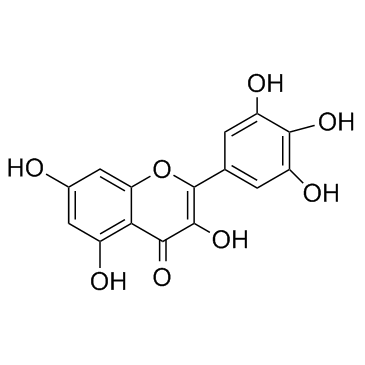
Myricetin
CAS No. 529-44-2
Myricetin( Cannabiscetin | NSC 407290 )
Catalog No. M14876 CAS No. 529-44-2
Myricetin is produced from the parent compound taxifolin through the (+)-dihydromyricetin intermediate and can be further processed to form laricitrin and then syringetin, both members of the flavonol class of flavonoids.
Purity : >98% (HPLC)
 COA
Datasheet
HNMR
HPLC
MSDS
Handing Instructions
COA
Datasheet
HNMR
HPLC
MSDS
Handing Instructions
| Size | Price / USD | Stock | Quantity |
| 25MG | 33 | In Stock |


|
| 50MG | 50 | In Stock |
|
| 100MG | 68 | In Stock |
|
| 500MG | 158 | In Stock |
|
| 1G | Get Quote | In Stock |
|
Biological Information
-
Product NameMyricetin
-
NoteResearch use only, not for human use.
-
Brief DescriptionMyricetin is produced from the parent compound taxifolin through the (+)-dihydromyricetin intermediate and can be further processed to form laricitrin and then syringetin, both members of the flavonol class of flavonoids.
-
DescriptionMyricetin is produced from the parent compound taxifolin through the (+)-dihydromyricetin intermediate and can be further processed to form laricitrin and then syringetin, both members of the flavonol class of flavonoids. Dihydromyricetin is frequently sold as a supplement and has controversial function as a partial GABAA receptor potentiator and treatment in Alcohol Use Disorder (AUD). (In Vitro):Myricetin exhibits the scavenging activity towards a number of radicals and ions. It displays poor activity (IC50 value=1.4 mg/mL) in a superoxide dismutase (SOD)-like activity assay. It prevents cancer cell death via apoptosis via regulation of PI3K/Akt and MAPK signalling pathways. Myricetin exhibits antiphotoaging effects by quenching causative free radicals in the skin. Myricetin is able to suppress UVB-induced COX-2 expression in mouse skin epidermal JB6 P+ cells. It inhibits UVB-induced initiation of activator protein-1 and NF-κβ, as well as Fyn kinase activity. Myricetin inhibits viability of SKOV3 ovarian cancer cells in a dose-dependent manner. It induces DNA DSBs and ER stress, which leads to apoptosis in SKOV3 cells. Myricetin inhibits human Hsp70 by more than 80% with IC50 values of 83, 11 and 12 μM, respectively.(In Vivo):Treatment of orthotopic pancreatic tumors with myricetin results in tumor regression and decreases metastatic spread. Exposure to 150 μM myricetin causes 14%, 26%, 5% and 49% inhibition of rabbit platelet aggregation, induced by ADP, arachidonic acid, collagen and PAF, respectively.
-
In Vitro——
-
In Vivo——
-
SynonymsCannabiscetin | NSC 407290
-
PathwayPI3K/Akt/mTOR signaling
-
TargetPI3K
-
RecptorPI3Kγ
-
Research AreaCancer
-
Indication——
Chemical Information
-
CAS Number529-44-2
-
Formula Weight318.24
-
Molecular FormulaC15H10O8
-
Purity>98% (HPLC)
-
SolubilityEthanol: 20 mg/mL warmed (62.84 mM); DMSO: 63 mg/mL (197.96 mM)
-
SMILESO=C1C(O)=C(C2=CC(O)=C(O)C(O)=C2)OC3=C1C(O)=CC(O)=C3
-
Chemical Name3,5,7-trihydroxy-2-(3,4,5-trihydroxyphenyl)-4H-chromen-4-one
Shipping & Storage Information
-
Storage(-20℃)
-
ShippingWith Ice Pack
-
Stability≥ 2 years
Reference
1.Flamini R, et al. Int J Mol Sci. 2013 Sep 27;14(10):19651-69.
molnova catalog



related products
-
PI-103 hydrochloride
A potent, dual class I PI3K/mTOR inhibitor with IC50 of 2/3/3/15/ for p110α/β/δ/γ, respectively.
-
PI-103
A potent, dual class I PI3K/mTOR inhibitor with IC50 of 2/3/3/15/ for p110α/β/δ/γ, respectively.
-
AZD 6482
A potent, selective and ATP competitive PI3Kβ inhibitor with IC50 of 10 nM.
