


 Cart
Cart
 sales@molnova.com



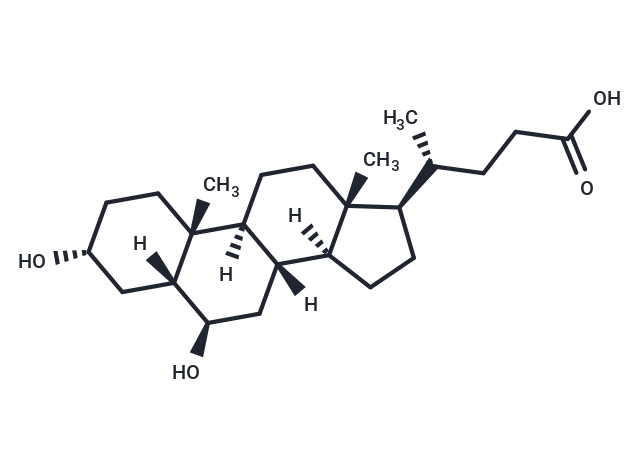
Murideoxycholic Acid
CAS No. 668-49-5
Murideoxycholic Acid( —— )
Catalog No. M34997 CAS No. 668-49-5
Murideoxycholic Acid alleviates non-alcoholic fatty liver disease by modulating the enterohepatic axis.
Purity : >98% (HPLC)
 COA
Datasheet
HNMR
HPLC
MSDS
Handing Instructions
COA
Datasheet
HNMR
HPLC
MSDS
Handing Instructions
| Size | Price / USD | Stock | Quantity |
| 2MG | 606 | Get Quote |


|
| 500MG | Get Quote | Get Quote |
|
| 1G | Get Quote | Get Quote |
|
Biological Information
-
Product NameMurideoxycholic Acid
-
NoteResearch use only, not for human use.
-
Brief DescriptionMurideoxycholic Acid alleviates non-alcoholic fatty liver disease by modulating the enterohepatic axis.
-
DescriptionMurideoxycholic acid is a 6 beta-hydroxylated bile acid.
-
In Vitro——
-
In Vivo——
-
Synonyms——
-
PathwayProteasome/Ubiquitin
-
TargetEndogenous Metabolite
-
RecptorEndogenous Metabolite
-
Research Area——
-
Indication——
Chemical Information
-
CAS Number668-49-5
-
Formula Weight392.57
-
Molecular FormulaC24H40O4
-
Purity>98% (HPLC)
-
Solubility——
-
SMILES[H][C@@]12CC[C@H]([C@H](C)CCC(O)=O)[C@@]1(C)CC[C@@]1([H])[C@@]2([H])C[C@@H](O)[C@]2([H])C[C@H](O)CC[C@]12C
-
Chemical Name——
Shipping & Storage Information
-
Storage(-20℃)
-
ShippingWith Ice Pack
-
Stability≥ 2 years
Reference
1. Khallou J, et al. Metabolism and time-course excretion of murideoxycholic acid, a 6 beta-hydroxylated bile acid, in humans. J Hepatol. 1993;17(3):364-372. ?
molnova catalog



related products
-
N-Lactoyl-Phenylalan...
N-Lactoyl-Phenylalanine (Lac-Phe) is a peptide coupling of lactic acid and phenylalanine, one of the metabolites in acute exercise, which can be used in the study of obesity and metabolism-related diseases.
-
Glutaric acid
Glutaric acid is a simple five-carbon linear dicarboxylic acid. Glutaric acid is naturally produced in the body during the metabolism of some amino acids including lysine and tryptophan. Glutaric acid may cause irritation to the skin and eyes. When present in sufficiently high levels glutaric acid can act as an acidogen and a metabotoxin.
-
2-Methylcyclohexanon...
2-Methylcyclohexanone is an endogenous metabolite.
