


 Cart
Cart
 sales@molnova.com



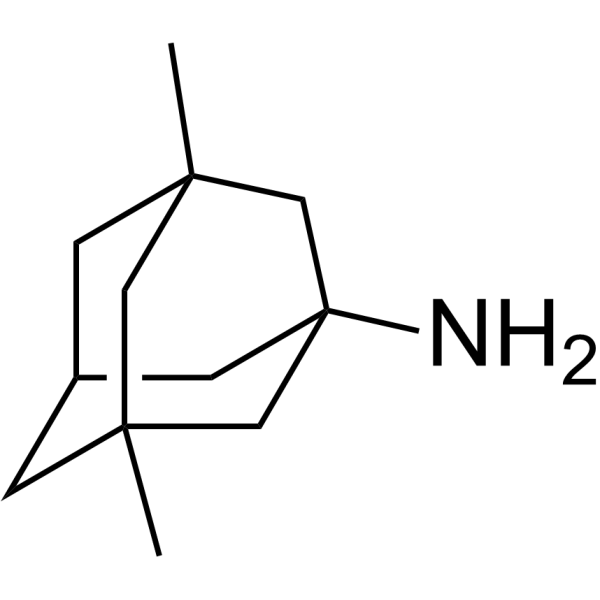
Memantine
CAS No. 19982-08-2
Memantine( —— )
Catalog No. M27356 CAS No. 19982-08-2
Memantine, an amantadine derivative with some dopaminergic effects, has been proposed as an antiparkinson agent and has may be used to treat moderate to severe Alzheimer's disease. It acts on the glutamatergic system by blocking NMDA receptors.
Purity : >98% (HPLC)
 COA
Datasheet
HNMR
HPLC
MSDS
Handing Instructions
COA
Datasheet
HNMR
HPLC
MSDS
Handing Instructions
| Size | Price / USD | Stock | Quantity |
| 5MG | 45 | In Stock |


|
| 10MG | 63 | In Stock |
|
| 25MG | 103 | In Stock |
|
| 50MG | 150 | In Stock |
|
| 100MG | 223 | In Stock |
|
| 500MG | 482 | In Stock |
|
| 1G | Get Quote | In Stock |
|
Biological Information
-
Product NameMemantine
-
NoteResearch use only, not for human use.
-
Brief DescriptionMemantine, an amantadine derivative with some dopaminergic effects, has been proposed as an antiparkinson agent and has may be used to treat moderate to severe Alzheimer's disease. It acts on the glutamatergic system by blocking NMDA receptors.
-
DescriptionMemantine, an amantadine derivative with some dopaminergic effects, has been proposed as an antiparkinson agent and has may be used to treat moderate to severe Alzheimer's disease. It acts on the glutamatergic system by blocking NMDA receptors.
-
In Vitro——
-
In VivoMemantine (1, 5 and 10, 15 mg/kg; i.p.; daily for 15-20 days) significantly decreased the large LTP recorded in hippocampal slices from aged animals.Memantine (1-3 mg/kg; per os (p.o.)) for 14 days significantly improves depressive-like behaviors in olfactory bulbectomized (OBX) mice, as assessed using the tail-suspension and forced-swim tests. Animal Model:Male Wistar rats Dosage:1, 5 and 10, 15 mg/kg Administration:i.p.; daily for 15-20 days Result:Significantly decreased the large LTP recorded in hippocampal slices from aged animals.
-
Synonyms——
-
PathwayOthers
-
TargetOther Targets
-
RecptorEndogenous Metabolite
-
Research Area——
-
Indication——
Chemical Information
-
CAS Number19982-08-2
-
Formula Weight179.307
-
Molecular FormulaC12H21N
-
Purity>98% (HPLC)
-
Solubility——
-
SMILESC[C@@]12CC3C[C@@](C)(C1)CC(N)(C3)C2
-
Chemical Name——
Shipping & Storage Information
-
Storage(-20℃)
-
ShippingWith Ice Pack
-
Stability≥ 2 years
Reference
1.SUZUKI T, SUGII M, KAKIMOTO T. Metabolic incorporation of L-valine-[14C] into S-(2-carboxypropyl) glutathione and S-(2-carboxypropyl) cysteine in garlic. Chem Pharm Bull (Tokyo). 1962 Apr;10:328-31.
molnova catalog



related products
-
5-TAMRA
5-TAMRA (5-Carboxytetramethylrhodamine) yields bright, pH-insensitive orange-red fluorescence (approximate excitation/emission maxima ~546/579) with good photostability.
-
LHRH (4-10)
LH-RH (4-10) is a heptapeptide, one of major degradation products of luteinising-hormone releasing hormone (LHRH) via pituitary and hypothalamus. LH-RH (4-10) produced in macrophages and type II pneumocytes.
-
Experimental Autoimm...
Experimental Autoimmune Encephalomyelitis Complementary Peptide
