


 Cart
Cart
 sales@molnova.com



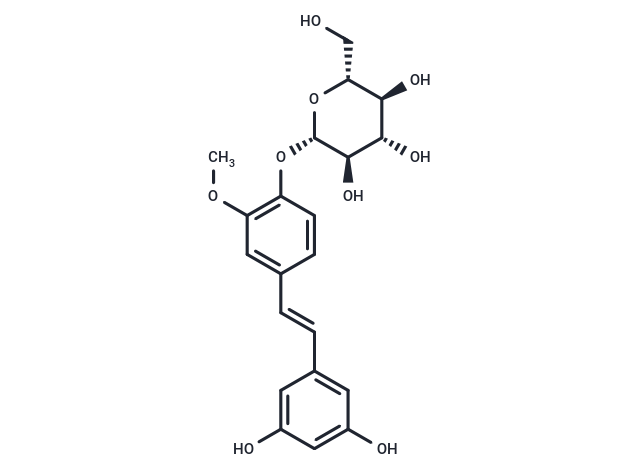
Gnetifolin E
CAS No. 140671-07-4
Gnetifolin E( —— )
Catalog No. M37781 CAS No. 140671-07-4
Gnetifolin E is a new resveratrol trimer derivative from Gnetum brunonianum.
Purity : >98% (HPLC)
 COA
Datasheet
HNMR
HPLC
MSDS
Handing Instructions
COA
Datasheet
HNMR
HPLC
MSDS
Handing Instructions
| Size | Price / USD | Stock | Quantity |
| 1 mL x 10 mM in DMSO | 1055 | In Stock |


|
| 5MG | 1055 | In Stock |
|
| 10MG | 1406 | In Stock |
|
| 25MG | 2119 | In Stock |
|
| 50MG | 2734 | In Stock |
|
| 100MG | 3692 | In Stock |
|
| 200MG | Get Quote | In Stock |
|
| 500MG | Get Quote | In Stock |
|
| 1G | Get Quote | In Stock |
|
Biological Information
-
Product NameGnetifolin E
-
NoteResearch use only, not for human use.
-
Brief DescriptionGnetifolin E is a new resveratrol trimer derivative from Gnetum brunonianum.
-
DescriptionGnetifolin E is a resveratrol trimer derivative that can be isolated from Gnetum brunonianum. Gnetifolin E has anti-inflammatory activity, and inhibits TNF-α.
-
In Vitro——
-
In Vivo——
-
Synonyms——
-
PathwayOthers
-
TargetOther Targets
-
RecptorOthers
-
Research Area——
-
Indication——
Chemical Information
-
CAS Number140671-07-4
-
Formula Weight420.41
-
Molecular FormulaC21H24O9
-
Purity>98% (HPLC)
-
Solubility——
-
SMILESO(C1=C(OC)C=C(/C=C/C2=CC(O)=CC(O)=C2)C=C1)[C@@H]3O[C@H](CO)[C@@H](O)[C@H](O)[C@H]3O
-
Chemical Name——
Shipping & Storage Information
-
Storage(-20℃)
-
ShippingWith Ice Pack
-
Stability≥ 2 years
Reference
1. Yao CS, et al. A new resveratrol trimer derivative from Gnetum brunonianum. J Asian Nat Prod Res. 2012;14(9):918-22.?
molnova catalog



related products
-
R-G-D-S-P-A-S-S-K-P
RGDSPASSKP is a RGDS-containing fibronectin decapeptide.
-
Hydrocinnamic alcoho...
Hydrocinnamic alcohol exists in storax and fern balsam, also present in Vaccinium species fruits, guava fruit and peel, blackberry, other fruits, rum, white wine, shitake mushroom, matsutake mushroom and peated malt. It is a flavoring ingredient.
-
Otobaphenol
The fruits of Schisandra sphenanthera.
