


 Cart
Cart
 sales@molnova.com



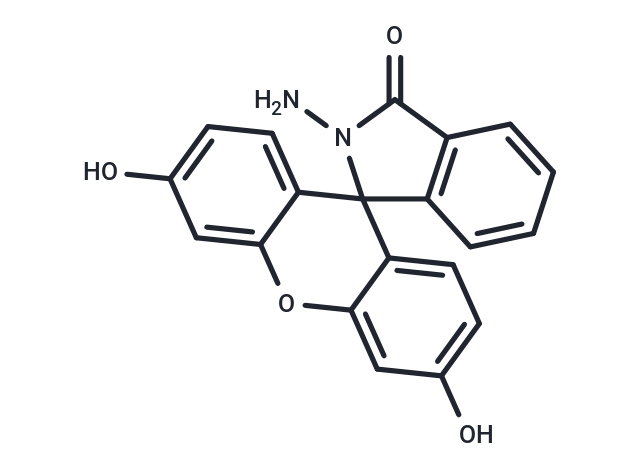
N-Aminofluorescein
CAS No. 98907-26-7
N-Aminofluorescein( —— )
Catalog No. M37590 CAS No. 98907-26-7
N-Aminofluorescein is a highly selective and sensitive fluorescent probe for Cu2+ and can be used to detect Cu2+ in biological systems (λex/em=495/516 nm).
Purity : >98% (HPLC)
 COA
Datasheet
HNMR
HPLC
MSDS
Handing Instructions
COA
Datasheet
HNMR
HPLC
MSDS
Handing Instructions
| Size | Price / USD | Stock | Quantity |
| 5MG | 32 | In Stock |


|
| 10MG | 51 | In Stock |
|
| 25MG | 103 | In Stock |
|
| 50MG | 152 | In Stock |
|
| 100MG | 226 | In Stock |
|
| 200MG | 337 | In Stock |
|
| 500MG | Get Quote | In Stock |
|
| 1G | Get Quote | In Stock |
|
Biological Information
-
Product NameN-Aminofluorescein
-
NoteResearch use only, not for human use.
-
Brief DescriptionN-Aminofluorescein is a highly selective and sensitive fluorescent probe for Cu2+ and can be used to detect Cu2+ in biological systems (λex/em=495/516 nm).
-
DescriptionN-Aminofluorescein is a fluorescein hydrazide with spiro form, a highly selective and sensitive fluorescence probe for Cu2+. N-Aminofluorescein has no selective fluorescence response to other common metal ions, can be used for direct detection of Cu2+ in biological systems with λex/em=495/516 nm.
-
In VitroGuidelines (Following is our recommended protocol. This protocol only provides a guideline, and should be modified according to your specific needs). N-Aminofluorescein consists of a fluorescein moiety and a hydrazide group to recognize and bind Cu2+, can promote the hydrolysis of amide.N-Aminofluorescein (FG) shows selectivity on Cu2+ and shows the absorption and emission bands at 632 nm and 515 nm in 70% aqueous HEPES buffered solution (pH 7.4) containing Cu2+.Guidelines (Following is our recommended protocol. This protocol only provides a guideline, and should be modified according to your specific needs). General procedure for Cu2+ determination:1.Prepare the 1.0 mM stock solution of spiro form fluorescein hydrazide in ethanol;Conduct the fluorescence-on reaction in 0.01 M Tris-HCl buffer (pH 7.2), with 10 μM N-Aminofluorescein;3.Add an appropriate volume of sample solution with a final Cu2+ concentration of not more than 10 μM, and adjust the final volume 10 mL with 0.01 M Tris-HCl buffer (pH 7.2);4.After 2 h, transfer a 3-mL portion of the solution to a 1-cm quartz cell, and measure the fluorescence intensity/spectrum at room temperature with λex/em = 495/516 nm and both excitation and emission slit widths of 5 nm;5.In the meantime, prepare a blank solution containing no Cu2+ and measure with the same conditions for comparison.
-
In Vivo——
-
Synonyms——
-
PathwayOthers
-
TargetOther Targets
-
RecptorOthers
-
Research Area——
-
Indication——
Chemical Information
-
CAS Number98907-26-7
-
Formula Weight346.34
-
Molecular FormulaC20H14N2O4
-
Purity>98% (HPLC)
-
SolubilityIn Vitro:?DMSO : 125 mg/mL (360.92 mM; Ultrasonic )
-
SMILESO=C1C=2C=CC=CC2C3(C4=CC=C(O)C=C4OC5=CC(O)=CC=C53)N1N
-
Chemical Name——
Shipping & Storage Information
-
Storage(-20℃)
-
ShippingWith Ice Pack
-
Stability≥ 2 years
Reference
1. Chen X, et al. A selective fluorescence-on reaction of spiro form fluorescein hydrazide with Cu(II). Anal Chim Acta. 2006 Aug 11;575(2):217-22. ?
molnova catalog



related products
-
β- Amyloid (1-33)
β- Amyloid (1-33)
-
Dihydrodehydrodiconi...
Dihydrodehydrodiconiferyl alcohol 9-O-β-glucopyranoside
-
chaetoglobosin Vb
chaetoglobosin Vb is a new cytochalasan alkaloid isolated?from endophytic Chaetomium globosum.
