


 Cart
Cart
 sales@molnova.com



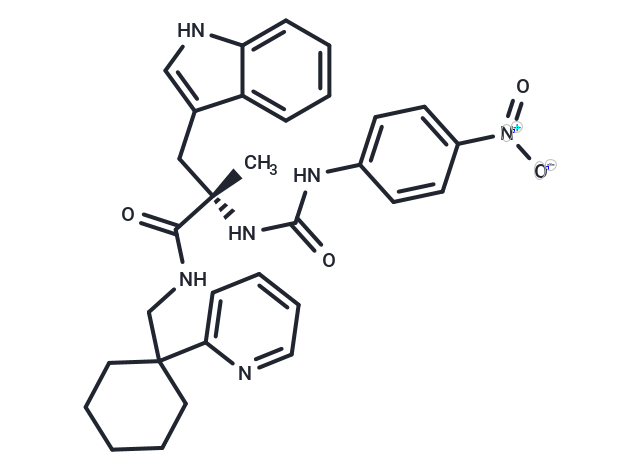
PD 168368
CAS No. 204066-82-0
PD 168368( —— )
Catalog No. M37589 CAS No. 204066-82-0
PD 168368 is a novel, potent, competitive and selective nonpeptide neuromodulin B receptor (NMB-R) antagonist with inhibitory effects on the gastrin-releasing peptide receptor (GRPR).
Purity : >98% (HPLC)
 COA
Datasheet
HNMR
HPLC
MSDS
Handing Instructions
COA
Datasheet
HNMR
HPLC
MSDS
Handing Instructions
| Size | Price / USD | Stock | Quantity |
| 2MG | 150 | In Stock |


|
| 100MG | Get Quote | In Stock |
|
| 200MG | Get Quote | In Stock |
|
| 500MG | Get Quote | In Stock |
|
| 1G | Get Quote | In Stock |
|
Biological Information
-
Product NamePD 168368
-
NoteResearch use only, not for human use.
-
Brief DescriptionPD 168368 is a novel, potent, competitive and selective nonpeptide neuromodulin B receptor (NMB-R) antagonist with inhibitory effects on the gastrin-releasing peptide receptor (GRPR).
-
DescriptionPD 168368 is a potent, competitive, and selective neuromedin B receptor (NMB-R) antagonist with the Ki of 15–45 nM. PD 168368 is neuromedin B receptor (NMBR; IC50=96 nM) / gastrin-releasing peptide receptor (GRPR IC50=3500 nM) antagonist. PD 168368 also is a mixed FPR1/FPR2/FPR3 agonist with EC50s of 0.57, 0.24, and 2.7 nM, respectively.
-
In VitroPD 168368 (PD168368) is highly active and stimulated [Ca2+]I release in human neutrophils with EC50 values in the nanomolar range. PD 168368 (PD168368) suppresses migration and invasion of the human breast cancer cell line MDA-MB-231. PD 168368 reduces epithelial-mesenchymal transition (EMT) of breast cancer cells by E-cadherin upregulation and vimentin downregulation. PD 168368 (5 μM) inhibits migration and invasiveness in breast cancer cells.PD 168368 (10 μM) suppresses the activation of mTOR/p70S6K/4EBP1 and AKT/GSK-3β pathways in breast cancer cells.Cell Viability Assay Cell Line:Human breast cancer cell line MDA MB-231 Concentration: 5 μM Incubation Time:24 hours Result:Clearly decreased the migratory ability of MDA-MB-231 cells in a Boyden chamber migration assay.Cell Viability Assay Cell Line:MDA-MB-231 cells Concentration:10 μM Incubation Time:0, 0.5, 1, 2, 4, 8, and 16 hours Result:Decreased phosphorylation levels of mTOR, p70S6K, 4EBP1, AKT and GSK-3β in a time-dependent manner.
-
In VivoPD 168368 (PD168368) potently inhibits in vivo metastasis of breast cancer. PD 168368 (1.2 mg/kg; intraperitoneal injection for 30 days) inhibits metastasis of breast cancer in mice.Animal Model:Female BALB/c-nude mice (age 8-10 weeks) bearing MDA-MB-231 xenograft model Dosage:1.2 mg/kg Administration:Intraperitoneal injection for 30 days Result:No metastatic tumor nodules were observed in lungs of PD 168368-treated mice compared to PEG-injected mice.
-
Synonyms——
-
PathwayGPCR/G Protein
-
TargetBombesin Receptor
-
RecptorBombesin Receptor
-
Research Area——
-
Indication——
Chemical Information
-
CAS Number204066-82-0
-
Formula Weight554.64
-
Molecular FormulaC31H34N6O4
-
Purity>98% (HPLC)
-
SolubilityIn Vitro:?DMSO : 30 mg/mL (54.09 mM) DMF : 10 mg/mL (18.03 mM)
-
SMILESC[C@@](Cc1c[nH]c2ccccc12)(NC(=O)Nc1ccc(cc1)[N+]([O-])=O)C(=O)NCC1(CCCCC1)c1ccccn1
-
Chemical Name——
Shipping & Storage Information
-
Storage(-20℃)
-
ShippingWith Ice Pack
-
Stability≥ 2 years
Reference
1. R R Ryan, et al. Comparative pharmacology of the nonpeptide neuromedin B receptor antagonist PD 168368. J Pharmacol Exp Ther. 1999 Sep;290(3):1202-11.?
molnova catalog



related products
-
BRS-3 agonist Compou...
A potent, selective, orally active bombesin receptor subtype-3 (BRS-3) agonist.
-
BA 1
Potent bombesin receptor agonist (IC50 values are 0.26, 1.55 and 2.52 nM for BB1, BB2 and BB3 respectively). Enhances glucose transport in obese and diabetic primary myocytes. Also stimulates NCI-H1299 lung cancer cell proliferation in vitro.
-
PD176252
PD176252 is a potent BB1 and BB2 antagonist with inhibitory effects on BB1 and BB2 receptors.PD176252 acts as a small molecule GRPR inhibitor and FPR1/FPR2 agonist to inhibit the growth and proliferation of a variety of cancer cells.
