


 Cart
Cart
 sales@molnova.com



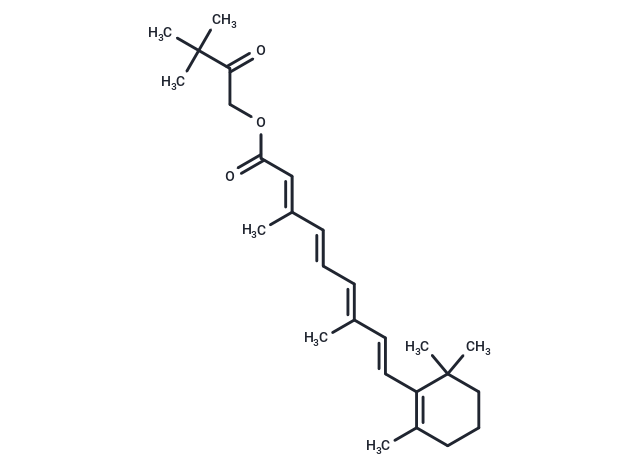
Hydroxypinacolone Retinoate
CAS No. 893412-73-2
Hydroxypinacolone Retinoate( —— )
Catalog No. M37498 CAS No. 893412-73-2
Hydroxypinacolone Retinoate (HPR) is a retinoid commonly added to skin care products and can be used to study skin aging and acne.
Purity : >98% (HPLC)
 COA
Datasheet
HNMR
HPLC
MSDS
Handing Instructions
COA
Datasheet
HNMR
HPLC
MSDS
Handing Instructions
| Size | Price / USD | Stock | Quantity |
| 10MG | 30 | In Stock |


|
| 25MG | 46 | In Stock |
|
| 50MG | 62 | In Stock |
|
| 100MG | 88 | In Stock |
|
| 200MG | 128 | In Stock |
|
| 500MG | 213 | In Stock |
|
| 1G | Get Quote | In Stock |
|
Biological Information
-
Product NameHydroxypinacolone Retinoate
-
NoteResearch use only, not for human use.
-
Brief DescriptionHydroxypinacolone Retinoate (HPR) is a retinoid commonly added to skin care products and can be used to study skin aging and acne.
-
DescriptionHydroxypinacolone Retinoate (HPR) is a retinoid commonly added to skin care products and can be used to study skin aging and acne.
-
In Vitro——
-
In Vivo——
-
Synonyms——
-
PathwayOthers
-
TargetOther Targets
-
RecptorOthers
-
Research Area——
-
Indication——
Chemical Information
-
CAS Number893412-73-2
-
Formula Weight398.58
-
Molecular FormulaC26H38O3
-
Purity>98% (HPLC)
-
Solubility——
-
SMILESC(=C/C(=C/C=C/C(=C/C(OCC(C(C)(C)C)=O)=O)/C)/C)\C=1C(C)(C)CCCC1C
-
Chemical Name——
Shipping & Storage Information
-
Storage(-20℃)
-
ShippingWith Ice Pack
-
Stability≥ 2 years
Reference
molnova catalog



related products
-
2-Hydroxy-3-methoxy ...
2-Hydroxy-3-methoxy chalcone has anticancer activity and inhibits colon cancer.
-
L-ABRINE
L-ABRINE is a toxic protein found in the jequirity seed.can be used as a biomarker for abrin exposure.
-
BRD-K98645985
BRD-K98645985 is a BAF (mammalian SWI/SNF) transcriptional repression inhibitor with an EC50 of ~2.37 μM. BRD-K98645985 binds ARID1A-specific BAF complexes, prevents nucleosomal positioning, and potently reverses HIV-1 latency, without T cell activation or toxicity.
