


 Cart
Cart
 sales@molnova.com



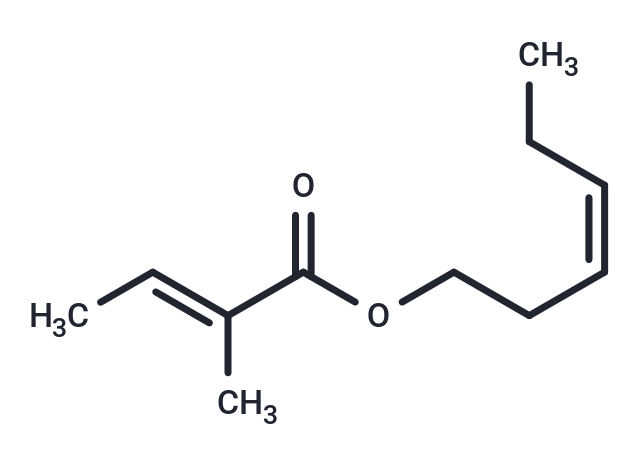
(Z)-3-Hexenyl tiglate
CAS No. 67883-79-8
(Z)-3-Hexenyl tiglate( —— )
Catalog No. M37417 CAS No. 67883-79-8
(Z)-3-Hexenyl tiglate ((3Z)-Hex-3-en-1-yl (2E)-2-methylbut-2-enoate) is a RIFM fragrance that can be used in paints, coatings, inks, resins and other fields.
Purity : >98% (HPLC)
 COA
Datasheet
HNMR
HPLC
MSDS
Handing Instructions
COA
Datasheet
HNMR
HPLC
MSDS
Handing Instructions
| Size | Price / USD | Stock | Quantity |
| 10MG | 30 | In Stock |


|
| 25MG | 46 | In Stock |
|
| 50MG | 62 | In Stock |
|
| 100MG | 88 | In Stock |
|
| 200MG | 128 | In Stock |
|
| 500MG | 213 | In Stock |
|
| 1G | Get Quote | In Stock |
|
Biological Information
-
Product Name(Z)-3-Hexenyl tiglate
-
NoteResearch use only, not for human use.
-
Brief Description(Z)-3-Hexenyl tiglate ((3Z)-Hex-3-en-1-yl (2E)-2-methylbut-2-enoate) is a RIFM fragrance that can be used in paints, coatings, inks, resins and other fields.
-
Description(Z)-3-Hexenyl tiglate ((3Z)-Hex-3-en-1-yl (2E)-2-methylbut-2-enoate) is a RIFM fragrance that can be used in paints, coatings, inks, resins and other fields.
-
In Vitro——
-
In Vivo——
-
Synonyms——
-
PathwayOthers
-
TargetOther Targets
-
RecptorOthers
-
Research Area——
-
Indication——
Chemical Information
-
CAS Number67883-79-8
-
Formula Weight182.26
-
Molecular FormulaC11H18O2
-
Purity>98% (HPLC)
-
Solubility——
-
SMILESC(OCC/C=C\CC)(/C(=C/C)/C)=O
-
Chemical Name——
Shipping & Storage Information
-
Storage(-20℃)
-
ShippingWith Ice Pack
-
Stability≥ 2 years
Reference
molnova catalog



related products
-
isomer-GAT 107
isomer-GAT 107 ((-)GAT 107) is an inactive isomer of (+)GAT 107.
-
TNF-α (10-36), human
TNF-α (10-36), human is a potent pro-inflammatory cytokine involved in the acute phase stress response.
-
2-Acetylpyrazine
2-Acetylpyrazine is a flavoring ingredient. 2-Acetylpyrazine is an avolatile flavor constituent of wheat and rye bread crust.
