


 Cart
Cart
 sales@molnova.com



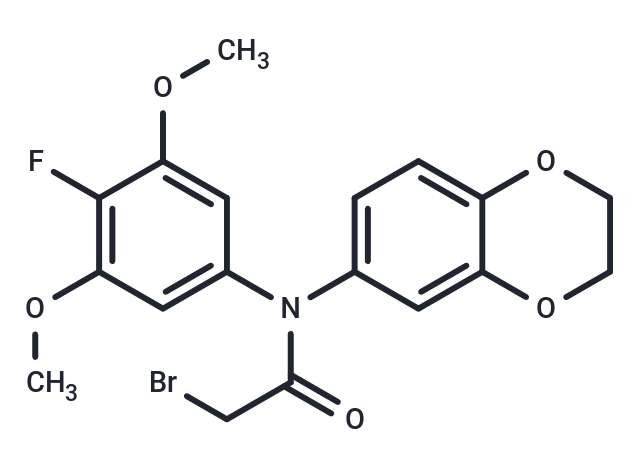
GPX4-IN-6
CAS No. 2922824-07-3
GPX4-IN-6( —— )
Catalog No. M37107 CAS No. 2922824-07-3
GPX4-IN-6 is a small molecule covalent GPX4 inhibitor (IC50: 0.12 μM) with antitumour activity.
Purity : >98% (HPLC)
 COA
Datasheet
HNMR
HPLC
MSDS
Handing Instructions
COA
Datasheet
HNMR
HPLC
MSDS
Handing Instructions
| Size | Price / USD | Stock | Quantity |
| 1 mL x 10 mM in DMSO | 67 | In Stock |


|
| 5MG | 61 | In Stock |
|
| 10MG | 92 | In Stock |
|
| 25MG | 180 | In Stock |
|
| 50MG | 276 | In Stock |
|
| 100MG | 445 | In Stock |
|
| 200MG | Get Quote | In Stock |
|
| 500MG | Get Quote | In Stock |
|
| 1G | Get Quote | In Stock |
|
Biological Information
-
Product NameGPX4-IN-6
-
NoteResearch use only, not for human use.
-
Brief DescriptionGPX4-IN-6 is a small molecule covalent GPX4 inhibitor (IC50: 0.12 μM) with antitumour activity.
-
DescriptionGPX4-IN-6 (Compound C25) is a GPX4 covalent inhibitor with an IC50 value of 0.13 μM.GPX4-IN-6 (Compound C25) can induce ferroptosis for the research of triple-negative breast cancer (TNBC) .
-
In Vitro——
-
In Vivo——
-
Synonyms——
-
PathwayOthers
-
TargetOther Targets
-
RecptorGPX
-
Research Area——
-
Indication——
Chemical Information
-
CAS Number2922824-07-3
-
Formula Weight426.23
-
Molecular FormulaC18H17BrFNO5
-
Purity>98% (HPLC)
-
SolubilityIn Vitro:?DMSO : 50 mg/mL (117.31 mM; Ultrasonic )
-
SMILESO=C(N(C1=CC=C2OCCOC2=C1)C3=CC(OC)=C(F)C(OC)=C3)CBr
-
Chemical Name——
Shipping & Storage Information
-
Storage(-20℃)
-
ShippingWith Ice Pack
-
Stability≥ 2 years
Reference
1. Chen T, et al. Discovery of Novel Potent Covalent Glutathione Peroxidase 4 Inhibitors as Highly Selective Ferroptosis Inducers for the Treatment of Triple-Negative Breast Cancer. J Med Chem. 2023 Jul 27;66(14):10036-10059.
molnova catalog



related products
-
1R,3S-RSL 3
1R,3S-RSL 3 is a harmala alkaloid.
-
[D-Ala2]-b-Casomorph...
[D-Ala2]-b-Casomorphin (1-6), bovine
-
1-TETRACOSANOL
1-Tetracosanol is a natural component extracted from Hylocereus polyrhizus.
