


 Cart
Cart
 sales@molnova.com



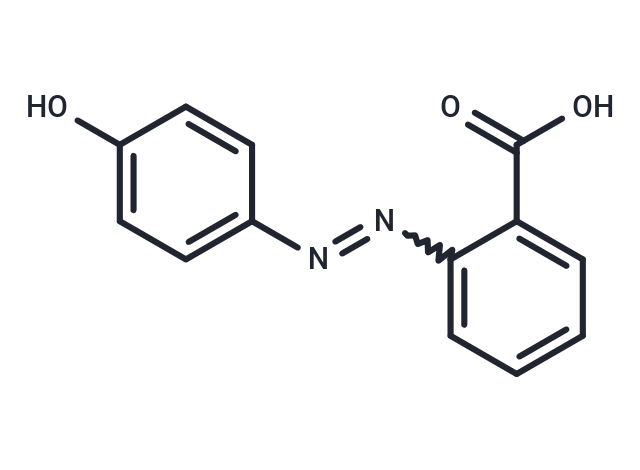
2-(4-Hydroxyphenylazo)benzoicacid
CAS No. 1634-82-8
2-(4-Hydroxyphenylazo)benzoicacid( —— )
Catalog No. M36947 CAS No. 1634-82-8
2-(4-Hydroxyphenylazo)benzoicacid is a spectrophotometric probe that shows changes in absorption spectra upon binding to proteins and binds to bovine serum proteins.
Purity : >98% (HPLC)
 COA
Datasheet
HNMR
HPLC
MSDS
Handing Instructions
COA
Datasheet
HNMR
HPLC
MSDS
Handing Instructions
| Size | Price / USD | Stock | Quantity |
| 100MG | Get Quote | In Stock |


|
| 200MG | Get Quote | In Stock |
|
| 500MG | 34 | In Stock |
|
| 1G | 47 | In Stock |
|
Biological Information
-
Product Name2-(4-Hydroxyphenylazo)benzoicacid
-
NoteResearch use only, not for human use.
-
Brief Description2-(4-Hydroxyphenylazo)benzoicacid is a spectrophotometric probe that shows changes in absorption spectra upon binding to proteins and binds to bovine serum proteins.
-
Description2-(4-Hydroxyphenylazo)benzoicacid is a spectrophotometric probe that shows changes in absorption spectra upon binding to proteins and binds to bovine serum proteins.
-
In Vitro——
-
In Vivo——
-
Synonyms——
-
PathwayOthers
-
TargetOther Targets
-
RecptorOthers
-
Research Area——
-
Indication——
Chemical Information
-
CAS Number1634-82-8
-
Formula Weight242.23
-
Molecular FormulaC13H10N2O3
-
Purity>98% (HPLC)
-
Solubility——
-
SMILESOC(=O)c1ccccc1N=Nc1ccc(O)cc1
-
Chemical Name——
Shipping & Storage Information
-
Storage(-20℃)
-
ShippingWith Ice Pack
-
Stability≥ 2 years
Reference
molnova catalog



related products
-
Acetyl Dopamine Dime...
(E)-(-)-Aspongopusamide B (Compound 9) is a natural product that can be isolated from the insect Aspongopus chinensis.
-
P69 (522 - 534), M. ...
P69 (522 - 534), M. leprae
-
Selenocysteine
Selenocysteine is recognized as the 21st amino acid in ribosome-mediated protein synthesis and its specific incorporation is directed by the UGA codon.
